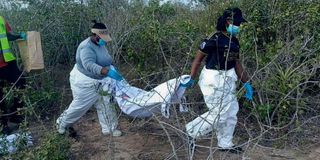
The National Police Service (NPS) has admitted that it failed to learn lessons from the Shakahola massacre. It has acknowledged that crucial proposed reforms had not been properly implemented.
Rare as it is, the admission has reignited the debate surrounding the gaps in multi-agency coordination and Kenya's preparedness to prevent such crises.
Speaking to journalists in Mombasa during a training session on accountability, police spokesperson Michael Muchiri said that the Shakahola tragedy, in which at least 400 bodies were exhumed two years ago, should have served as a turning point, yet it didn’t.
“The issues around Shakahola are truly saddening. We believed such a tragedy would not be repeated. But there are always learning curves. We could have done better, especially by applying the lessons from Shakahola One,” said Mr Muchiri.
National Police Service Spokesperson Michael Nyaga Muchiri during an interview at his office at Jogoo House, Nairobi on July 2, 2025.
Photo credit: Wilfred Nyangaresi | Nation Media Group
He pointed out weaknesses in collaboration between security agencies, the Directorate of Criminal Investigations, local administrators and the community.
“This is about how we managed the response. Remember, Paul Mackenzie (the Shakahola cult leader) is still before court, but the wheels of justice can be slow. Sometimes cases take so long that we are unable to conclude them quickly and decisively,” he added.
“We do not yet know how many bodies will be exhumed. This is a case of religious extremism, brainwashing and indoctrination. Members are sworn to silence, making it difficult to establish the full truth,” he said.
The Independent Policing Oversight Authority (IPOA) also raised concern, saying the failures extended beyond the police service.
IPOA Chief Executive Officer Elema Halake admitted that security agencies had not acted with the urgency required.
“The lapse cuts across the National Police Service, as the spokesperson has noted. It is a multi-agency failure from National Government Administrative Officers to police officers on the ground,” he said.
Mr Halake revealed that IPOA had intervened to rescue victims through its Mombasa regional office and had shared recommendations with investigators.
“We made our own observations and recommendations, but our mandate ends there. From what you have heard, there was indeed failure, and that is not something we celebrate,” he said.
The IPOA boss further disclosed that the authority had recommended action against senior officers who were in charge during the Shakahola probe, adding that similar accountability measures would be pursued in the Kwa Bi Nzaro case.
“This is a matter of national interest. We will be monitoring closely as this second tragedy unfolds,” said Mr Halake.
The remarks come as exhumations at Kwa Bi Nzaro in Kilifi County where at least 32 bodies and several human remains have so far been recovered, are temporarily halted.
The Shakahola massacre happened when controversial preacher Mackenzie Nthenge and his team caused more than 450 members of his Good News International Church to starve to death in Kilifi County. Mackenzie is accused of brainwashing his followers into fasting to death in order to “meet Jesus.”
Evidence presented in court shows that Mr Mackenzie directed his flock into the dense Shakahola Forest, where they were denied food, medical help, and subjected to violence if they resisted. Survivors narrated harrowing ordeals, saying those who attempted to escape were beaten or strangled.
From April 2023, security agencies exhumed at least 450 bodies from shallow graves in the forest in an exercise that lasted over six months. Many of the victims were children.
Mr Mackenzie and his 95 co-accused face multiple charges including murder, terrorism-related offences, child cruelty, radicalisation and abuse. The Director of Public Prosecutions has described the deaths as “well-coordinated killings executed under the guise of religion.”
Courts have been told of how children suffered before dying. Court documents indicate that Mackenzie and 38 associates slapped and whipped children aged six to 17 with thorny sticks while enforcing the deadly fast. The beatings left them with torn skin, injuries and aggravated starvation.
The accused were charged with 17 counts related to violating children’s rights, including the right to basic education. Named in court alongside Mackenzie were Smart Deri Mwakalama alias Mzee Smart, Stephen Sanga Muye alias Steve wa Mtwapa, and Evans Kolombe Sirya, alleged to have personally carried out the flogging.
Charges include assault causing bodily harm, subjecting a child to torture, cruelty to a child, and withdrawing children from school.
Prosecutors said children aged between 13 and 17 were pulled from learning institutions in Mombasa and Kilifi between 2019 and 2020 and kept out of school as the cult tightened its grip.
The Shakahola massacre shocked the country and the world, drawing comparisons to the Jonestown tragedy of 1978. For many families, the pain continues as DNA matching and identification of bodies drags on.