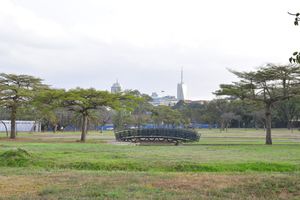
The transformation of a notorious dumpsite into a green public park took centre stage on Sunday as Kisii hosted Kenya’s national celebrations to mark World Cleanup Day.
For years, the Nyambera dumpsite in the heart of Kisii Municipality was a growing mountain of garbage surrounded by homes, schools, hospitals and businesses.
Today, the site has been transformed into a recreational park where children can play, and residents can breathe cleaner air.
The transformation was highlighted as Kisii hosted the national World Cleanup Day celebrations at the Agricultural Training College under the theme “From Clean Plates to Clean Cities”.
Governor Simba Arati hosted a high-level delegation, led by UN-Habitat Director for East and Horn of Africa Ishaku Maitumbi, Controller of Budget Margaret Nyakango, Broadcasting and Telecommunications Principal Secretary Stephen Isaboke and Migori Governor Ochilo Ayacko. Environment and Climate Change ministry officials and National Environment Management Authority (Nema) Director-General Mamo B. Mamo, among other dignitaries, were also present.
“Working hand in hand with Nema, we decommissioned that site. And today, where a mountain of garbage once stood is a green recreational park where the people of Kisii walk, rest and breathe clean air. We do not take the honour of hosting this day lightly. We receive it as a responsibility,” Mr Arati said.
UN-Habitat and the Environment and Climate Change ministry selected Kisii to host this year’s national celebrations. World Cleanup Day is a global environmental event that brings together millions of people to tackle the waste problem and promote sustainable solutions. According to UN Habitat, every day, more than one billion meals are wasted globally, while millions of people face hunger and lack basic services. Food waste places enormous pressure on waste systems, contributes to climate change, wastes land and water resources, and represents a missed opportunity to build more resilient and equitable systems.
The new governor's park that was launched on September 20, 2026 by Kissi Governor Simba Arati.
Photo credit: Wycliffe Nyaberi | Nation Media Group
This year’s observance focuses on food waste, one of the largest and most preventable sources of waste in cities worldwide. More than one billion meals are wasted globally every day, even as millions of people continue to face hunger and lack basic services.
The organisers say food waste puts pressure on waste management systems, contributes to climate change, consumes land and water resources and represents a missed opportunity to build more resilient and equitable communities.
For Mr Arati, the transformation of Nyambera was also a warning about what can happen when waste management problems are ignored, citing two recent landfill disasters in Africa.
“In August 2024 in Kampala, just across our border, the Kiteezi landfill collapsed. Years of accumulated garbage, heaped to a height of some 36 metres, gave way in the night—35 people were killed. Homes were buried. And barely one month ago, in August, downpours brought down the main landfill in Conakry, Guinea—36 people died. Many of them were asleep in their own homes when the mountain of waste came down upon them.
“These were not natural disasters. These were consequences of warnings ignored. Had we not moved with speed on the Nyambera dumpsite, Kisii could well have been in those headlines,” Mr Arati said. “I refused to allow Kisii, and by extension Kenya, to become another statistic for Africa to read about and mourn.”
He said Kisii’s waste challenge was growing alongside its population and economic activity. In 2019, Kisii Municipality had about 200,000 residents. Another 150,000 people streamed into the town each day for markets, healthcare, banking and other commercial activities, he said.
By 2037, the population is projected to reach 500,000. The county currently generates an estimated 200 tonnes of waste every day, with considerably more produced on market days. About 60 per cent of the waste is organic.
Much of it could be recovered, but most ends up buried because different types of waste are mixed at source. Mr Arati linked the problem directly to this year’s theme. “When we throw food into a bin, we do not throw away food alone. We throw away the land that grew it, the water that nourished it, the fuel that transported it, and the sweat of the farmer who woke before dawn to produce it,” he said.
He cited Article 42 of the Constitution, which guarantees the right to a clean and healthy environment. “Clean cities are not made at the landfill. They are not made at the recycling plant. Clean cities are made in our kitchens, at our market stalls, in our homes, and on our plates.”
The county has now begun shifting towards waste recovery and recycling. Mr Arati said attempts to relocate the dumpsite to Etora in Bobasi and later to Nyatieko in Kitutu Chache South met resistance from residents.
“Wherever we turned, the reason was the same: Everyone believed waste was worthless, and nobody wanted a burden in their backyard, so we stopped asking our people to accept waste, and began showing them that waste has value,” he said.
With support from the UK, through the Sustainable Urban Economic Development programme, Kisii has set up a Materials Recovery Facility at the Kisii Agricultural Training Centre. Described as the first of its kind in the region, it can process 50 tonnes of waste daily.
The facility includes a Black Soldier Fly unit that converts 10 tonnes of organic waste into protein-rich animal feed and organic fertiliser. It also has a weighbridge, allowing the county to collect data on waste volumes and improve planning. “This is the full meaning of ‘taka ni mali’; waste is wealth,” Mr Arati said.
As part of activities marking the day, Nema trained waste service providers drawn from 12 zones across the county in waste recovery and segregation.
The new governor's park that was launched on September 20, 2026 by Kissi Governor Simba Arati.
Photo credit: Wycliffe Nyaberi | Nation Media Group
The Taka Ni Mali Group also demonstrated composting, while NEMA demonstrated waste segregation at source using the three gazetted colour codes — green for organic waste, blue for recyclable dry waste and black for non-recyclable general waste.
Governor Arati said waste management was not only about infrastructure but also about creating livelihoods.
Through the Kazi Mashinani programme, the county contracts youth and women to conduct regular clean-ups and unclog drains.
About 2,000 men and women are engaged every month on a rotational basis, with the county projecting that about 24,000 residents will have earned a living through the programme by next year.
The presence of Migori Governor Ochilo Ayacko, Governor Arati said, demonstrated that waste management was a wider Lake Region challenge requiring counties to work together.
Kisii has also invested in truck-mounted skip loaders and colour-coded bins and is finalising policies and by-laws aimed at strengthening the circular economy.
Violators will be prosecuted through the Municipal Court, with revenue generated reinvested in public education. The county is also positioning itself to earn carbon credits.