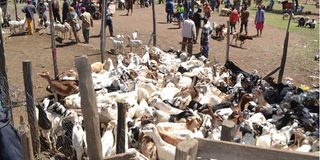
Every Thursday, hundreds of traders from far and wide converge at the Rumuruti Livestock Market in Laikipia County to purchase animals for resale, slaughter or rearing.
For many, it is a weekly ritual with traders travelling from as far as Nairobi, Nakuru, Isiolo, Maralal, Nyahururu, Nyeri, Naivasha and Meru, drawn by competitive livestock prices and the reputation of Rumuruti beef and mutton which are preferred by many consumers.
This market is the single most lucrative revenue source for the Laikipia County government, generating up to Sh500,000 in a single day.
Traders with their livestock at Rumuruti Livestock Market.
Photo credit: File | Nation Media Group
However, beneath the daylong bustle where an estimated Sh30 million changes hands, lie numerous discomforts caused by inadequate facilities in the crowded market environment. Despite serving thousands of traders for decades, the market remains neglected.
“It is a shame that the county government continues to collect millions from us, yet they cannot prioritise the construction of toilets to serve the large number of traders. Most people also relieve themselves in nearby bushes, which is a health hazard,” says Anthony Ngugi, a veteran livestock trader from Nyahururu.
Ngugi, who often purchases up to 10 head of cattle in a single visit, questions the rationale behind the county’s failure to prioritise traders’ welfare. He criticises the mandatory Sh300 fee charged per head of cattle as exploitative.
Similar concerns are voiced by Habiba Mohammed, a trader from Nyeri County who has eight years of experience in the livestock business.
“Our biggest concern is water and sanitation. The county may not afford to build all the essential facilities at once. But toilets and piped water are basic and should not require a large budget,” she says.
Woge Nache, who purchases about 400 goats weekly, many of which are exported to Middle Eastern countries, has frequented the market since 1997 and notes that very little has changed over the years in terms of infrastructure, except for a metallic enclosure that aids in loading animals onto lorries.
He says traders have raised concerns for years, but county authorities have largely ignored them.
Each Thursday, Nache pays Sh90 per goat to the county revenue collector, totalling Sh36,000 for his load. The purchase price per goat ranges from Sh5,000 to Sh15,000, depending on size.
Traders at Rumuruti Livestock Market in Laikipia County.
Photo credit: File | Nation Media Group
The goats are ferried to a slaughterhouse in Nairobi’s Lucky Summer area. Half are exported to Saudi Arabia, Bahrain and the United Arab Emirates, while the rest are sold locally.
His major concern is the lack of sheds to protect animals from harsh weather while waiting to be loaded.
“We need shades to protect the animals and the loaders from the scorching sun and rain. Loading takes hours due to congestion, yet there is only one loading bay,” he says.
The market, which has operated for over four decades since the days of defunct local authorities, has seen rising revenue due to improved security, though droughts occasionally reduce the number of livestock available for sale.
When devolution came in 2013, traders had renewed hope that the infrastructure at the market would be upgraded. But those hopes have been dashed repeatedly with every passing budget cycle.
Senior county officials admit that the market which is the county’s highest revenue earner at about Sh2 million per month, urgently needs infrastructure upgrades. However, they cite funding constraints as a major hurdle.
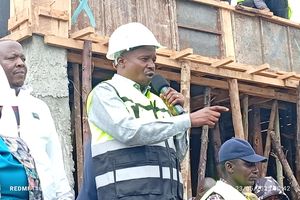
County Finance Executive Member Samuel Gachigi, in an interview, acknowledged the market's needs but said available funds have had to be redirected.
“We are among the counties receiving the least amount from the equitable share allocation, despite increasing our own-source revenue. Sometimes we are forced to divert funds already budgeted for specific projects to address emergencies,” Gachigi explained. He adds that the exchequer’s allocation was reduced by Sh200 million in the current financial year.
Traders at Rumuruti Livestock Market in Laikipia County.
Photo credit: File | Nation Media Group
The official further revealed that infrastructure upgrades at the Rumuruti Livestock Market have been included in the 2025/2026 budget.
“We plan to spend Sh10 million in the next financial year to construct an ablution block and improve access roads. The entire open market spans over five acres. Hopefully, the following year we can add a perimeter wall and sheds,” he said.
But for the traders who have endured harsh conditions for years, such promises are met with scepticism.
“This is not the first time they’ve promised to improve the market. There have been promises year after year, so we’ll believe it when it’s done,” says Mr Ngugi.