For two weeks, the border towns of Moyale in Ethiopia and Moyale in Kenya have dominated the headlines, gripped by a raging conflict and a deepening humanitarian crisis.
As the Nation correspondent for the Upper Eastern region, I had been reporting on the developments from Meru, some 540 kilometres away.
The residents' accounts of the fighting between Ethiopia's Oromia and Somali regional forces sounded distant and abstract.
That changed on November 1, 2026, when NTV's Sam Wanyoike, our driver Duke Areri and I were deployed to Moyale to report from the front line.
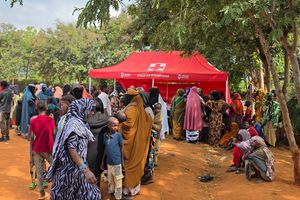
Ethiopians displaced by ongoing clashes in Moyale undergo registration at OMC camp in Moyale, Marsabit County on November 2, 2026.
Photo credit: David Muchui | Nation
We left Meru town at 8am and sped north, eager to see, hear and feel the unfolding story for ourselves. By 4pm we reached Moyale, exhausted and hungry, and began the search for a place to call home for the next four days.
It quickly dawned on us that this was no ordinary assignment. Our guide warned us to choose our guest house carefully.
"Be careful how and where you stand or walk. Be careful to avoid open spaces. You never know when a stray bullet from Ethiopia will be flying into the Kenyan side," he said.
Moyale lies about 770km from Nairobi and 240km from Marsabit town, sitting along the Kenya-Ethiopia border.
On a normal day, it is a beehive of activity. Transit trucks line the streets on both sides of the border, and tuk-tuks and boda bodas jostle for space as people dash back and forth to trade.
Ethiopian boys sit atop a tree at Al Huda Muslim Centre in Moyale on November 3, 2026.
Photo credit: Sila Kiplagat | Nation Media Group
The town we found was a ghost of that bustling place. Trucks sat stranded on the Kenyan side, and hundreds of people stood or sat along the streets, forlorn and uncertain. Across the border in Ethiopia, the town is deserted.
The customs offices have been shut for days, now, after workers fled the stray bullets.
As Sunday night closed in, all seemed calm, apart from the darkness caused by power rationing after the Ethiopian grid was cut off. We retreated to our rooms, next to the Marsabit County Government offices and opposite Moyale Prison, only 600 metres from the border.
However, the calm did not last. From 9pm, bursts of gunfire broke the silence as the warring groups clashed.
At 2am, I was jolted awake by mosquito bites, the crackle of gunfire and the thunder of artillery rolling.
But it was Monday night that left many in terror. From 10pm, there were rapid bursts of gunfire. Artillery explosions shook the town, and red streaks of bullets tore through the darkness.
The fighting on the Ethiopian side is visible from my guest house window, and I flinched at every burst. Sleep deserted me.
Ethiopian nationals waiting for registration at Al Huda Muslim Cerntre in Moyale on November 3, 2026.
Photo credit: Sila Kiplagat | Nation Media Group
Worse was the reality that a 64-year-old woman had died in Moyale town on Monday, killed by a stray bullet just steps from where we were staying.
For the people of Moyale, Kenya, this war is no longer someone else's. Nights, once a time for rest, have become a time of fear, uncertainty and anxious listening. Every burst of gunfire from across the border sends a fresh wave of panic through a town that is struggling to tell the safety of Kenya from the danger on the other side.
What began as fighting between rival forces in Ethiopia's Oromia and Somali regional states has become a humanitarian and security crisis for Kenya.
Two men rest on a bench at a temporary shelter at Oriental Mission Church camp in Moyale on November 3, 2026, during the identification and registration of people displaced from Ethiopia.
Photo credit: Sila Kiplagat | Nation Media Group
Local authorities estimate that more than 36,000 Ethiopians have crossed into Kenya, fleeing the violence and seeking refuge with relatives, in host communities and in temporary shelters. Now the war is claiming lives, maiming people and displacing Kenyans as well. Moyale Deputy County Commissioner Benedict Munywoki says more than 10 unexploded rocket-propelled grenades have landed on the Kenyan side.
Bullet holes scar houses in Sessi, Lami and Manyatta Heillu, as well as the Moyale Sub-County Hospital and Moyale market, a grim sign of the threat from a war next door.
On Monday, the DCC said plans were underway to relocate residents of Sessi Estate, which has been hit by a barrage of stray artillery fire.
Moyale Sub-County Hospital Chief Executive Officer Abshiro Hapicha says the facility has received 21 patients with gunshot wounds since the fighting began. Two have died, and two others have been referred to Meru and Nairobi for advanced treatment.
And the hospital suffered another loss of a different kind. A medical engineer died of a heart attack triggered by the thunder of artillery fire.
"Last night, there was heavy fighting in Ethiopia, and unfortunately, we lost one of our staff members, Martin Kirimi. Immediately, there was a loud bang; he started complaining of chest pains and succumbed while undergoing treatment," Mr Hapicha said.
Last week, another staff member narrowly escaped death when a bullet grazed his stomach in the hospital's staff quarters.
An elderly woman is helped to the registration desk at Al Huda Muslim Centre in Moyale on November 3,2026.
Photo credit: Sila Kiplagat | Nation Media Group
"We have collected seven spent cartridges in the hospital compound since the fighting broke out. Workers have abandoned the staff quarters because of the danger of being shot. It is very scary working here because the hospital is less than 500 metres from the border," the CEO said, pointing out the bullet holes in the hospital roof.
At the hospital, we met Mr Biko Moyo and Ms Habiba Nacho, who had brought in their brother with a bullet lodged in his shoulder.
"He was hit by a stray bullet while asleep in Manyatta area last night. It is a shocking experience. We are no longer safe here in Kenya," Mr Moyo said.
Manyatta Chief Adan Nur said the Kenya Defence Forces detonated one of the unexploded devices that had been fired toward Kenya in Manyatta yesterday morning.
Moyale Cross-border Peace Committee Treasurer Shamsia Abdillahi said it is becoming harder and harder for people to move freely on the Kenyan side.
All in all, the residents of Moyale want only one thing: a swift end to the hostilities, so that peace can return and ordinary life can resume again.