Premium
Kala-azar outbreak kills three, 29 hospitalised in Marsabit
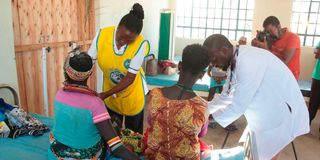
Health workers at Laisamis Sub-County Hospital in Marsabit attend to babies suffering from Kala-azar on April 20, 2019.
What you need to know:
- The sand fly bites mostly between dusk and dawn.
- Kala-azar is caused by more than 20 species of parasitic protozoa of the genus Leishmania.
At least three people have died, while 29 have been hospitalised following an outbreak of Kala-azar disease in Laisamis, Marsabit County.
Of the 29 cases, 17 are adults, while 12 are children under the age of five.
The outbreak is an escalation from the cases reported in September 2024, said Laisamis Sub-County Hospital CEO Liban Wako.
"The outbreak was officially documented in the Log Logo area between January and February 2025, and between two and five patients are testing positive for Kala-azar at the hospital every day," Mr Wako said, adding that other affected areas in the latest outbreak include Laisamis.
He said the health facility first received six patients in September 2024, five in October, 10 in November and one more in December 2024 before new cases were reported this year.
Kala-azar is caused by more than 20 species of parasitic protozoa of the genus Leishmania. It is transmitted to humans by sandflies (Phlebotomus and Lutzomyia species), which live mainly in anthills and mud houses.
Mr Wako urged all health partners to support mass health education and sensitisation of the population.
He recalled the previous outbreak of Kala-azar in March 2019, when the facility received more than 30 patients, with the high number of admissions overwhelming the Laisamis Sub County Hospital, which only had a capacity of 16 beds at the time.
According to Yussuf Galmogle, the nurse in charge of Laisamis Sub-County Hospital, the majority of residents who are pastoralists contract the disease in satellite camps where they take their livestock in search of pasture and water.
Nomadic households are more susceptible to sandfly bites because they sleep on dusty ground in camps set up in the grazing fields.
Sandfly bites
Even urban dwellers can be affected if they sleep in mud-walled huts with cracks, which are breeding grounds for sandflies. The sandfly bites mostly between dusk and dawn.
The nurse said Kala-azar outbreaks in Marsabit are typical during the dry season between March and June.
Following the outbreak, the County Assembly's Health Committee Chairperson, Hadhi Mohammed, told the Nation that the assembly had asked the county health department to approve emergency funds to enable a timely response to the current crisis.
Local leaders have also appealed to Governor Mohamud Ali, during a public meeting in Moyale, to intervene immediately and direct the Health Department to take urgent measures to avert further deaths from Kala-azar in the county.
Log logo MCA Benard Leakonor noted that the region has been prone to Kala-azar outbreaks since the first cases were detected in 2017, adding that at least 253 people have been affected by the disease since then.
Addressing a press conference in Nairobi last week, Marsabit Senator Mohammed Chute called for a surveillance report on the outbreak since the first cases were detected and the total number of infections and deaths reported so far.
He also urged the National Parliamentary Committee on Health to take up the matter as a matter of urgency and called for an urgent budget allocation from the National Treasury for emergency response in the affected areas in Marsabit and all other counties in Northern Kenya.
"We call on the National Government and other health partners such as WHO and Médecins Sans Frontières to come to the aid of our people," said Senator Chute.
The World Health Organization reports that Kala-azar outbreaks have been active for several years in five counties including Kitui, Marsabit, Baringo, Wajir, West Pokot and Isiolo.
Worldwide, the disease is endemic in 98 countries and affects about two million people every year. In 2019, WHO, in partnership with the Marsabit County government, distributed at least 550 treated nets in the hotspot areas as part of an awareness campaign which targeted 200 households in the hotspot zones.