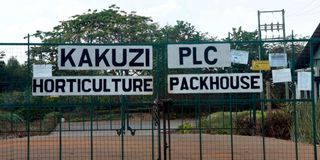
For the 123 years that the 32,900-acre Kakuzi Plantation has existed in Murang'a County, it has grown into a publicly listed economic powerhouse, and its controversies have deepened alongside its growth.
From allegations of forcibly amassing ancestral land to damning claims of human rights abuses, Kakuzi remains at the centre of a heated land dispute with no end in sight.
Documents filed with the National Land Commission reveal that the plantation’s lease status remains unclear. Kakuzi began operations in 1902 as Kakuzi Fibreland Limited and is said to have acquired land from British settlers.
Kakuzi PLC tree plantation in Makuyu, Murang'a County on October 14, 2020.
Photo credit: File | Nation
Today, it is majority-owned by the British multinational Camellia PLC, with the local tycoon John Kibunga Kimani holding a significant minority stake.
The company’s troubles with some Murang'a residents stem from the way the land was allegedly acquired through colonial occupation.
“Kakuzi, like many other tracts of land owned by multinationals in this country, is rightfully Kenyan land. But post-colonial relics continue to act like we never fully attained self-rule,” says Mzee Kuria Kiiru, 92.
“The worst part of colonisation, beyond servitude, was the legal framework that ensured fertile land stayed in the hands of settlers—or the so-called elites of independent Kenya. We fought for land and freedom (uhuru na mashamba), but that cry was conveniently changed to ‘freedom and work’ (uhuru na kazi), leaving us squatting on the very lands we fought to reclaim.”
Although Kakuzi PLC has shifted its focus from sisal to modern farming over the past 97 years, the demand for land restitution has intensified. Previously championed by human rights activists, the movement now has political influence, with Maragua MP Mary wa Maua taking the lead.
“There is no office I won’t knock on. I will keep pushing President William Ruto and Deputy President Kithure Kindiki to intervene. This company must settle the squatters who continue to live in squalor on this land,” the MP says.
During an empowerment event in Maragua last week, Ms Maua confronted Prof Kindiki with a petition on behalf of the squatters. She requested that 25 families be permitted to settle on the plantation and urged the government to fund the construction of temporary shelters.
Kakuzi offices in Murang'a County on October 14, 2020.
Photo credit: File | Nation
Prof Kindiki avoided directly addressing the request in his public remarks. However, when pressed again by Ms Maua, he responded, “Ms Maua is reminding me that I have unfinished business... Let me begin addressing the issue from July 28, 2025, and see how we can work together.”
The controversy is further complicated by complex legalities and lack of clarity on the duration of its current lease.
While the 2010 Constitution capped leaseholds for non-citizens at 99 years, the actual timeline of Kakuzi’s lease, as a hybrid of foreign and local ownership, remains ambiguous, compounded by the murky land registry system.
Residents say that this unresolved lease issue only strengthens their call for justice and land restitution, arguing that the promises of independence remain unfulfilled.
The situation came to a head in 2019, when 85 residents, supported by UK law firm Leigh Day, sued Kakuzi at the High Court in London, alleging gross human rights abuses, including sexual assault by company guards.
However, the claims were were dropped, with the litigation going ahead against Kakuzi's parent company Camellia and its subsidiaries Linton Park Plc and Robertson Bois Dickson Anderson Limited.
However, the land grievances back in Kenya persisted.
“This company behaves cheekily. It pretends to engage, signs memorandums, then backtracks,” said Ms Maua. “This time, we will not relent. We must reclaim what is rightfully ours.”
She cited a 2010 and a 2017 memorandum of understanding (MoU) that granted 23 Gichagi Self Help Group members to use 10 acres of land while paying and annual fees to Kakuzi.
“Only 10 were settled. The rest are still waiting,” she said.
Ms Maua added that Kakuzi occupies land registered as LR10731 and LR11674, and has made claims on 12,000 and 4,000 acres, respectively. She claimed that, even where land has been ceded for public use, such as for Kakuzi Primary School (founded in 1958) and Kinyangi Primary School (established in 1949), the company has never transferred ownership or issued title deeds.
However, Kakuzi PLC maintains a firm stance.
Kakuzi PLC tree plantation in Makuyu, Murang'a County on October 14, 2020.
Photo credit: File | Nation
The company’s Executive Director of Corporate Affairs, Simon Odhiambo, acknowledged an MoU with Gachagi village residents, which allows some to occupy 10 acres under strict terms and annual fees. However, he emphasised that no ownership was transferred.
"Over the years, a mutually agreed memorandum has been in place between the residents of Gachagi village and Kakuzi. It permits specific community members who are parties to the agreement to occupy a portion of our land, measuring 10 acres, in consideration of an annual fee and adherence to outlined conditions," he said.
For now, the standoff continues, with the political situation amplifying the long-running human rights campaigns surrounding the battle for ancestral land.