‘We betrayed little Liam’: Anger as truck runs over boy on ‘ignored’ Syokimau road

Liam Munyua, 10, who was ran over by a heavy commercial truck while riding his bicycle along Kiungani Road in Syokimau, Machakos County on Friday November 27, 2026.

For 10-year-old Liam Munyua, a bicycle ride should have been one of the simple pleasures of childhood. It should have ended with him returning home, perhaps with stories of where he had been and what he had seen.
Instead, it ended in a tragedy that has left his family shattered and an entire neighbourhood mourning.
Liam was crashed by a heavy commercial truck while riding his bicycle along Kiungani Road in Syokimau, Machakos County, on Friday evening in an incident that has reignited anger over the use of residential roads by lorries serving nearby quarries.


He died at the scene.
His death came barely days after residents took to the streets on November 23 and 24 to protest against the movement of heavy trucks through their neighbourhood, warning that the vehicles posed a danger to pedestrians, cyclists and schoolchildren.
For the residents, the worst fears they had been trying to draw the authorities’ attention to had now become a painful reality.
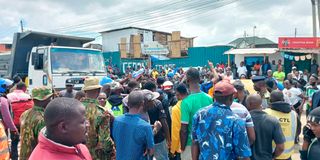
Residents of Syokimau-Katani protest over the poor state of the Katani-Syokimau Road in Machakos County on November 23, 2026.
But perhaps the most heartbreaking aspect of Liam’s death is that the danger had been formally raised before the tragedy.
In a letter dated October 10, 2026 and addressed to the Syokimau Residents Association chairman and the area chief, Mt Sinai CMI School had warned of the reckless operation of tipper trucks along Kiungani Road, saying hundreds of learners were being exposed to unacceptable risks.
The school, through its director, Fr John Ajith CMI, said the danger was not hypothetical.
“Just yesterday, during our school’s Mazingira Day community clean-up, a speeding lorry barrelled down the road and nearly struck a group of young learners who were actively participating in environmental activities,” the letter stated.
The school said it had 500 learners, some of whom walked to school, rode bicycles or used school transport, all exposed to the danger posed by heavy vehicles.
“As a school community, we refuse to wait for a tragedy to occur before decisive action is taken,” Fr Ajith warned.
The letter demanded immediate action, including sanctions against reckless drivers and transport companies, diversion of quarry-bound trucks to designated routes and installation of speed-control measures near school zones.
“The safety and well-being of our children must take absolute precedence over commercial convenience,” the director wrote.
Yet, before the concerns could be resolved, a child was dead.
The tragedy has left Syokimau Residents Association chairman Mohamed Ismail Abdi struggling with guilt, as he reflects on the protests residents had staged in an attempt to keep the trucks away from their neighbourhood.
In an emotional message to residents, Mr Abdi said he received a distress call at about 5pm on Friday while attending a meeting at the association’s offices.
The caller reported that a child, identified as Liam Munyua, had been killed by a truck while riding his bicycle.
“We rushed to the scene to calm down the angry members of the community and thankfully we successfully contained the situation,” he said.
“I am heartbroken and unable to forgive myself. We betrayed little Liam and our Syokimau children. He thought we had made roads that were secure for his ride. He thought his community and estate was safe for him and the rest of Syokimau children,” he said. “He did not have to die; not when we spent the last days on the road to take these trucks off our roads and we were defeated.”
Liam was the firstborn child of Jeddy Wawasi and Cliff Gichuhi, a young family now forced to confront a loss no parent should ever have to endure.
Mr Abdi appealed to residents to visit the bereaved parents at their home in Baraka Court along Mwananchi Road, saying the family needed the support of the community.
The pain was evident at the scene, where residents who witnessed the arrival of Liam’s father broke down as he struggled to come to terms with what had happened.
His mother arrived later.
According to residents, she wailed uncontrollably as the reality of losing her child sank in.
“Their world has been shattered and hearts crushed,” one account of the incident read.
Liam’s death has also raised difficult questions about why the concerns raised by residents and the school did not translate into effective action.
In their letter, Mt Sinai School had asked authorities to identify and penalise transport companies and drivers engaging in reckless driving and speeding.
It also demanded that quarry-bound trucks be blocked from using Kiungani Road and diverted to Quarry Road or other designated freight routes.
The school further called for rumble strips, speed bumps and other traffic-calming measures around school zones.
These were not simply demands for better roads. They were pleas for the protection of children who use the same roads as heavy commercial vehicles.
Residents have repeatedly complained that quarry trucks use estate roads despite the availability of designated routes, while also damaging the roads and exposing families to danger.
They argue that the movement of the lorries through residential areas has become a daily safety threat.
The protests on November 23 and 24 brought these frustrations to the streets. On the second day, police used tear gas to disperse demonstrators, with several protesters arrested.
The residents were demanding intervention. Days later, they were mourning a child.
Mr Abdi placed responsibility for the tragedy on several institutions and the wider community, accusing them of failing to protect children.
He questioned why the Kenya Urban Roads Authority (Kura) had not maintained alternative roads in Syokimau and Katani to provide trucks with routes away from residential estates, despite repeated correspondence and meetings with the residents' association.
He also accused the Machakos County Government of collecting nearly Sh10 million daily in cess from more than 3,000 trucks without adequately maintaining Tuff Foam Road, which residents say could help divert the vehicles.
The chairman further accused police of failing to stop trucks from evading the weighbridge and using estate roads, while deploying tear gas against residents protesting their presence.
These claims are likely to intensify scrutiny of the agencies responsible for road maintenance, traffic enforcement and public safety.
Police said Liam died on the spot and that investigations had been launched. Officers were also trying to trace the truck driver, who reportedly fled after the incident, leaving the vehicle at the scene.
The Machakos County Government had yet to issue a specific public response to the complaints over heavy trucks using Kiungani Road and the latest fatality.
The tragedy now places renewed pressure on Kura, the county government, traffic police and other agencies to explain what measures had been taken following the residents’ complaints and the school’s warning.
Why were quarry trucks still using the residential road? Were the designated alternative routes accessible and properly maintained? Were speed limits enforced? And why had the safety measures demanded by the school not been implemented?
For Liam’s parents, however, no investigation or official explanation can undo what has happened.
Painful reminder
For his neighbours, his death has become a painful reminder that the warnings they issued were about real lives, not merely traffic inconvenience.
In his emotional message, Mr Abdi said he would no longer ask residents to come out and protest, expressing frustration at what he described as the community’s failure to sustain the fight.
“May God have mercy on us, we failed that boy yesterday (Friday), every single one of us,” he said.
But perhaps the most haunting words remain those in the school’s letter, written before the tragedy, when there was still an opportunity to prevent it.
“As a school community, we refuse to wait for a tragedy to occur before decisive action is taken,” it said.
Police said the truck driver fled the scene after the incident, abandoning the vehicle. They added that they were pursuing the matter.
“We will follow up with his (driver’s) employer so that he can clear the air of what happened,” police said.
The driver’s disappearance has added to residents’ anger, with questions emerging over the circumstances of the accident and the responsibility of the company operating the truck.
Follow our WhatsApp channel for breaking news updates and more stories like this.