The government is facing intense scrutiny over its inability to rein in the escalating lawlessness within the boda boda sector, a problem that has repeatedly put lives at risk and disrupted public transport.
Boda bodas, which employ over a million Kenyans and generate billions in annual revenue, are increasingly acting outside the law, emboldened by political influence and a history of government inaction.
Despite previous warnings and attempts to introduce stricter regulations, authorities have repeatedly caved to pressure, allowing rogue riders to administer “justice” without fear of consequences.
The latest arson attack triggered a strike by matatu operators under the Matatu Owners Association (MOA), leaving passengers stranded across Nairobi City yesterday.
Vehicles operating on major routes such as Thika Road, Ngong Road, Mombasa Road and Jogoo Road abandoned passengers forcing many to walk long distances or pay boda boda operators higher-than-usual fares.
On January 23, 2026, boda boda operators torched a bus belonging to Forward Travellers following an accident in which the bus allegedly ran over and killed a rider.
The attack mirrors similar incidents last year involving Super Metro and City Shuttle buses and has raised fresh concerns over lawlessness in the sector.
It was business as usual for some matatu operators at the Kencom bus terminal.
Photo credit: Billy Ogada| Nation Media Group
Despite their chaotic reputation, boda bodas form a significant part of Kenya’s economy, employing over a million people and generating estimated annual earnings of Sh365 billion four years ago, according to a 2022 report by Car & General, a leading manufacturer and retailer of motorcycles.
The report estimated that operators earned about Sh1,000 daily from 15 rides, contributing 3.4 percent to the country’s Gross Domestic Product (GDP).
With the number of riders and popularity of boda bodas surging since 2022, both earnings and operators are believed to have grown significantly.
Yet the government and Parliament have largely turned a blind eye to the growing trend of arson attacks and blatant traffic violations by boda boda operators.
Last year, Kakamega Senator Boni Khalwale was forced to withdraw the Public Transport (Motorcycle Regulation) Bill of 2023 following nationwide uproar from operators.
The Bill sought to curb reckless behaviour, including riding against traffic, using pavements and failing to wear helmets or reflective jackets. It also proposed stiff penalties for riders ganging up to intimidate or harm others following an accident, including fines of up to Sh100,000 or imprisonment of up to a year.
“Any rider who participates in ganging up with others to intimidate, threaten, or harm another person, including during an accident, commits an offence,” the Bill stated. While the Senate had approved the legislation, Dr Khalwale withdrew it ahead of its National Assembly consideration, reflecting the sector’s political clout.
Despite previous promises by former Interior CS Fred Matiang’i in 2022 to crack down on rogue riders, no substantial action has materialised. Four years later, operators appear bolder in administering what they consider “justice” whenever one of their own is involved in an accident.
Even though motorcycle registrations have declined from a high of 252,601 units in 2020 to 72,868 in 2024, the industry remains popular, particularly in urban areas, thanks to affordability and the ability to navigate heavy traffic.
Car & General’s 2024 annual report acknowledged the decline in unit sales but highlighted the ongoing importance of the sector in Kenya’s transport ecosystem.
“Our biggest operational challenge has been the continuing decline in Kenya of the two-wheeler business,” the company said.
Public transport was heavily disrupted for most of Monday morning, leaving passengers stranded across Nairobi as some public service vehicles were withdrawn from the roads. The strike followed calls by the Matatu Owners Association (MOA) for its members to boycott work until the government addresses their grievances, including the recent spate of vehicles allegedly set ablaze by boda boda operators.
Most Nairobi residents were forced to walk to work after matatu operators, wary of being targeted by colleagues who joined the strike, dropped passengers some distance from their destinations.
Vehicles operating on the Thika route, for instance, left passengers off at the Fig Tree area in Ngara, forcing them to either take a boda boda or walk the rest of the way to the Central Business District (CBD).
Similar disruptions were reported along Ngong Road, Mombasa Road, Jogoo Road, and other major routes.
“This is actually torture. Why is the government allowing us to walk when they should be addressing this issue? Can’t they negotiate and resolve the matter without subjecting us to this?” said commuter Tom Otieno.
Some boda boda operators in the CBD denied involvement in the recent arson attacks on matatus. Nevertheless, they benefited financially from the strike, charging higher fares to transport commuters to their workplaces.
“We are making a killing today. We even hope the strike continues daily. We have no issues as boda boda riders; we are peaceful. Let them strike without involving us,” said Arnold Alulu.
Mr Alulu added that those accused of burning the buses are not part of registered boda boda sacco groups. “Let me be clear: these matatu guys are not as innocent as they claim. They often knock us down on the roads, killing our colleagues, and nothing is done. We report it to the police, yet the same matatus return to the roads the next day while our colleagues remain dead,” he said.
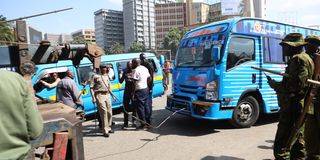
Police Officers tow a matatu blocking the road along Haile Selassie Avenue in Nairobi.
Photo credit: Billy Ogada| Nation Media Group
The riders urged the government to implement measures that address both the concerns of the matatu sector and grievances raised by boda boda operators.
For motorcycle taxi touts like Peter Muchiri, the deserted stages meant a significant loss of income, disrupting his daily target of about Sh3,000.
“Let them talk and reach an agreement. We are being affected as hustlers,” he said.
According to MOA Chairperson Albert Karakacha, the strike was nonetheless successful, disrupting normal operations in major cities, including Nairobi and Nakuru.
Mr Karakacha said recent meetings with some boda boda associations revealed that the individuals responsible for burning vehicles were hooligans and that the matter should be handled by the national government.
“We apologize to our passengers, but we are fighting for your rights. If a vehicle is burnt with passengers on board, all of them could perish,” he said.
The chairperson added that the association is ready to meet President William Ruto to seek an amicable solution and prevent further losses.
He also announced a change in strike tactics, warning passengers to expect weekly protests.
“We will be striking every Monday. If there is no negotiation next Monday, we will continue protesting on the roads until our concerns are addressed,” he said.
Mr Karakacha stated that, since last year, a total of 20 vehicles have been set on fire by hooligans hiding within the boda boda sector. Some drivers have been arrested and taken to Central, Kamukunji and Kayole police stations while some vehicles were impounded and registration plates confiscated.
Inter Corridor Mobility Chairperson Joseph Kagai said during a press briefing that operators will not back down until the government takes decisive action against those captured torching vehicles.
“This is only the beginning. Instead of listening to us, the government sent GSU officers and special units to confiscate our vehicles. We want the impounded matatus returned and all arrested drivers released. We will be back on Monday,” he said, accusing some government officials of spreading propaganda about the strike on social media.
By Monday, neither the Ministry of Interior nor the Ministry of Transport had addressed the crisis, which continued to disrupt business and the smooth movement of people and goods in the city.