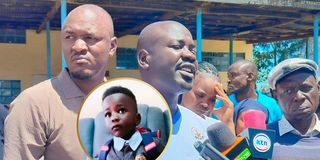
Mystery continues to shroud the tragic death of three-year-old Faiz Faraj, a pupil at Gilgil Hills School, whose lifeless body was discovered in the institution’s fishpond on Friday.
The circumstances of the child’s death have left investigators and the family grappling with unanswered questions.
What initially appeared to be a simple accident has evolved into a case marked by inconsistencies, suspicion and growing calls for accountability, with the school maintaining that the child accidentally accessed the pond and drowned.
Faiz, a playgroup pupil, was reported missing from class around 11 am last Friday only for his body to be found floating in the fishpond at 1pm under circumstances that the school says remain under investigation.
The boy’s family, however, disputes the sequence of events leading to his death, citing conflicting timelines and unclear communication from school officials. They insist the explanations provided so far do not add up.
Police have launched investigations into the incident with detectives expected to piece together the events that led to Faiz’s death.
Three year old Faiz Faraj from Gilgil Hills School who died under unclear circumstances
Photo credit: COURTESY
"The postmortem has been conducted and everything points to drowning. The matter is now with the Directorate of Criminal Investigation to establish how the boy got into the pond," said Gilgil Sub-County Police Commander Winstone Mwakio.
Faiz’s father Faraj Ibrahim recounted the moment he received the call that changed his life. He said a teacher initially informed him around 1 pm that his son was unwell and had been taken to the hospital, explaining it might be a fever, possibly malaria.
Moments later, the school principal called with devastating news that Faiz had fallen into the fishpond. “I was first told my child had a fever, but minutes later I was told he had fallen into the pond. When I got there, I found he was already dead,” he recalled.
The shifting explanations left Mr Ibrahim suspicious. He questioned the circumstances surrounding the drowning noting that his son’s body appeared unusually clean despite the dirty pond water.
Faiz’s mother Jane Mwangi said she was also initially informed that her son was sick before receiving the news of his death.
“We take our children to school to learn and to be cared for. I want the children’s department to investigate and tell us what really happened,” she said.
On Saturday, tensions escalated at the Gilgil sub-County offices when the family confronted school staff, demanding justice.
A postmortem conducted by government pathologist Dr Titus Ngulungu at the Gilgil Sub-County Hospital mortuary revealed that the cause of death was aspiratory asphyxia, a condition that occurs when foreign material such as liquid, vomit, or food enters the airway and lungs, blocking oxygen exchange.
However, the family dismissed the report, casting doubt on the autopsy findings.
Faiz’s uncle Dickson Ndiragu noted that the child’s stomach contained only food particles and no water.
“We disagree with the pathologist report because we feel the school may have played a role. We call on the DCI to investigate fully. The teacher and principal should be questioned so we can get closure,” he said.
The school administration led by headteacher Joseph Kehato expressed condolences and pledged full cooperation with investigators.
“The school community is deeply saddened. Efforts were made to resuscitate the child and rush him to hospital, but sadly, we lost him. The matter is under investigation and we urge all parties to allow authorities to complete their work,” he said.
The discrepancy between the initial report of illness and the eventual revelation of drowning remains a central point of contention.
The family insists that crucial details were delayed or withheld, leaving them unable to understand what truly happened in Faiz’s final moments.
As the investigation continues, the grieving family’s only wish is to uncover the truth behind the tragic loss.
“We cannot just let this go. Next time, it could be another child. We need to know exactly what killed him,” said the uncle.