Nakuru squatters reopen 38-year fight over forest land
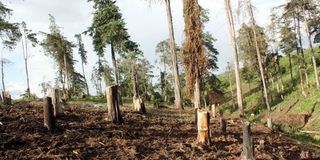
A section of Bahati Forest in Subukia Constituency, Nakuru County. More than 10,000 squatters evicted from the forest in 1988 have petitioned the National Land Commission for compensation.

A fresh petition to the National Land Commission (NLC) has reopened a 38-year-old dispute involving 10,000 squatters from Nakuru and revived questions over 200 acres set aside for their resettlement.
The petitioners, including former residents of Bahati and Dundori forests, say more than 10,000 people were forcibly removed in 1988 and that land later excised by the government for their resettlement went to other beneficiaries. They are seeking land allocation, compensation and resettlement.
The dispute dates to a national government campaign to remove people from forest settlements, with petitioners saying homes, farms, schools, graves and places of worship were destroyed.


The petition filed with the NLC asks the commission to recognize the evictions as a historical land injustice and determine remedies for affected residents and their descendants.
The petition says residents had established settlements in Bahati and Dundori, including Rugongo, Kendurumu and Mugumo.
Through their representative group, Elimisha Mwananchi Initiative, the petitioners say the residents cultivated land, kept livestock and participated in conservation.
The group say State officers, including provincial administration and forestry officials, carried out an abrupt eviction in 1988, demolishing houses, schools and places of worship.
“The entire exercise was disgraceful, demeaning, humiliating and discourteous resulting into painful loss of these peoples’ treasured valuables and other properties,” the petition says.
They claim residents could not remove livestock, crops, household property and academic documents before the operation.
They also say graves were disturbed and families were scattered to Nyandarua, Laikipia, Baringo, Kiambu and urban settlements.
The petition says some evicted residents became squatters, while others were hosted by relatives.
It also expressly raises equity and non-discrimination, arguing that victims of other historical forest displacements, specifically Mt Kenya Forest, received formal state settlement and financial compensation, while the Bahati and Dundori victims have not.
“While victims of similar historical forest displacements (e.g. Mt. Kenya Forest) have received formal state settlement and financial redress, the victims of the 1988 Bahati Forest and Dundori evictions remain neglected,” says Elimisha Mwananchi Initiative in the papers.
The petitioners’ central claim concerns land intended to resettle those displaced from the forests.
They 84.49 hectares (494.2 acres) were set aside for their settlement, but the land was subdivided and allocated to people who were not original evictees.
A 2025 baseline survey on Dundori records that the 84.49 -hectare land was set aside in 1987 for people evicted from forest settlements. It says the land was subdivided in 1994, with beneficiaries paying Sh2,000 to Sh4,000 to the former county council, and reports that some rightful beneficiaries did not receive plots.
The evictees who missed out demonstrated to the Rift Valley Provincial Commissioner in 1997 and were promised action.
The current petition asks the NLC to investigate the allocation history and provide land to affected families and their descendants.

In a petition to the National Land Commission, Nakuru squatters claim that over 10,000 people were forcibly evicted in 1988, and that the land earmarked by the government for their resettlement was given to other recipients.
It seeks compensation for lost property, livestock and agricultural production, alongside damages for alleged human-rights violations.
The petition also seeks infrastructure support, including roads, water, electricity, health facilities, schools, police posts and markets.
Also Read: Hotspots of Kenya’s deadly land disputes
It asks for replacement of personal documents allegedly destroyed during the eviction.
The dispute has also been before Parliament.
The Senate received a similar petition in December 2019 from Dundori Forest residents, who said they had lived there from 1930 until their forceful eviction and alleged that people not recorded as evictees benefited from land excised for resettlement.
In 2020, a Senate committee recommended that the NLC coordinate investigations with the Lands, Interior and Environment ministries and county governments.
The committee classified the matter among historical forest-eviction disputes requiring investigation and recommended a status report.
The petitioners renewed their request through Parliament in May 2023, but say it remains unresolved.
A Senate letter dated July 19, 2023 advised the petitioners to follow up with the NLC, Lands ministry and related agencies.
The NLC petition now asks the commission to acknowledge State responsibility, identify remedies and facilitate resettlement.
In the 2019 Senate record, the Ministry of Environment and Forestry disputed the characterization of the 1988 exercise as forced eviction, saying the policy required forest labourers to stop living in government forest houses.
However, the petitioners maintain that the operation was an unlawful eviction that displaced established communities and left families without land.
Follow ourWhatsApp channel for breaking news updates and more stories like this.


