Kenya is once again on the global stage after the world-renowned Maasai Mara Game Reserve was recognised by the World Book of Records, United Kingdom, as a favourite tourism destination.
The Maasai Mara has been recognised under the title: “World’s Greatest Annual Terrestrial Wildlife Migration,” for hosting the dramatic annual movement of more than 1.5 million wildebeests, zebras and antelopes across the greater Serengeti-Mara ecosystem—the largest event of its kind on Earth.
The reserve has earned its reputation as one of the world's favourite tourism destinations due to the spectacular annual wildebeest migration across the Mara River.
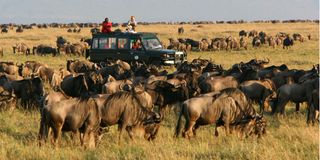
Wildebeests arrive at Kenya's Maasai Mara Game Reserve from Tanzania's Serengeti National Park during the start of the annual migration.
Photo credit: File I Nation Media Group
The World Book of Records Limited, UK, is an organisation that catalogues and verifies extraordinary global records through authentic certification.
Representatives from the World Book of Records are expected to visit the reserve soon to formally present the certificate.
Narok Governor Patrick Ole Ntutu welcomed the inclusion of the Maasai Mara National Reserve in the World Book of Records (UK), terming it a moment of pride for Kenya and a milestone in ongoing conservation efforts.
The recognition comes just two and a half years after the county government launched a wide-ranging conservation and management initiative aimed at revitalising the iconic reserve.
Key interventions under the campaign have included the implementation of a comprehensive management plan, enhancing ranger capacity, improving road infrastructure within the reserve and embracing modern, tech-based conservation strategies to ensure sustainability.
Governor Ntutu said the certification by the World Book of Records is both an international validation and a celebration of the Mara’s global significance.
“We are deeply honoured to receive this recognition, officially certifying the Maasai Mara as the home of the world’s greatest annual terrestrial wildlife migration,” he said.
He further underscored the broader ecological value of the reserve, which hosts over 25 per cent of Kenya’s biodiversity and plays a critical role in the lifecycle of migrating species, especially during their mating and grazing seasons within the Mara.
“This is a proud moment for Kenya, for Narok County, and for our conservation partners. It is a call to the world to come and witness nature’s greatest theatre,” said the governor.
The Maasai Mara remains arguably one of the most picturesque and famous wildlife sanctuaries on Earth, having been voted the Eighth Wonder of the World in 2007.
Tourists on game drive watch a herd of elephants at Musiara area of the Maasai Mara National Reserve.
Photo credit: File | Nation Media Group
For decades, the iconic reserve has served as a key source of foreign exchange, attracting thousands of visitors each year to witness the famed wildebeest migration.
The reserve draws hundreds of thousands of tourists annually, owing to its rich wildlife, the vibrant Maasai culture and unique safari experiences.
Each year, over two million wildebeests, zebras and other herbivores migrate from the Southern Serengeti to the lush green grasses of the Maasai Mara in what is considered one of the seven wonders of the natural world.
The wildebeest and zebra migration occurs between July and October, with the dramatic river crossings typically taking place at the Mara River during this period.
This year, more than 350,000 tourists are expected to visit the Maasai Mara Game Reserve in the coming weeks to witness the renowned migration.