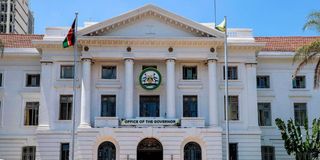
A report has singled out Nairobi, Kilifi, Kiambu, Machakos and Narok as counties where doing business with contractors and suppliers is proving to be a “death penalty”, with payments for goods and services rarely made on time.
The latest report by Controller of Budget Margaret Nyakang’o revealed that 47 counties owe contractors and suppliers a staggering Sh177 billion.
The five highlighted counties alone account for more than 61 percent of total pending bills, amounting to Sh109 billion as of September 30, 2025.
Controller of Budget Margaret Nyakango at a past event.
Photo credit: Jared Nyataya | Nation Media Group
The total debt comprises Sh125.67 billion for recurrent activities and Sh51.79 billion for development projects. County executives account for Sh171.92 billion, while county assemblies owe Sh5.55 billion.
Governor Johnson Sakaja’s Nairobi County tops the list with Sh82.8 billion in pending bills, of which Sh62.3 billion is historical, inherited from the previous administration. The current government has accumulated Sh20.5 billion in three years.
Governor Gideon Mungaro’s Kilifi County follows with Sh9.6 billion in outstanding payments, of which Sh8.2 billion were incurred by the current administration.
Kiambu County owes Sh6.4 billion, with over Sh2.3 billion accumulated in less than a year under Governor Kimani Wamatangi while in Machakos, led by Governor Wavinya Wandeti, has Sh3.1 billion in unpaid bills since she assumed office.
Narok County has more than Sh5 billion pending, with Governor Patrick Ole Ntutu inheriting only Sh265 million.
A pending bill is an unsettled financial obligation at the end of a fiscal year, arising from failure to pay for goods and services delivered. By law, these should be the first charge in the following financial year, but many counties have not complied.
Analysis of pending bills shows Sh46.83 billion (26 percent) are less than a year old, Sh24.12 billion (14 percent) between one and two years, Sh19.62 billion (11 percent) between two and three years, and Sh85.15 billion (48 percent) over three years old.
Some counties, however, have performed well.
Elgeyo Marakwet (Sh17.49 million), Lamu (Sh18.5 million), and Turkana (Sh721 million) promptly pay contractors and suppliers. Other counties with less than Sh500 million in pending bills include West Pokot (Sh308 million), Nyeri (Sh342.3 million), Makueni (Sh402.5 million), Samburu (Sh457.6 million), and Baringo (Sh477.1 million).
Mombasa County, under Governor Abdulswamad Nassir, has not paid inherited bills exceeding Sh3 billion but has cleared debts aged two to three years, leaving only Sh167 million incurred by the current administration.
Mombasa Governor Abdulswamad Nassir.
Photo credit: Kevin Odit | Nation Media Group
The report also flagged nine other counties for poor payment records. Mandera has Sh2.1 billion pending, Siaya Sh1.74 billion, Kisumu Sh3.65 billion, Nyandarua Sh1.53 billion, Kwale Sh1.6 billion, Wajir Sh3.65 billion, Bomet Sh1.52 billion, Bungoma Sh3.1 billion, and Busia Sh2.6 billion.
In contrast, Turkana, which inherited Sh7 billion from former Governor Josphat Nanok, currently owes just Sh721 million after verification, demonstrating strong fiscal management.
The Controller of Budget’s report paints a grim picture of some devolved units failing to honor financial obligations, leaving contractors and suppliers to endure significant hardships.