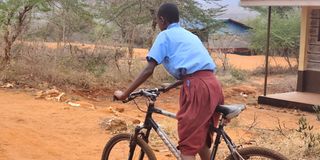
Every weekday, long before the sun rises over the hills of Sagalla in Voi, Taita Taveta, more than 1,500 pupils walk over 14 kilometres to and from their schools, navigating wildlife-prone paths.
Driven by the hunger for education and the hope of a better future, they brave wildlife corridors and the long distances to school.
Some of the bicycles donated to Sowa Primary School in Sagalla, Taita Taveta County.
Photo credit: Lucy Mkanyika | Nation
Pupils from eight schools in the lower areas of Sagalla in Kitibo, Wanje, Mwachaza, Rahasi, Zongwani, Mchang'a and Mwakirawa villages are forced to trek for hours, risking encounters with elephants and other dangerous animals. For those from Zongwani village, their morning begins at 4 am, and by 5 am, they are already on the move, embarking on a two-hour trek to Sowa Primary School.
Sagalla lies between Tsavo East and Tsavo West, where elephants roam freely. During dry seasons, the wildlife invade villages in the area in search of water and food, often crossing paths with children on their way to school.
A parent, Ms Phanise Ngongo, whose children attend Sowa Primary School, said her children leave at dawn and return at dusk. She said they reach school by 7 am and return home at 7 pm, often navigating the same paths where elephants have been spotted just hours before.
Aged nine and 10, they are no strangers to elephants; they have encountered them many times.
“My children wake up at 4 am to prepare for school. Then I escort them,” she said.
A parent, Phanise Ngongo, says her children walk 20 kilometres every day to and from school. Parents are forced to escort them in the morning, as the area is prone to human-wildlife conflict.
Photo credit: Lucy Mkanyika | Nation
The mother of two says she wakes up each morning with a prayer that her children will return home safely.
“I tell them to be careful but what can I do? They must go to school because we want them to learn. If they had a bicycle or other means of transport, they would get to school faster and not be so tired,” she said.
Many other pupils from the same school and even the neighbouring ones walk nearly the same kilometres every day.
Teachers in the area have grown used to late arrivals and absenteeism, especially during dry seasons when human-wildlife invasions increase.
Kwaela Sere CBO Chairperson Wabosha Kamattah during an interview at Sowa Primary School in Sagalla, Taita Taveta County. The organisation aims to distribute over 5,000 bicycles to schools in Sagalla to cushion students from long distances and the wildlife.
Photo credit: Lucy Mkanyika | Nation
To mitigate the risks, parents escort their children and share information about elephant sightings with the teachers and other villagers. Education stakeholders in the area said the challenges are not limited to wildlife. The long distances and late returns have exposed children, especially girls, to risks of early pregnancies and sexual assault.
In response to the crisis, a local community-based organisation, Kwaela Sere (A Dawn of Peace), has launched a campaign named 'Bicycles for Sagalla'. The initiative has been calling for donations of used bicycles, turning them into lifelines for the schoolchildren. It aims to obtain over 5,000 bicycles.
Ms Ngongo said her children will now be leaving home at 6 am and returning early before the sun sets.
Sowa Primary School Board of Management Chairperson Hillary Mwachombo says the idea of building a new school closer to these villages is impractical due to the low population density.
“We have learnt to cope. Children go to school late and get home early because of wildlife, which sometimes forces a curfew on villagers. Apart from wildlife, there are child molesters who might prey on these children,” he said.
Headteacher Jane Mwazaule echoed the concerns, saying some children miss school entirely when they encounter elephants.
“When we ask, they say they had to turn back, so we understand. If a child says they saw elephants, we believe them. We have seen them ourselves,” she said.
Recently, the headteacher said, elephants invaded the school and destroyed property, including water tanks.
“What can be done is to have an electric fence around the school. This can help us to protect school property. We can also have community rangers to drive them away,” Ms Mwazaule proposed.
Ms Mwazaule added that the bicycles will not only reduce the risk of wildlife encounters but also protect girls from early pregnancies and sexual assault. Led by their chairperson, Wabosha Kamatta, the organisation aims to reduce the time children spend on foot and lower their exposure to human-wildlife conflict and sexual assault.
“A bicycle may seem small, but it’s a game-changer for the education of these children. For those walking from far, it cuts the journey time significantly. It allows children to move faster, avoid known elephant paths and get to school safely,” she said.
So far, 30 bicycles have been donated to Sowa Primary School, with priority given to pupils from the far-flung areas.
“There are children who own bicycles but don’t use them. We ask them to donate so we can give these children a means of transport to school,” Ms Kamatta said.
The organisation has also written proposals to the Taita Taveta County government and wildlife organisations, hoping to get support for more bicycles.
“We are targeting 15 schools in this area. Students from schools in the upper Sagalla also walk long distances, and the terrain is a challenge. We started with the lower areas because their challenges are many compared to other areas,” she said.
The bicycles will be owned by the schools, and beneficiaries will return them once they no longer need them, so they can be reassigned to other pupils. The organisation will also handle repairs and maintenance to ensure the bicycles serve their purpose.
Kwaela Sere has partnered with My Little Thing Organisation to sensitise communities to donate unused bicycles for the pupils.
The Little Thing Director, Ramadhan Obiero, said they plan to launch a campaign in major towns, especially Nairobi, to collect used bicycles.
My Little Thing Director Ramadhan Obiero says the organisation plans to collect bicycles from estates across major towns in the country.
Photo credit: Lucy Mkanyika | Nation
“We will continue to support this initiative, and going forward, we will launch a massive campaign which will be spearheaded by the children themselves as ambassadors,” he said.
He said absenteeism and poor performance are directly linked to the long distances children must walk every day.
“Distance can be a challenge because pupils may fail to come to school, and this affects their performance. That is why we need to take up this initiative,” he said in an interview.
Kwaela Sere’s Logistics Manager, Ferdinand Kamatta, says the project will eventually be extended to other parts of the county.
“Human-wildlife conflict has affected most parts of the county. That is why we are also thinking of extending the project to other areas, but this is after we are done with Sagalla,” he said.