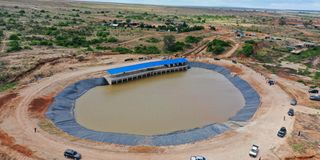
Thousands of farmers in Tana River and Kilifi counties are set to benefit from year-round irrigation following a Sh40 billion deal to construct the Galana Kulalu Dam and expand the current Galana Kulalu Irrigation Scheme.
Signed by the National Irrigation Authority (NIA) and China Communications Construction Company Kenya Ltd, in partnership with the United Arab Emirates, the project will cover 300,000 acres to boost agricultural yields in the semi-arid region.
Additionally, the dam is expected to provide clean drinking water to approximately 70,000 households, significantly improving access to safe water for both domestic and agricultural use.
The project addresses a bottleneck the President identified as early as 2023, when he noted that the water initially available at the site could only cater to 20,000 acres of production.
“The dam that I am building would enable us to scale farming to 300,000–400,000 acres,” he stated at the time, framing the infrastructure as key to the scheme’s viability.
In a statement released following the signing, President Ruto described the project as a move to stabilise the agricultural sector by reducing the impact of unpredictable weather.
“The signing of the Sh40 billion contract for the construction of the Galana Kulalu Dam will strengthen our food security by irrigating up to 300,000 acres. This is a bold step in our transition from rain-fed farming to reliable, large-scale irrigation,” the President said.
According to Dr Ruto, the dam is designed to hold 305 million cubic metres of water, with an expected annual delivery of one billion cubic metres.
He highlighted that the project’s objectives include stabilising food prices, expanding agro-processing and creating employment opportunities within the agricultural sector.
The deal marks a significant expansion of the Galana Kulalu Irrigation Scheme, which has historically been limited to small-scale pilot phases due to inconsistent water supply. The new dam acts as the technical catalyst required to scale operations at the scheme, which recently celebrated its first successful harvest under the new management model.
National Irrigation Authority CEO Charles Muasya, who oversaw the signing of the dam contract, had earlier noted that the scheme’s potential was already being proven.
In a statement following the first harvest in October 2025, Mr Muasya said the initial 1,500-acre pilot produced an impressive yield of 30 bags of seed maize per acre.
He emphasised that the country is targeting to scale this success across 200,000 to 300,000 acres, with a long-term goal of producing 14 million bags of maize annually—a vision that becomes achievable upon completion of the dam.
To protect the exchequer, State House said Kenya’s contribution to the project is being financed through the newly established National Infrastructure Fund (NIF). However, this funding mechanism has immediately come under intense legal scrutiny.
In late December 2025, the High Court issued conservatory orders staying the implementation of the NIF following a petition filed by Dr Magare Gikenyi and other activists.
The petitioners argue that the fund was established illegally through a State House communiqué and gazette notice rather than an Act of Parliament, a move they contend bypasses constitutional requirements for transparency and parliamentary oversight.
While President Ruto maintains that the investment is anchored in a sustainable Water Purchase Agreement framework, critics warn that if the court nullifies the NIF’s legal standing, the contract could mirror the stalled starts and legal vacuums that have historically plagued the Galana Kulalu scheme.