Before one of the worst droughts ravaged arid and semi-arid areas of the country in 2016, Komora Igiro had 77cows.
He was one of the wealthiest men in Danisa village in Tana River County, among the middle-aged men whose opinions were held in high regard.
He had herdsmen on his payroll who would take his cattle to Boni forest for pasture in the dry season, as his children went to the local private school in Garsen on a motorbike.
Then came the year that grabbed his riches, when a drought claimed almost all water reservoirs and pasture in the Delta.
Between 2016 and 2017, he lost 65 cattle to the biting drought, leaving him with 12.
“The distance to the available water sources was too long, there was no grass along the route so the cows grew tired and one after the other they refused to move and most of them died of fatigue,” he says.
One of his men was trampled and killed by buffaloes and some of his cattle were stolen by herdsmen seeking to replace their losses.
Some died from injuries caused by machetes, inflicted on them by farming communities after the animals invaded their farms.
“One of the boys came back home and told me we had lost everything, I took a donkey and embarked on a journey to see for myself,” he says.
He was gone for three months and returned home with only 12 cows in a truck as he feared losing them all on the long trek.
“I was a depressed man. I did not know where I was going to start. I could see my wife’s face, she was afraid we were being ruined and losing our prestige,” he says.
Their children withdrew from school as there was no milk to sell and he could not risk selling the remaining cattle he had as they were his only source of pride as a man.
They were no longer being invited to important discussions regarding the community but instead were ordered around.
“There was a lot of disrespect that as a man I found very difficult to bear. Eventually I withdrew from people and decided to focus on my family,” he says.
When he was richer, he had toured many places in the country, had witnessed a lot of livestock keeping in Embu, Meru and villages in Rift Valley.
He had seen how livestock keepers were making forage to cushion their animals during the dry season, but he came back home and did not try to copy what he had seen.
In the past three and a half years, he has depended on relief aid from the National Drought Management Authority.
Komora Igiro, pasture farmer in Danisa village, Tana River County during an interview with nation.africa
Photo credit: Stephen Oduor I Nation Media Group.
His dream of making forage for his remaining livestock, however, now seems achievable following the intervention of the European Union through a project called Rebuild.
The project seeks to rescue the community from the effects of drought by encouraging pasture farming and forage making.
More than 20 households have been trained on pasture production and management and have embarked on the farming.
The Danisa community has provided 18 acres of land that has been tilled and planted ahead of the long rains.
The project, Mr Igiro says, is a life-changer for herdsmen in the village as it will save them from conflicts with farmers over pasture.
“This is a dream come true. I saw others do this elsewhere. I wished for it in my village. It is here with us, I am delighted,” says the joyous 58-year-old.
Hawaa Abdi, 28, is also delighted about the project, as she thinks this will help save her marriage.
“I gave birth to three of my children while my husband was away. He only came back to make me pregnant, then after a few months he disappears. But with this, he is going to stay home," she says.
Ms Abdi, a mother of four, calls the forage-making the idea a life-changer as he foresees a moment when the community will sell forage to other herdsmen.
An 18-acre Farm in Danisa Village, Tana River County where production of pasture and forage is taking shape.
Photo credit: Stephen Oduor I Nation Media Group.
However, challenges still abound about the farm’s security.
Villagers are worried that itinerant pastoralists may drive their herds into the farm if it is not fenced.
“The herdsmen are always the problem to communities in the delta. They are unruly and may undermine our efforts,” says elder Mohammed Boru.
Mr Boru appeals to the organisation to support them further in raising money to erect a barbed wire perimeter fence as they enforce security in turns.
The project is one of the European Union’s agenda in Tana River County geared towards creating peaceful coexistence.
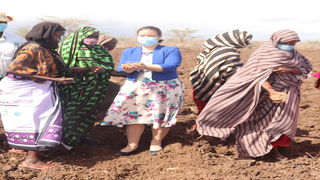
The EU’s ambassador to Kenya, Katrin Hagemann, said Tana River County had experienced some of the worst ethnic clashes over pasture.
“This is reportedly a volatile area in the region, hence our efforts are to neutralise the notion and ensure there is cohesion among communities through supporting in such projects,” she says.
The idea also seeks to encourage the development of healthy cattle for the market by feeding them with proper forage as well as inspire pastoralist families to settle in one place for their development, Ms Hegemann says.
“They keep travelling, but the world keeps changing day by day, their children need to attend school and that will only happen if they choose to settle, and for that to happen, they must be taught how to create the resource they seek forever time.”
More communities will be enrolled in the programme in a plan meant to help reclaim the Tana Delta’s glory.