Premium
Tana River governor rules out compensation for fire victims

Tana River Governor Godhana Dhadho.

Just days after a task force concluded its investigation into the series of fire disasters that have plagued Tana River County in recent years, Governor Dhadho Godhana has sparked controversy by declaring that no compensation will be extended to the victims.
According to Governor Godhana, the task force was never mandated to offer relief or compensation.
Instead, the county boss said its primary goal was to assess the county’s fire preparedness and develop a long-term roadmap to prevent future disasters.


“This was not a relief operation. It was a technical assessment to help us understand our weaknesses and improve our emergency response. Compensation is not part of the task force's mandate,” the governor said.
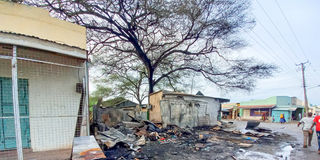
Moses Waihumbu's food kiosk, seen here, was reduced to ashes by a fire in Hola town, Tana River County.
That explanation has rubbed victims of the fire accidents in the wrong way, many of whom had pinned their hopes on some form of government support to help them rebuild their shattered lives.
Some lost businesseswhile others lost homes, belongings and even family members.
“It feels like we have been told to suffer quietly. We expected empathy, not abandonment,” said Amina Noor, a trader whose wholesale shop was gutted in a fire in Bura Town.
Defending the county’s stance, Governor Godhana also blamed historical factors.

Tana River County Governor Dhadho Godhana.
He noted that Hola Town—the epicenter of several of the fires—suffers from poor urban planning. Traditionally, he said, the town was laid out by community elders without the technical foresight needed to mitigate modern disasters.
“Most trading spaces are congested. There are no service lanes for emergency vehicles. The buildings are too close to each other. That kind of environment is a death trap,” he said.
He further pointed out that most business owners do not comply with basic fire safety requirements.
“It’s unfortunate that very few traders own fire extinguishers. You cannot completely blame the government for everything. We must also look at individual responsibility,” he said.
Glaring weaknesses
The governor also acknowledged that unofficial assessments over time have revealed glaring weaknesses—not just among business owners but within the county’s own fire response unit.
“We are understaffed, under-equipped and our firemen need upskilling,” he admitted.
While the governor stood firm, the task force struck a more sympathetic tone.
Task force member Mary Komora expressed heartfelt sympathy for the victims noting that many remain deeply traumatised.
“Some of these people are living in tents. Others lost their children. A few have slid into poverty, unable to recover their livelihoods. The pain is deep,” she said.
Ms Komora revealed that the task force will recommend restitution for some affected families and businesses in its final report. However, she stressed that the decision to act on those recommendations lies squarely with the county government.
“We have done our part. We hope the county will show compassion,” she said.

A fire engine parked at the offices of the Department of Public Works in Hola, Tana River County, in this picture taken on April 10, 2025.
For many residents, however, hope is turning into anger. They argue that the county government has both a moral and constitutional obligation to respond with more than just policy papers.
Catherine Nyagothie, a businesswoman, is among those calling for a change in stance.
“There is an emergency fund under the Department of Special Programs. Why can’t that be used to at least give building materials to those who lost homes?” she asked. “For traders, let them be included in the Inuka Fund. It’s an interest-free loan—let them bounce back with dignity.”
She warned that failing to support fire victims would set a dangerous precedent of institutional neglect.
“You can’t talk about disaster prevention without acknowledging the pain and loss already suffered. That is not leadership but abdication of duty,” she said.
The fire tragedies in Tana River have exposed deep cracks not only in urban planning and emergency response, but also in disaster governance and public accountability.
For a county already grappling with poverty and underdevelopment, the loss of even a single business or home is a significant socioeconomic setback.