For residents of Todonyang village in Turkana County, killing of their loved ones no longer seems to shock Kenyan authorities.
They feel forsaken and betrayed by the government after the latest attack on the village that borders Ethiopia claimed more lives.
Turkana County Commissioner, Julius Kavita, said four bodies of fishermen who were killed around 3am on May 15 were found by a security team five hour later, thanks to poor communication network in the disputed Ilemi Triangle.
“The bodies have been moved to Lodwar County and Referral Hospital mortuary. We urge Todonyang residents to remain calm as investigations into the incident continue,” Mr Kavita said.
“We are also in contact with Ethiopian authorities to ensure those responsible are brought to justice.”
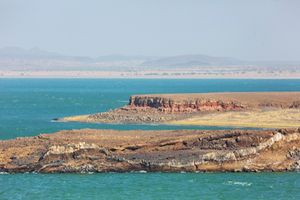
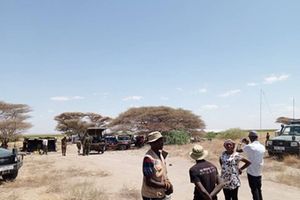
Security patrols have been stepped up in Todonyang village on the shores of Lake Turkana after an unknown number of fishermen were killed in deadly attacks along the Kenya-Ethiopia border on February 22, 2025.
Photo credit: Pool | Nation
County Police Commander, John Tarus, said patrols on the border have increased.
Suspected militia from Ethiopia attacked pastoralists, fishermen and traders in Lotiira and Lopeimukat villages on the shores of Lake Turkana, on February 22, killing 40 people.
It took four days for Kenyan authorities to access the scene of the attack after being granted clearance by Ethiopia. The Kenyan security officials found two bodies. The third was found eight days later.
Todonyang residents said they expected quick response from border security personnel soon after the raiders arrived.
Security personnel blamed the slow response on poor road and communication network. Some households are still looking for their relatives believed to be victims of the attack.
The last official update from Kenyan authorities on the Todonyang killings was on March 7, when Rift Valley Regional Commissioner Abdi Hassan said 66 people had been rescued while 38 were still missing.
Government authorities reject the idea of declaring the Todonyang incident a massacre, citing a lack of bodies. And the attacks continue.
Mr John Etir, a resident of Todonyang, told the Saturday Nation that he does not know if his son is missing or dead, as he was not among the three bodies returned and buried at a graveyard established by locals with the support of Our Lady Queen of Peace Todonyang Mission of the Catholic Diocese of Lodwar.
Victims of militia attacks are buried there in single or mass graves, depending on the nature of an attack.
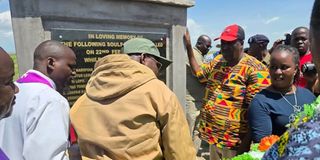
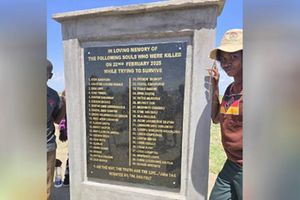
A monument in Todonyang village for those killed in February by militia from the Dassenech community of Ethiopia, with 40 names that was unveiled by Turkana Governor Jeremiah Lomorukai on March 3, 2025.
Photo credit: Pool
“I know many people who were buried here. My son is also a victim of the attack. Even if Yomer died, where is his body? Many have been killed and their bodies left in hard-to-reach areas. Some bodies are eaten by wild animals,” Mr Etir said.
He then referred to a plaque at the graveyard bearing the names of 40 people that are presumed dead. The plaque, unveiled by Turkana Governor Jeremiah Lomorukai, has the inscription: “In loving memory of the following souls who were killed on February 22, 2025, while trying to survive.”
The plaque bearing his son’s name is the only “proof” that Yomer died when he was attacked while fishing in Lake Turkana.
Nominated MCAs Jacinta Abenyo, Esther Apetet and several women leaders in Turkana County were in Lodwar at the time of the attack.
Along with Todonyang residents, they resolved that the recovered bodies must be taken to the mortuary.
“In many of these incidents, women never get a chance to see the bodies of their husbands, sons or brothers,” Ms Abenyo said.
“Any man killed in these attacks is a huge loss to the village. Men are not just our husbands, sons, brothers and uncles. They are our protectors and breadwinners.”
The nominated ward representative said Todonyang locals expected the security operation launched and hyped by Interior Cabinet Secretary Kipchumba Murkomen following the February attack would lead to stability, peace and justice.
“The government promises to beef up security every time we bury people but nothing really happens. These endless attacks show that border security is not working,” Ms Abenyo told the Saturday Nation .
She added that when killings are blamed on residents of Turkana County, Ethiopian forces equipped with sophisticated weapons and helicopters launch operations and target innocent people.
Our Lady Queen of Peace Todonyang Mission signpost at Todonyang village in Turkana County.
Photo credit: Pool
“The most Kenyan security agents are doing is finding bodies and taking them to mortuaries. To be honest, it is out of the pain and bitterness that our men opt for revenge,” the politician said.
She added that residents of Todonyang and neighbouring areas need the ability to protect themselves from invaders, saying Kenya Defence Forces soldiers have not been deployed to Todonyang.
“Militias from Ethiopia know Kenya has no strong security presence on the border. We want the government to recruit National Police Reservists and give them the necessary tools needed to protect the community,” Ms Abenyo said.
She added that the lake is the main source of livelihood in the region and that if men cannot catch fish for fear of getting killed, most families would starve.
“Mr Murkomen to return and tell us the progress made from the time he left. He promised to arm police reservists but all they got were uniforms. Our leaders’ voices must be heard and acted upon,” she said.
According to Ms Apetet, the raiders could be having the backing of Ethiopian authorities as bodies are often hidden to conceal the extent of the attacks.
“Let President William Ruto intervene and ensure these killings and lawlessness come to an end. That can only happen with the deployment of the military and specialised security forces to this region,” Ms Apetet said.
She added that locals are always targeted while fishing, making the hiring of police reservists critical.
Governor Lomorukai said his administration has prioritised peace-building on the borders of Ethiopia, Uganda and South Sudan, “but the killings suggest some communities are not committed to peace”.
“We are saddened by the continuous killings of innocent people, even after many communities pledged to promote and uphold peace. These killings show that the Merille people are not ready for peaceful co-existence,” Governor Lomorukai said.
“I call on the government to value the lives of our people as enshrined in Kenya’s Constitution. What is the government doing to prevent more killings and bring the perpetrators to book?”
He said the government must deal firmly with foreign militias occupying Kenyan territory and killing fishermen, pastoralists, traders and other innocents.
The porous border is also a hub for illegal trade, with large quantities of cannabis trafficked from Ethiopia.
“The border has many illegal crossings, increasingly being used by migrants. Our security officials are either complicit or neglecting their duty, which is to protect lives and property,” Mr Lomorukai said.
Residents report an increase in the number of lorries transporting illegal goods. The governor demanded investigations into whether security officers are involved in the business.
“Security agencies want us to remain quiet but for how long? They should drive these militias back to their country,” he said.
Residents in the border region say poor mobile network connectivity exposes them to attacks. Mr Bernard Etukon, a fisherman, said limited security from Merikuka to Todonyang calls for mobile phone masts to keep people connected.
“There were rumours of an attack on Lopeimukat. Unfortunately, victims couldn’t be reached by phone. After the killings, it took more than 10 hours to get information to the authorities,” he said.
Ms Agnes Ekutan, a fish trader in Merikuka, said she cannot alert state officials of suspicious activities due to unreliable network.
“Mobile connectivity is important for residents and traders. It can also help share intelligence with security personnel for swift response and coordination,” she said.
“We need to be able to communicate about suspicious individuals so that police can plan better to repel attacks,” she said.
Improved network would also make mobile money transactions easy, reducing the need to travel, the trader added.
Turkana Senator, James Lomenen, said lack of mobile connectivity weakens response and exposes police and locals to danger.
“The attacks should make the state invest in communication infrastructure,” he said.