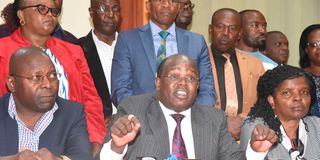
Troubles of the cash-strapped Moi University are far from over, as the academic staff issue a fresh strike notice over delayed salaries and other unpaid dues, a move that could cripple learning activities at the institution.
The Universities’ Academic Staff Union (Uasu) has warned of a shutdown of learning activities over delayed salaries for its members and the flouting of the return-to-work formula, which had ended a more than three-month strike by university workers.
“All Uasu members at Moi University shall withdraw their labour and shall not resume duty until the return-to-work formula is fully implemented, the June and July 2025 salaries are paid in full, and the National Collective Bargaining Agreement 2021–2025 is honoured,” said Dr Constantine Wasonga, Uasu national secretary-general, in a strike notice copied to the university council chairman, Prof Noah Midamba.
The strike is set to commence on Wednesday as the university prepares to admit first-year learners for the 2025–2026 academic year.
“We appeal to academics of all ranks and ages to come out and champion their rights. No single person in any rank can sit comfortably with the situation at hand,” said Ojuki Nyabuta, chapter organising secretary.
The union has taken issue with university management for contravening the Return-to-Work Formula agreed in November 2024, which had ended the prolonged strike by teaching and non-teaching staff that disrupted learning at the institution.
Under the deal, signed in the presence of Education Cabinet Secretary Julius Ogemba and Higher Education Principal Secretary Beatrice Inyangala, the unions secured Sh2.6 billion in cash and assets, with an immediate release of Sh500 million.
The union was allocated Sh7.7 billion under the 2021/2027 CBA, to be implemented in two phases of Sh4.3 billion and Sh5.2 billion in the 2025/2026 and 2027/2028 financial years.
However, the university has admitted that it faces challenges paying salaries even after receiving additional funding from the national treasury and it has disclosed plans to lay off hundreds of employees to cut down on a ballooning wage bill.
The Acting Vice-Chancellor Prof Kiplagat Kotut, has previously acknowledged the university’s financial challenges but said the council is working on solutions.
Moi University, once a leading institution of higher learning in the country, sent 324 workers on contract early this year, even as it recovers from a three-month closure following protests by teaching and non-teaching staff.
“Although the restructuring process may be painful, it is aimed at reclaiming the lost glory of the university. It is regrettable that we are currently totally dependent on the government to manage our operations. The reorganisation will make the university self-sustaining,” explained Prof Kotut.
He disclosed that student numbers have dropped from 48,000 in 2015 to the current 21,000, making it difficult for the university to meet its financial obligations, including payment of employees’ emoluments.
The financial woes facing the university have been partly attributed to reduced exchequer funding due to the implementation of Differentiated Unit Cost (DUC) in computing recurrent capitation and rising personnel costs due to National Collective Bargaining Agreements that have not been fully funded.
Among the financial irregularities under probe at the university are the failure to remit Sh4 billion in payroll deductions, defaulting on a Sh3 billion loan owed to Rivatex East Africa Limited, and accumulating Sh1.1 billion in unpaid bills as of June 2020.
The Ethics and Anti-Corruption Commission (EACC) launched a probe on September 9, 2021, into allegations of ghost workers.
The university issued redundancy letters to about 900 employees, including 120 lecturers, early this year as part of cost-cutting measures.
However, Uasu moved to court and obtained orders directing the university to put the lecturer layoffs on hold pending the hearing and determination of cases filed under certificates of urgency, challenging the layoff process.