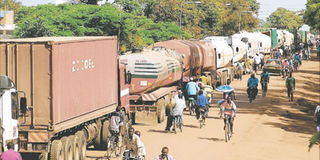
Maize farmers in Kenya are turning to regional markets in Uganda, South Sudan and the Democratic Republic of Congo (DRC) as local prices stagnate and imports threaten a further decline.
After two months of flat prices, earnings have dropped to Sh4,000 per 90kg bag locally compared to between Sh4,650–5,500 across the border, pushing growers to seek better returns while navigating shrinking profits and shifting demand.
In the North Rift, farmers who have been hoarding their produce in anticipation of higher prices are now targeting cross-border markets as falling local prices threaten their earnings.
Prices have dropped from Sh4,200 to Sh4,000 per 90kg bag over the past two months, with fears of further declines due to an influx of low-cost grain from Tanzania and the harvesting of alternative foodstuffs, both of which are reducing the demand.
Across the region, however, prices remain stronger. A 90kg bag is selling at Sh4,500 in Lira and Sh4,650 in Kampala, Uganda, while it fetches Sh5,000 in South Sudan and up to Sh5,500 in the DRC, where shortages linked to crop failure have tightened supply.
“It is beneficial for farmers who have been hoarding the crop to pool resources and export in bulk to cut down on transport costs as part of a strategy to cushion themselves from losses, after the anticipated higher prices failed to materialise,” said Mr Kipngetich Mutai, a farmer and trader operating between Kenya and Uganda.
Farmers are taking advantage of regional trade agreements under the East African Community (EAC) and the Common Market for Eastern and Southern Africa (Comesa), which allow free movement of goods and services.
“We are assessing conditions in regional markets with a view to tapping opportunities where the crop attracts better returns,” said Mr Wilson Koech from Trans Nzoia County.
At home, policy pressure is building. The Ministry of Agriculture last month issued a 30-day ultimatum to farmers to release maize stocks after acknowledging limited domestic supplies, which could force the government to allow duty-free imports to stabilise flour prices.
Agriculture Cabinet Secretary Mutahi Kagwe urged farmers to sell to the government to avert potential losses.
“We are offering Sh4,000 per bag and we have Sh1.7 billion for payments. We must stock our strategic reserves and be prepared for emergencies. Our priority is not to import but to buy from farmers,” he said.
However, many large-scale farmers who had ignored the directive and held onto their grain now find themselves under pressure, forced to release and sell their stocks at between Sh3,800 and Sh4,000 or explore export options.
“We are stuck with maize in our stores and there is no other option but to sell the produce at current market prices,” said Mr James Songok, a large-scale farmer from Kerita in Uasin Gishu County who is holding over 200 bags.
In response to recurring price volatility, county governments in the region are pushing for value addition and diversification into fast-maturing, higher-value crops to cushion farmers against market swings.
Governors, through the North Rift Economic Bloc, are spearheading plans to establish maize milling plants and a fertiliser plant to lower production costs and create more stable markets.
Trans Nzoia County has partnered with the Industrial and Commercial Development Corporation (ICDC) to build a Sh800 million milling plant expected to process two million bags annually, while also producing animal feed for dairy farmers.
In neighbouring Uasin Gishu, the county government has set aside Sh200 million through a revolving fund to establish a milling plant at Kabenes in Soy via the Moisoy Cooperative Union.
The projects aim to enable farmers to process and package their own flour for both local and export markets, allowing them to capture more value from their produce.
The counties are also strengthening the cooperative movement as a vehicle for aggregation and market access, with Uasin Gishu alone having registered 650 cooperatives as part of a wider regional push.