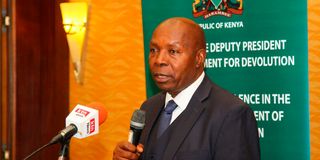
Governors have struck a deal with the national government over the transfer of health, education and trade functions to the devolved units.
The development is part of an ongoing exercise to assess devolved functions involving governors and principal secretaries in Naivasha, Nakuru County.
There are 12 functions earmarked for devolution that have been identified as pending and are still being performed by government ministries, departments and agencies.
These are regional development authorities; trade; tourism, wildlife and culture; agriculture; health; energy; lands; public works; housing and urban development; education; and environment and disaster management.
This was revealed by Intergovernmental Relations Technical Committee chairperson Kithinji Kiragu, who described the validation exercise, expected to take three weeks, as “successful so far” having been carried out “without any disputes between the national and county governments.”
The national government has been holding onto some 19 elements of the Trade and Industry function, which comes with a budget of Sh4.8 billion.
The deal now means that counties will be fully involved in trade licensing, developing and implementing county policies on trade development and regulation, providing business development services, and conducting trade fairs and exhibitions.
Further, they will continue to build, control and manage markets, allocate stalls to traders and operators, license markets and aggregation centres, allocate land for and identify market sites, develop value addition products, and conduct surveillance of counterfeit or substandard products, among other functions.
In the cooperative sub-sector, counties will be responsible for promoting and conducting pre-cooperative education.
Speaking in Naivasha, Cooperatives Cabinet Secretary Simon Chelugui lauded counties for allowing the national government to develop standards, by-laws, economic appraisal and application documents for the registration of cooperative societies.
He requested counties to allow the national government to issue registration certificates in order to ensure cross-county operation of the cooperatives.
In education, there has been a push-and-pull between the two levels of government over the management of early childhood development and education centres after the Presidential Working Party on Education Reforms recommended that the function should be recentralised.
Under health, counties will perform promotion of primary healthcare, ambulance services, licensing and control of undertakings that sell food to the public, and veterinary services. They, however, will be barred from managing health workers, regulating cemeteries, funeral parlours and crematoria, and managing waste disposal.