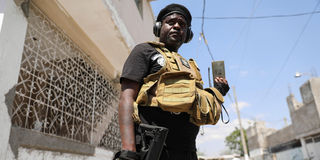
Gangs in Haiti now claim to have been well paid to cause more havoc in the Caribbean nation, denouncing the current regime led by Prime Minister Alix Didier Fils-Aime, in which Kenya is leading a Multinational Security Support (MSS) Mission.
In a statement released this week, Jimmy "Barbecue" Cherizier, the leader of the Viv Ansanm gang — which translates from Haitian Creole as "living together" — said that top officials in Haiti had made payments to ensure the country's instability.
“We enjoy good friendship with a section of top leaders here in Haiti and they have paid us well so that we can destabilise the country,” he claimed, adding that the goal was to remain in power.
The Nation cannot mention the names of the leaders who paid them for legal reasons, but it is in possession of a video in which Barbecue speaks about the deals they made and how they have survived in Haiti.
Barbecue also claims that one of his close associates in the gang leadership visits a top leader almost every weekend.
Haitian National police SWAT unit and Kenyan Police on the streets of Port-au-Prince, Haiti, on June 28, 2024.
Photo credit: Reuters
This revelation comes at a time when the Kenyan-led MSS has one month to wait for a decision on whether its mandate will be extended.
If the gangs' financial clout is anything to go by, it explains why the United Nations Office on Drugs and Crime (UNODC) recently warned Kenya that the gangs' arsenals are far more powerful than those of the Haiti police force.
In its latest report, the organisation warned that the gangs are armed with Russian AK-47s, US-made AR-15s, and Israeli Galil assault rifles.
"A surge in the trafficking of increasingly sophisticated weapons has gripped Haiti since 2021," UNODC said in the report.
The report identified the US as the main source of weapons ending up in the hands of gangs. The other main source is the Dominican Republic.
Meanwhile, the Haitian government has expressed support for the US's plans to transform the struggling MSS mission into a new Gang Suppression Force (GSF), which will comprise 5,000 members and have a permanent support office in Port-au-Prince to coordinate logistics and operations.
He said that the GSF, which has a stronger mandate and logistical support, is vital in order to confront the gangs that now dominate most of Port-au-Prince and many provincial towns.
Haitian security forces patrol during a protest against insecurity, in Port-au-Prince, Haiti, April 16, 2025.
Photo credit: Reuters
It is worth noting that Kenya has been struggling with a lack of better equipment and limited funding, manpower, and logistical support, which would not be the case if the proposal for the GSF is approved.
“I affirmed the Haitian government’s resolute support for transforming the Multinational Security Support Mission into a strategic force capable of carrying out intensive and targeted operations against armed groups that threaten our country,” Fils-Aimé said in a statement.
He added that “security remains essential to consolidate institutional foundations, revive the economy, and ensure credible, free, and transparent elections.”
The proposal for the GSF to lead the mission was made by the US and Panama in mid-August during a meeting with the UNSC and the Organisation of American States (OAS).
The proposal has so far received backing from some Caribbean and Latin American nations, with a total of 32 member states showing support for the ongoing efforts to help Haiti tackle the gangs that have already caused the deaths of more than 3,000 people this year.
Kenya also supports the mission, with the Principal Secretary for Foreign Affairs, Dr Abraham Korir Sing’oei, telling the Nation in an earlier interview that Nairobi welcomed such discussions, but stressed that the ultimate goal must be to restore peace in Haiti.
“The interest of Kenya from the word go was to ensure that peace is restored in Haiti. Already, the US has proposed establishing a group of partners with the aim of revamping the security force in Haiti, which is right,” Dr Sing’oei said.
This week, Haitian human rights group, Movement Unforgettable Dessalines Jean Jacques (MUDJJ), told the Nation that it supported Dr Ekuru Aukot’s call for accountability and justice regarding the deployment of Kenyan officers to the Caribbean nation.
Haitian security forces patrol during a protest against insecurity, in Port-au-Prince, Haiti, April 16, 2025.
Photo credit: Fildor Pq Egeder | Reuters
It is worth noting that Dr Aukot, a lawyer and a political leader, had taken the government to court, vehemently opposing the deployment of officers to Haiti on the grounds that it was unconstitutional. Even before a decision could be made, Kenya started sending its officers to the Haiti.
“As descendants of Haiti, we empathise deeply with the struggles of those living under oppressive conditions and we firmly denounce acts of state-sponsored violence and ethnic discrimination,” MUDJJ said in a statement.
The organisation expressed deep concern about the human rights situation in Kenya, questioning why the country had chosen not to deploy its own officers to address local challenges.
The group said that the political leaders with whom the Kenyan government had chosen to collaborate in Haiti were not legitimate, which raised questions about the government's commitment to democratic values and human rights.
“Let us work together towards a shared vision of a brighter future for both Kenya and Haiti, where human rights are respected, and governance remains transparent and accountable,” the human rights group concluded in the statement.
The Kenya-led MSS mission has been under scrutiny for some time, with critics questioning its effectiveness in the face of intensified gang activity across the country.
Kenya first entered Haiti in June 2024, and, as of September 2025, three Kenyan officers have died while serving on the mission. Those injured during the mission are receiving treatment in the Dominican Republic, Haiti's neighbour.
Approximately 1,000 Kenyan officers are currently serving in the Caribbean nation, drawn from the General Service Unit (GSU), the Anti-Stock Theft Unit (ASTU), the Rapid Deployment Unit (RDU), and the Female Special Weapons and Tactics Team (SWAT).