'Approaching women is impossible': Kilifi men suffer in silence as swollen testicles shatter self-esteem, dream for love
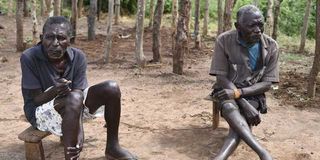
Mganga Kalama Ndiro and his brother, Jefwa Kalama Ndiro, at their home in Mfulani village, Magarini, Kilifi County, on July 11, 2025. They are among residents living with lymphatic filariasis.

What you need to know:
- These men in coastal Kenya live with stigma and poverty from lymphatic filariasis.
- Poverty, myths, and stigma trap them in lifelong suffering from mapumbu.
The air in Mfuleni, a small village in Kilifi County, hangs heavy with the scent of dust and struggle. Inside a cluster of grass-thatched huts, barefoot grandchildren play freely, while two brothers sit quietly, burdened by an illness that has shaped their lives for decades.
For more than three decades, Jefwa Kalama Ndiro, 69, and his younger brother, Mganga Kalama Ndiro, 50, have lived with massive swellings in their scrotums, locally known as mapumbu. Both men suffer from lymphatic filariasis, a neglected tropical disease that has left them visibly marked and socially stigmatised.
Hope
Infection
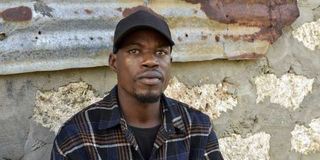
Baraka Baya, 24, at their home in Mavueni, Kilifi County. He desires to have children, but she can't marry because of lymphatic filariaisis, which terms a turn-off for potential wives.
The disease also shackles the young. Back in Mavueni, about 160 kilometres from Mfuleni, 23-year-old Baraka Baya navigates the chaotic matatu stage, calling passengers, hustling for survival. Beneath his deliberately baggy trousers, he carries a hidden burden he has shouldered for three years. “I have never sought treatment at all,” he confesses, his gaze often fixed on the dusty ground.
The reasons are anchors dragging him down: the crippling expense of surgery and the suffocating stigma. “It doesn’t allow me to participate, even among my peers,” he says softly.
With his confidence shattered, he often withdraws into isolation. The vibrant dreams of youth; love, family, and children feel like distant mirages for him. “If I got that chance for surgery, I would run with it,” he declares, a flicker of desperate hope cutting through the resignation.
The ailment has crippled his self-esteem; approaching women feels impossible. “I love children,” he admits with a distant longing. “I wish I could have my own. But I do not even have the courage to approach a woman. My esteem is in the gutter. How do I even start explaining my swollen testicles to someone I long and feel love for?” he asks. “They might laugh at me and maybe even leak my shameful secret especially if they do not share the affection.”
Diet
For now, his management is as simple as it is inadequate: he is selective in his diet, choosing to stay away from peppery food, and the camouflage of loose clothing. Baraka represents a silent generation of young men whose futures are clouded by a preventable disease, but trapped by fear and poverty.
Amidst the struggle, Justin Kiringi Mrabu, in his 30s, stands as a powerful symbol of possibility. A community health promoter in Kilifi, Justin himself lived under the shadow of hydrocele. In 2019, he underwent surgery at a medical camp supported by Amref at the Kilifi County Referral Hospital. The transformation was profound—physical and psychological.
"Before the surgery, I was uncertain about the outcome because there were unverified rumours that one would not sire after the surgery and that the surgery wound does not heal easily. I, however, took a chance and that remains one of the best decisions I ever made. I was lucky to be picked for the surgery,” he offers with a tone of gratitude.
“One year after my surgery, I was able to father a child,” he shares, an utterance heavy with significance in a culture where manhood and fertility are deeply intertwined.
After his successful surgery and seamless healing, Justin took it upon himself to dismantle the crippling myths that keep men from seeking help. He now tirelessly mobilises his community whenever surgical camps are announced. His core message, delivered with the authority of lived experience, is vital: “Surgery works, and it doesn’t end your life or your manhood. I talk them out of the fear and misconceptions.”
He grounds his advocacy in the local context. “Data from around 2019 indicated roughly 3,000 people were affected by hydrocele in Kilifi County alone,” Kiringi states.
While he believes concerted efforts such as more frequent surgical interventions and increased use of insecticide-treated mosquito nets are slowly reducing this number, the need remains immense. His plea is directed squarely at the authorities: “The county government needs to strategically partner with organisations bringing these medical drives. Structured collaboration would be far more impactful than the current situation.”
He emphasises the need for predictable, sustained access to treatment, not just occasional interventions. According to a March 2025 report by the International Society of Infectious Diseases, lymphatic filariasis is predominant in Africa and Asia.
The report indicates that Kenya established its National Programme to Eliminate Lymphatic Filariasis in 2000. It launched its first Mass Drug Administration (MDA) in Kilifi in 2002, with subsequent expansions to Kwale, Tana River, Lamu, and Mombasa. MDA was implemented in phases because of limited resources to treat all at-risk individuals.
Since 2016, the country has implemented continuous and successive MDA campaigns, which have contributed to a significant reduction in disease prevalence. The report envisages that Kenya is on track towards eliminating lymphatic filariasis as a public health problem by 2030.
Away from the commendable decline of the disease, Justin sounds the alarm on a horrifying trend born of stigma and misinformation: dangerous self-treatment. “I have noticed some young men sharpen umbrella wires and pierce themselves to drain the fluid, just so they can wear tight and trendy jeans,” he says, his voice tight with concern.
The relief is temporary as the fluid typically returns within three months and comes back at a terrifying cost. “It risks severe infection, permanent damage, and can make future surgery impossible,” he warns, having witnessed the disease’s indiscriminate reach, affecting individuals from three years old to over 90 and proving it’s a lifelong threat without accessible healthcare.
Decades-old struggle
The burden stretches beyond Kilifi. In Shanzu, Mombasa County, 70-year-old Masha Mramba Mwaiha endured the ailment for over 40 years. It caused him to stumble and fall, a constant, humiliating hazard. But it took a near-tragedy in April 2024 to force action. “He passed out in the toilet for a long time before we discovered him,” recounts his second-born son.
The collapse was severe and they rushed him to Mtwapa Sub-County Hospital where he underwent surgery in August 2024. Relief came at a staggering financial cost for his low-income family. “The cost was about Sh160,000,” his son states, a colossal sum that consumed savings and left them in debt they are still struggling to settle.
The hardship didn’t end at the operating theatre. “I was not discharged with any painkillers. Not even a single Panadol. They said I had to pay for the painkillers, yet I did not have any single coin left,” Masha reveals, bewilderment mixed with residual pain in his voice. “I was told to sit in salty water occasionally.”
Pain
The recovery was excruciating, a brutal testament to gaps in post-operative care. Yet, despite the financial strain and the agonising recovery, his overriding emotion is profound relief. The “load” that weighed him down for four decades is finally gone.
Lymphatic filariasis is a disease intrinsically linked to poverty, thriving where sanitation is inadequate, mosquito nets are inconsistently used, and access to basic, affordable healthcare remains a significant challenge. The stigma surrounding it, the shame, and the fear of emasculation is a potent silent accomplice, often more effective than the parasite itself in preventing men from seeking help, trapping them in cycles of isolation and economic ruin.
According to Dr Sultani Matendechero, Senior Deputy Director at the Ministry of Health, Kenya's lymphatic filariasis programme was launched in 2000 but faced early setbacks due to inconsistent funding and implementation gaps.
After stalled progress by 2010, a 2015 prevalence survey revealed the disease remained endemic across 21 coastal sub-counties. This triggered a major strategic shift: “We relaunched our campaign in 2015 with intensive advocacy and community mobilisation,” Dr Matendechere stated.
A breakthrough came in 2018 when research from Washington State University showed triple-drug therapy (Ivermectin + DEC + Albendazole/IBA) could eliminate lymphatic filariasis in just two years – down from five. Kenya became among the first nations globally to adopt this regimen, achieving dramatic results: “Our coverage was so good that in two years, we drastically reduced prevalence” in high-burden areas like Lamu and Mombasa.
Subsequent WHO-approved transmission assessments confirmed Kenya had fallen below the critical 1.0 per cent transmission threshold, putting elimination within reach. “What remains is just certification,” he noted.
While transmission has been interrupted, the government acknowledges the lasting impact on affected individuals. For chronic symptoms like hydrocele (swollen testicles) and lymphoedema (swollen limbs), the Morbidity Management and Disability Prevention (MMDP) programme was launched.
“Surgery corrects hydrocele and survivors can return to 100 per cent normal,” Dr Matendechere emphasised, contrasting it with irreversible limb swelling managed through hygiene, elevation, and specialised garments.
Since 2018, surgical interventions have significantly reduced the backlog: “We targeted over 4,500 surgeries initially... now we’re below 1,000.”
However, he highlighted persistent barriers: stigma (“some believe hydrocele is witchcraft”), poverty (inability to afford surgery), and lack of awareness that treatment exists. “We are rolling out the MMDP programme, surgeries and foot care,” he affirmed, noting ongoing efforts to clear remaining cases.
Summary
Cause: Lymphatic filariasis is transmitted by different types of mosquitoes, for example, by the Culex mosquito, widespread across urban and semi-urban areas, Anopheles, mainly found in rural areas, and Aedes, mainly in endemic islands in the Pacific.) The one responsible for the cases in Kenya’s coastal area is the Culex.)
Prevalence: Endemic in coastal Kenya. Kilifi County alone documented approximately 3,000 cases in 2019 (local health data). While prevention efforts (mosquito nets, Mass Drug Administration) may be gradually reducing new infections, thousands still live with the chronic, disabling manifestations like hydrocele.
The World Health Organization (WHO) in a November 2024 report reveals that over 657 million people in 39 countries worldwide remain threatened by lymphatic filariasis and require preventive chemotherapy to stop the spread.
Treatment: Surgery (hydrocelectomy) is the definitive cure for hydrocele, according to the WHO, offering immediate relief and restoration of function. It is a well-established and effective procedure when performed in an appropriate medical setting.
Prevention: Mass Drug Administration campaigns distributing preventative medicines (like ivermectin, albendazole, and diethylcarbamazine) to entire at-risk populations to interrupt transmission. Consistent, universal use of Insecticide-Treated Bed Nets to prevent mosquito bites.