'I wanted doctors to help me die but I've changed my mind'
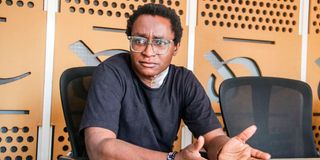
Joe Mudukiza during an interview at Nation Centre building in Nairobi on December 23, 2024.

What you need to know:
Joe says doctors told him his body functions have started shutting down.
If nothing is done, especially a hip replacement surgery, he may have a huge problem in the next 90 days that could result in death.
It has been roughly 630 days since Joe Mudukiza ditched the idea of dying and chose to live. In February last year, Joe, a sickle cell patient, wrote a long Facebook post detailing his plans to die. He had made arrangements to travel to Belgium, where he would undergo mercy killing, which is not a legal option for death in Kenya.
Also read: Why I want doctors to end my life
When we caught up with him last year, he still wanted to die, but he had a tinge of hope left to live. That desire to live won. But how has his life actually been?
“I was convinced to continue living by the many people who reached out after the interview, including my mum. I also stopped that process (euthanasia) because of my children,” he said when we visited his home on the outskirts of Nairobi on Wednesday afternoon.
We find him sitting on a couch with two of his adopted sons in the living room. They are watching television. The room is warm, but Joe is bundled up in a blanket and a light duvet while wearing a grey hoodie.
Visible wounds
There is a difference in his body compared to the last time we had an interview with him. The back of his hands now has visible black wounds. He has a bandage on the right side of his neck and another bandage on his left knee. There is one more wound that we can’t see on his hip joint, but he describes it as the most painful and one that needs medical attention. Before the interview starts, his 14-year-old son helps in injecting him with an opioid, which he takes every four hours to reduce the pain.
Joe admits that his quality of life had slightly improved a few months after people reached out to him when we published his story. The frequency of crises related to the sickle cell disease have reduced, giving him time to have a few hours of a painless life.
And then, another set of problems kicked in. His veins collapsed, and it was hard for him to get a blood transfusion or even to an injection for painkillers and antibiotics.
That is when doctors recommended that he have a central venous catheter (CVC) surgery that would give clinicians easier access for administering fluids, medications, nutrition, and for drawing blood.
His first CVC surgery was botched; he had to do a second one. The first site of the CVC surgery developed complications, but his second has been working just fine.
His hip joint is now the cause of his pain, and doctors have told him that he has a condition called avascular necrosis, which means that his bone tissue is dying because it is not adequately supplied with blood.
Convulsions
He now has frequent and unexpected convulsions. A few months before this interview, Joe told us that he was taken to the Intensive Care Unit (ICU) after a convulsion episode that resulted in a coma and had to be closely monitored for a week.
“My wounds have become so bad, I sometimes have live maggots coming from the site,” he says.
On the day we visited him, there was no live maggot, but he showed us a photo of his wound on the leg with a live maggot.
“I struggle to clean the wounds. Those in other parts of the body heal, the one on the hip doesn’t,” he says.
“The wounds are so painful and itchy. The ones on my leg feel as though I am walking on sharp nails.”
Over the years, Joe has been using different types of medication to manage his pain and infections.
He tells us that he has since become resistant to most of the antibiotics and is now almost running out of the existing acceptable types of antibiotics to use.
“When I started having infections, I was given Amoxil, and I was fine. I recently had a culture test and I couldn’t use most of the antibiotics,” he reveals.
For his pain relief, ideally, he says he was prescribed a daily dosage of an opioid, but he takes it more times in a day. One time, he got a prescription for fentanyl patches, which he could not keep up with because they are costly and are not easily given to a patient without a prescription.
This overdose has now affected different parts of his body such as the liver and kidneys.
He tells Nation that doctors told him his body functions have started shutting down. He says that if nothing is done, especially a hip replacement surgery, he may have a huge problem in the next 90 days that could result in death.
“I felt sad when I was told about the 90 days because when I decided I was not going for euthanasia, I wanted to live. Now I see death creeping naturally,” he says.
He is scared of what life will be like when his body shuts down completely, but his heart continues to beat.
“I have really worked hard not to commit suicide,” Joe tells Nation.
As his countdown to the 90 days begins, he wishes that the people who called him with promises of helping foot his medical bills could live up to their word. When he was an active sickle cell patient, he sent a petition together with other patients, whom he says have since passed on, asking the government to prioritise the plight of sickle cell
patients and subsidise their medication. He is still hopeful that one day, there will be a change.
As his clock ticks, he still believes that he can live longer should he get a hip replacement surgery.