Premature births and the price mothers pay for their babies’ survival
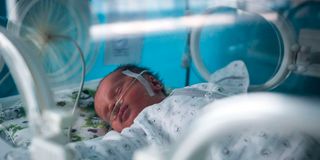
Apnea of Prematurity is a condition where premature babies experience brief pauses in breathing.

What you need to know:
- Warning signs of preterm birth include elevated blood pressure, draining of amniotic fluid, and bleeding before term.
- For women who attend regular clinics, a doctor can identify these signals early and provide sound medical advice and treatment.
When Ruphine Wekesa’s daughter was born prematurely, she had two hard choices: return to her new job after a short maternity leave or give it up to care for her fragile child. She chose her daughter.
She tells Nation it was a difficult decision, but she needed to take care of the baby.
Ruphine was diagnosed with a chronic hemorrhage when she was eight weeks pregnant. The bleeding persisted nonstop until the 17th week. When it finally stopped and she thought she was out of the woods, another complication arose at the tail end of the 28th week.
Admitted to the hospital, she was assured that bed rest would ensure everything was fine. Three days after she was told that she was doing well, her water broke at 29 weeks.
"I stayed in the hospital while doctors managed my condition," she tells Nation.
On the third day, she did a scan and was told to wait another week. The doctors gave her an injection to delay labour, but it only worked for three hours.
“I had a normal delivery, and my baby was immediately taken to the Neonatal Intensive Care Unit."
Initially, the nurses estimated a three-day stay, but Ruphine and her baby stayed in the hospital far longer. Every day held the threat of a new complication for her newborn, from sepsis to jaundice.
Ruphine says it was her first time seeing a baby in such a condition, and the experience was lonely as other new mothers would arrive, give birth, and go home sooner.
Her baby turned three in August, and she hopes her developmental parameters are great. She only struggles when the baby catches a cold, but they have since learned to manage it. Ruphine has also been taking the baby for physiotherapy, which has helped her learn to walk.
“We were told the baby would get over these complications, and that is the hope we have for now,” she says.
Ruphine is not alone. Eclay Mutemba, pressured by work, felt she had to ignore a doctor's order for bed rest during her lastborn child’s pregnancy. The consequence was a sharp back pain that triggered early labour at 34 weeks.
Her son, born in 2016 weighing just 800 grammes, was pale, dehydrated, and his lungs weren't functional. He spent nearly two months in the hospital, requiring a blood transfusion and specialised drugs sourced from India because they were not available in the country.
“That transfusion gave him back his life,” says Eclay.
Almost 10 years later, Eclay’s son has undergone one surgery, and he is due for a second one to correct an anomaly around his pelvic area.
Ruphine recalls her doctors warning her that preterm birth often comes with future health complications, advice that has proven true. Yet, there is much to celebrate. "He is hyper now and doing well in school," she says.
Ruphine and Eclay represent millions of mothers whose children are born before their time. On this World Prematurity Day, whose theme is to give preterm babies a strong start for a hopeful future, experts shed light on how best to take care of such babies.
Who qualifies as a preterm baby?
Dr Gideon Mutai, a medical officer at Gilgil Sub-county Hospital, explains that a baby is considered preterm if they are born before the end of 37 weeks.
In Kenya, care is mostly given to those who are above 28 weeks; those at 24 weeks or weighing 500 grammes often cannot be saved.
Why mothers need attention too
Dr Laura Oyiengo, a maternal newborn health specialist at UNICEF, states that the journey to a healthy baby begins with educating all women to prepare their bodies for pregnancy and birth. She emphasises the importance of regular clinic visits, which allow doctors to monitor how well a mother is coping with the changes of pregnancy.
“We need a healthy mother to carry a pregnancy to term, which results in a baby of good weight who has remained in the womb for the recommended nine months,” she explains.
She notes that warning signs of preterm birth can include elevated blood pressure, draining of amniotic fluid, and bleeding before term. For women who attend regular clinics, a doctor can identify these signals early and provide sound medical advice and treatment.
“At times, a woman is placed on bed rest to prolong the pregnancy, as a longer gestation leads to better outcomes for the baby,” she says.
She also recommends Kangaroo Mother Care, a technique where the diaper-clad baby is placed on the mother's chest. This skin-to-skin contact provides essential warmth and has been shown to increase infant survival rates.
A baby’s father or another close relative can also provide this care if the mother is in critical condition.
Dr Oyiengo adds that community health promoters are vital for following up with mothers of preterm babies and ensuring the infants are reviewed in case of any complications.
What happens behind the scenes when a baby is born prematurely
Dr Mary Waiyego, a neonatologist at Kenyatta National Hospital, explains the efforts taken to ensure a pre-term baby's survival.
She tells Nation that these babies are sometimes given medication to help mature vital organs, such as the brain and lungs.
She explains that once born, a preterm baby may be gently resuscitated using methods tailored for their delicate condition. To protect them from cold, they are swaddled in special polyethene wraps. Depending on their gestational age and condition, they are then admitted to either a High Dependency Unit or, if
critically ill, the Neonatal Intensive Care Unit.
She explains that most premature babies experience breathing complications. Treatment may include medication to support lung development and Continuous
Positive Airway Pressure, a form of breathing support that provides oxygen and helps keep the lungs inflated. For more severe cases, mechanical ventilation may be necessary, where a tube is inserted into the baby's trachea and connected to a machine.
“They are usually too fragile to breathe on their own and sometimes, they could even forget to breathe because their brain has not matured to know that it is time to breathe.”
At that age, their skin is too thin and may not have all the layers that can protect them from getting cold.
Dr Waiyego recommends that the mother's milk be given in small doses as clinicians monitor the baby's daily fluid requirements.
“Some babies get digestive complications, so we may have to pause and assess before resuming feeds,” she says.
At that time, the blood vessels in the brain are usually fragile, and they can break and cause bleeding. “We do surveillance to check if that (the breakage) has happened. We do everything to protect the brain,” she says.
She explains that premature babies are highly susceptible to infections, so they are closely monitored to prevent and quickly identify any signs of illness.
A baby is considered ready for discharge when it is generally healthy, has reached specific milestones like gaining sufficient weight, can feed by mouth, and can maintain its own body temperature. The mother's confidence in caring for her child is also a key factor.
Before leaving the hospital, the infants receive the standard vaccinations given to all newborns.
“When you discharge the babies, your point of contact does not end there because there are some things that we track to ensure that they are growing well,” she explains.
While this speciality is important for premature babies, it may not be available in all hospitals, and Dr Waiyego advises that hospitals in all counties should invest in infrastructure, equipment, personnel, training and empowerment of pregnant mothers.
“We need to have skilled and hospital deliveries. There is a need for data, and we should make decisions based on it.”
How has care changed over time?
Over the years, care for prematurity has changed to improve the infant’s quality of life. Dr Brian Maugo, a neonatologist lecturer at the University of Nairobi, tells Nation that there has been an improvement in the care of preterm babies.
He explains that hospitals now have better respiratory support such as the Continuous Positive Airway Pressure and surfactant therapy used for babies with respiratory issues. Unlike before, there are better-trained healthcare workers in neonatal care as well as improved infection prevention practices.
Dr Maugo explains that mothers at risk of preterm birth due to conditions like hypertension, diabetes, infections, a history of premature delivery, or complications like preeclampsia are often given antenatal steroids from 24 weeks gestation. This treatment helps accelerate the maturation of the baby's
lungs.
“It has also been shown to improve outcomes at birth and support long-term brain development,” he says.
Another key intervention is caffeine citrate. Dr Maugo explains that preterm babies often tend to forget to breathe due to their immature respiratory centre - apnea of prematurity-, and this can lead to poor outcomes. Caffeine citrate is administered to stimulate the brain's respiratory center and prevent these episodes.
However, among all these innovations, Kangaroo Mother Care has been the most revolutionary.
What does the government say?
Allan Govoga, programme officer in charge of Maternal and Newborn Health at the Health ministry, says to align with this year’s theme, it is important for pregnant mothers to start antenatal clinic as soon as they realise they are pregnant. He also emphasises the importance of skilled delivery for better outcomes for both mother and baby.
He says the government is improving maternal healthcare by equipping level 4 and above facilities with newborn equipment like Continuous Positive Airway Pressure machines, advocating to reduce the price of caffeine citrate, and introducing about four new guidelines and policies to ensure babies receive the best care.