Public hospitals on brink of collapse as nationwide strike set to begin on July 20

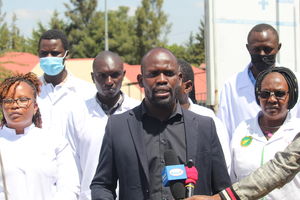
Kenya Union of Clinical Officers Chairman Peterson Wachira at a past event.

What you need to know:
- Grievances include job insecurity, unpaid risk allowances, and discriminatory grading practices.
Kenya’s public healthcare system is on the precipice of complete paralysis. Following months of simmering tension, the Kenya Health Caucus, comprising six medical unions, has officially declared that healthcare workers across all 47 counties will down their tools starting at midnight on Monday, July 20. This collective action threatens to shut down public medical facilities nationwide as workers demand immediate structural reforms, job security, and the honouring of long-delayed legal agreements.
The caucus is comprised of the Kenya Union of Clinical Officers, Kenya Environmental Health and Public Health Practitioners Union, Kenya National Union of Medical Laboratory Officers, Kenya Union of Nutritionists and Dieticians, Kenya National Union of Pharmaceutical Technologists and Professionals, and National Union of Biomedical Engineers of Kenya.
In a statement, the caucus chairperson, Peterson Wachira, said that despite clear and urgent demands issued by the Health Union Caucus on 15th June 2026 regarding the welfare and job security of healthcare workers, the Council of Governors (CoG) has persistently failed to acknowledge or act on these grievances. This administrative silence, he said, has left them with no other viable alternative.
At the core of the dispute lies a sense of betrayal over unfulfilled government commitments. Union leaders point to a persistent failure by the Ministry of Health (MoH), (CoG), and county administrations to absorb Universal Health Coverage (UHC) and Global Fund health workers into permanent and pensionable (PnP) employment, thereby perpetuating job insecurity and unfair labour practices.
He also cited pay accrued service gratuity to eligible UHC employees who have served under contractual terms for over six years, and to eligible Global Fund employees who have completed 24 months of contractual service, contrary to the applicable contractual terms and legitimate expectations
“On June 15, the health union caucus gave a strike notice to MoH and CoG. The National Assembly, together with the Senate, allocated the money to UHC staff from contracts to permanent and pensionable ones. One of our demands agreed with what CoG was pushing for, wanting the money as an equitable share as opposed to a conditional grant. We would like to thank President William Ruto and Health Cabinet Secretary Aden Duale because they have done their part in pushing for the UHC officers to be employed on PnP terms. The CS lobbied for this move after the President’s directive,” said Wachira.
Disturbingly, despite all conditions being fully met according to their requirements, they continue to refuse to issue the PnP letters to the 7,450 UHC workers. Consequently, the workers cannot access medical insurance, lack formal engagement with the counties they serve, and are in the dark regarding their contracts. With the payroll set to close, their salary status remains uncertain. Today, we reiterate that due to this inaction and delay, a strike appears inevitable. Workers have no other bargaining tool but their services,” added Wachira.
“CoG pushed for funds under equitable share. Disturbingly, despite all conditions being fully met according to their requirements, they continue to refuse to issue the PnP letters to the 7,450 UHC workers. Consequently, the health workers cannot access medical insurance. They also lack formal engagement with the counties they serve, and are in the dark regarding their contracts. With the payroll set to close, their salary status remains uncertain. Today, we reiterate that due to this inaction and delay, the strike appears inevitable. Workers have no other bargaining tool but their services,” added Wachira.
The unions also condemned CoG for failing to sign and execute the duly negotiated Collective Bargaining Agreement (CBA) on behalf of all county governments, and for not fully implementing the obligations contained in the Return-to-Work Formula dated January 28, 2026.
County governments had committed to signing the negotiated and concluded CBA by February 16. Under the agreement, county governments would pay clinical officers a monthly risk allowance of Sh5,000 during the 2025/2026 financial year, including arrears backdated to July 2025. From July 2026, at the start of the 2026/2027 financial year, the allowance was set to increase to Sh7,000.
The parties also agreed to the immediate implementation of the Salaries and Remuneration Commission (SRC)-reviewed remuneration structure under the third remuneration cycle, including the payment of all outstanding salary arrears by county governments. The parties also resolved that the absorption of Global Fund staff would be referred to the
Transition Committee established under the Intergovernmental Relations framework between the national and county governments. The committee was also tasked with considering the fate of UHC staff whose contracts were due to expire in April and May.
The agreement further provided that no clinical officer would face victimisation, intimidation or harassment, including the issuance of show-cause letters or the withholding of salaries, for participating in the industrial action or pursuing the grievances that led to the strike. Any disciplinary action previously taken against individual clinical officers or groups of officers in relation to the strike had been revoked and would be removed from their employment records.
As part of the return-to-work agreement, the Kenya Union of Clinical Officers agreed to immediately call off the strike. Union members who had participated in the industrial action that was then ongoing resumed duty immediately. However, despite the resumption of work, the CBA was not signed by the county governments.
“The strike is on, and we inform our members that on Sunday after midnight, we will not be expecting any health workers in facilities because CoG has failed to sign the agreement and implement the CBA agreement. This strike will be about enforcement and ensuring streamlining,” said Wachira.
The Kenya Union of Clinical Officers has also raised a major grievance regarding discriminatory grading practices. The union notes that authorities have failed to place newly employed clinical officers into the correct entry grade of job group J. Instead, they are allegedly still being appointed under the obsolete Job Group H, defying the Public Service Commission-approved 2024 Career Guidelines for Clinical Officers, which abolished the lower grade.
Representing the Kenya Environmental Health and Public Health Practitioners Union, Mohamed Ali condemned CoG for failing to act on their matters despite several pleas.
“Continuous refusal to comply leads to a breach of labour laws. This has created job insecurity and neglect that is no longer tenable,” said Ali, adding: “We demand immediate absorption of all eligible UHC and Global Fund health workers into permanent and pensionable terms of service, with the immediate issuance of appointment letters and immediate execution of the duly negotiated CBA by all county governments that have yet to sign and fully implement all obligations contained in the Return-to-Work Formula dated January 28, 2026.”
He also reiterated the demand to formalise and sign recognition agreements to facilitate lawful industrial relations processes. “We remain committed to constructive engagement and meaningful social dialogue aimed at amicably resolving these disputes,” added Ali.
With the clock rapidly ticking down to the July 20 midnight deadline, millions of Kenyans who rely on the public healthcare system now face the terrifying prospect of locked hospital doors and unattended wards.