The deadly cost of traditional cooking
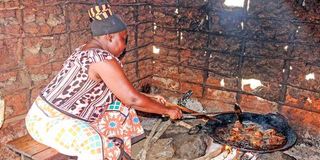
51-year-old Tabu Taura (Mama Sadiki) fries fish for sale at her business premises at Mavueni- Kilifi County on August 27, 2025. She has been using firewood for the last two decades, as this is the only affordable way to sustain her business and family. PHOTO BY WACHIRA MWANGI

What you need to know:
- This daily ritual, repeated in millions of Kenyan homes, is claiming more lives than malaria and HIV combined.
- According to the State of the Global Air Report, indoor air pollution led to approximately 23,000 deaths in 2020, ranking it the eighth leading cause of premature deaths in Kenya
As the first light spreads over Kilifi's horizon each morning, Mama Sadik lights her three-stone fire. Within minutes, thick smoke fills her small kitchen, stinging her eyes and choking her throat. What she doesn't see are the invisible killers dancing in that smoke—particulate matter smaller than a human hair, carbon monoxide, and toxic compounds that silently attack her lungs, heart, and blood with every breath.
This daily ritual, repeated in millions of Kenyan homes, is claiming more lives than malaria and HIV combined. According to the State of the Global Air Report, indoor air pollution led to approximately 23,000 deaths in 2020, ranking it the eighth leading cause of premature deaths in Kenya. Yet for mothers like Mama Sadik, a widow in Mavueni village who has sold fried fish for over two decades, the choice between survival and safety doesn't exist.
"I don't have a choice. If I could afford another way of cooking, I would. For now, firewood is all I can manage," she said, coughing between words—each cough a testament to years of breathing toxic air in her kitchen.
The smoke that fills Kenya's kitchens carries a deadly cocktail of pollutants. Household air pollution exposure leads to noncommunicable diseases, including stroke, ischaemic heart disease, chronic obstructive pulmonary disease (COPD), kidney problems, cancers, and even affects mental health and cognitive performance.
Willah Nabukwangwa, of the Clean Air Africa research program, explains that the air inside these homes is hazardous beyond imagination. "Indoor air pollution is not just about coughing. Our studies show it causes respiratory disease, heart conditions, kidney problems, cancers, and even affects mental health and cognitive performance. Right now, more than 26,300 Kenyans die each year from this pollution, a number that has risen by 4,000 in just four years."
More than 50 per cent of premature deaths due to pneumonia among children under five are caused by the particulate matter (soot) inhaled from household air pollution. The smallest particles, PM2.5, penetrate deep into the lungs and bloodstream, causing damage that accumulates over the years but can also strike within minutes.
"High levels of carbon monoxide can kill within seconds. Even brief exposure to extreme PM2.5 levels while cooking can trigger severe respiratory illness. This is a silent emergency in our homes," Nabukwangwa added.
The Weight of Tradition
A few metres from Mama Sadik's kitchen, Mama Hawe Lazima, in her late 80s, recalls a lifetime of the same struggle. Since childhood, she has known no other way to cook but over three stones and firewood. Even at her age, she still walks long distances to gather sticks, sometimes encountering snakes, sometimes collapsing from fatigue.
"It is what I grew up with. Food won't taste the same with those new stoves. I would rather die using firewood," she insisted.
Her words reveal one of the most entrenched barriers to clean cooking adoption in Kenya: cultural attachment to traditional methods. A significant barrier to adoption is stove designs that do not align with the cultural cooking traditions of the intended market. Many Kenyans believe that traditional cooking methods produce better-tasting food, and that modern alternatives cannot replicate the flavours achieved through wood-fired cooking.
This cultural resistance is compounded by practical concerns. Some stoves are not user-friendly, or not a good fit with the culture and cooking practices of the communities where they are introduced. It is difficult to convince users to change their cooking behaviours when the improved cookstoves are complicated and inconvenient.
Years back, Kilifi knew another face of struggle. Drought scorched the land, rivers ran dry, and crops withered in the fields. Families buried their dead as hunger stalked homesteads. Today, even as rains return in uneven patterns, many still depend on firewood and charcoal—not by choice, but because barriers to cleaner alternatives remain insurmountable.
The most immediate barrier is economic. Only 17 per cent of sub-Saharan Africans use clean cooking options, largely due to affordability constraints. For rural families living in informal settlements, refugee settings, or scattered villages where incomes are low and inconsistent, the upfront costs for cylinders, stoves, or electricity connections remain out of reach.
Dr. Faith Wandera, director of renewable energy in the Ministry of Energy and Petroleum, coordinates clean cooking programs but faces a fundamental challenge: "Kenya has no large-scale local manufacturing facilities for modern cookstoves. Most appliances—from LPG cylinders to electric pressure cookers and even biogas units—are imported, driving up costs. Bioethanol appliances exist, but fuel supply is still very limited."
Infrastructure presents another mountain to climb. Many rural areas lack reliable electricity supply, making electric cooking solutions impractical. Gas distribution networks are sparse, and even where available, the recurring cost of LPG refills strains household budgets already stretched thin.
The breakdown and malfunctioning of sustainable cooking methods, and the delayed or absence of a means of repairs, are some of the barriers to adopting sustainable cooking techniques. When modern stoves break down in remote areas, spare parts and technical expertise are often unavailable, forcing families back to traditional methods.
Gender and the burden of smoke
Women are disproportionately affected by traditional cooking methods, including those that use the three-stone open fire and metallic stoves, both of which are inefficient. Furthermore, women spend valuable time collecting firewood and in kitchens, bearing the brunt of household air pollution.
At the recent Clean Cooking Week exhibition in Kilifi, Nicholas Hare shared his frustrations as he watched his wife suffer. "When I'm at home, I see my wife suffer because of the smoke. She coughs and struggles to breathe. Sometimes I have to take her to the hospital. I just hope these new products will help us and reduce the illnesses."
Despite these challenges, momentum is building. GROOTS Kenya—a network of grassroots, community-based organisations—has found that by engaging its 3,000 women-led community-based groups, it is inspiring a broader female-led movement that advocates for safer and healthier cooking methods at both the household and policy levels.
Kilifi is one of three counties that have launched the clean cooking initiative. Governor Gideon Mung'aro, whose county has hosted the forum, insists the crisis demands bold solutions. "Our communities have faced drought, hunger, and now the health burden of unsafe cooking. That is why we are investing in solar-powered pumps, desalination plants, and clean cooking programs. Sustainable energy is not a luxury; it is a requirement for our growth."
The government's Clean Cooking Strategy is considering a subsidy program to help vulnerable households access clean cooking fuels and appliances. "It has not yet been rolled out, but it is in the action plan," Wandera noted.
The Alliance has been working with the Kenyan government, the Clean Cookstove Association of Kenya (CCAK), the Petroleum Institute of East Africa (PIEA), and other stakeholders to create a more supportive environment for the clean cooking sector.
Already, table banking groups, youth innovators, and partners are fueling the shift. Over 4,000 women have been trained as clean cooking champions in their villages, aligning with Kenya's vision of universal access to clean cooking by 2028.