‘We need to speak openly’: The battle to break Kenya's menopause stigma
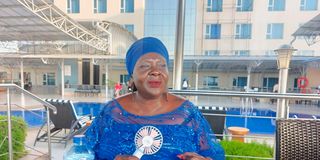
Menopause advocate Caroline Ojenge during an interview in Kisumu on January 6, 2026. Ms Ojenge is leading a campaign to break the cultural stigma surrounding the transition to menopause in rural communities.

What you need to know:
- The World Health Organization describes menopause as one point in a continuum of life stages for women, marking the end of their reproductive years.
- After this point, pregnancy is no longer possible, except in rare cases through specialised fertility treatments.
Under the clear afternoon skies of Kisumu, Caroline Ojenge stands out, elegantly dressed in a blue African kaftan with a matching scarf and dark shades. Yet, it is not just her fashion that draws attention. Seated at a rooftop poolside restaurant, a spot cooled by a coveted lake breeze yet challenged by the day’s scorching sun, Ojenge holds a portable fan close to her face. A second fan lies ready on the table.
Visibly in her late fifties, she smiles and admits the backup is for when the first fan loses power. “I have been experiencing hot flashes since my 55th birthday; the fans come in handy to cool my body temperature,” she says. This is despite the hotel rooftop offering a cool breeze, the kind anyone in the city would die for.
Once settled, the feminist-turned-teacher is ready to share her experience with menopause—a journey she says almost took a toll on her mental health.
The World Health Organization (WHO) describes menopause as one point in a continuum of life stages for women, marking the end of their reproductive years. After this point, pregnancy is no longer possible, except in rare cases through specialised fertility treatments.
Most women experience the stage between the ages of 45 and 55 years as a natural part of biological ageing. Menopause can also be a consequence of surgical or medical procedures.
The stage is characterised with sudden feeling of heat in the face, neck and chest, often accompanied by flushing of the skin, perspiration, also known as hot flashes, changes in the menstrual cycle, vaginal dryness, and difficulty in sleeping, mood swings, depression and anxiety.
Just a day prior to our interview, Ojenge, also an advocate on matters of menopause, had shared a short clip on her Facebook page on her experience and the reactions had been beyond what she had expected.
Many women admired her bravery speaking about a topic many of them shun.
“A number of women reached out to me on social media and phone calls asking for insights on how to navigate the stage. Some are also asking if I can speak about the same in the villages in vernacular language so I can reach women with poor academic backgrounds," she says.
Speak about it
What had prompted her to post the short clip, she says, was her experience with women who appeared to be on the stage but were not willing to speak about it.
One woman in her late 40s had hinted at feeling unwell; only upon further inquiry did Ojenge suspect the cause. Another friend confessed to avoiding intimacy with her partner for months because she felt irritated whenever he tried to touch her.
Ojenge, now 58, notes that menopause remains a neglected topic of conversation despite being a stage every woman will experience.
"In Luo culture, for example, a man cannot goyo dala—a phrase loosely meaning ‘establishing a home’—with a woman who has reached menopause, because she is no longer considered a woman," says Ojenge.
She adds: "In cases where a man has more than one wife, he may only stay close to his first wife if she is in menopause during the planting season, as tradition requires. Soon after, he leaves for the younger wife to satisfy his sexual desires."
For Ojenge, as for so many women, menopause arrived without warning. Initially, she had visited her gynecologist seeking treatment for fibroids due to constant bleeding.
After an examination, the doctor explained to the then 51-year-old that he would be placing her on medication that might make her feel "like a man."
"I didn't quite understand my doctor at the time," she recalls. "Weeks later, I returned having missed my periods. I also began experiencing occasional hot flashes." She adds that she was also dealing with persistent vaginal dryness.
The doctor clarified that these were the side effects he had mentioned earlier. He did, however, offer supplements to help manage the symptoms.
At age 52, her periods returned—this time with an unusually heavy flow. When they came, she would sometimes soil her seat, and wearing heavy, long clothing became her new normal.
Three years later, her periods ceased for good, but the hot flashes grew more frequent, eventually prompting her to carry a fan wherever she went.
Other changes followed: dry skin, weak bones, an easily irritated bladder, and discomfort with intimacy. “A man may not understand why you keep pushing his hands away. Some might think you are having an affair,” she says.
She also faced painful sex due to dryness, anxiety, mood swings, weak nails and hair, sagging skin, and a bulging abdomen. “At times I would look at myself in the mirror wondering how I got where I was.”
Ojenge credits her husband’s support as a turning point. He listened patiently and joined her in seeking medical and psychosocial help to navigate the transition.
Yet, her thoughts often turn to rural women without the same resources. “Menopause can be depressive. "Menopause can be depressive. Imagine going through body changes that you barely understand," she says. "You can no longer dress a certain way, go swimming, or interact with people as you once did—all because of what others might think."
She adds, jokingly: "I remember my parents had two beds in their bedroom, but I never quite understood why. After my own experience, I think I now understand why my mother didn’t want to share a bed with my father as they grew older."
During her outreach in rural communities, the advocate notes that some women revealed they now share a bed with their grandchildren to avoid intimacy with their partners.
Others confided that they felt compelled to submit to their spouses out of fear that they might otherwise remarry.
"During one discussion with a group of rural women about menopause, their questions poured forth relentlessly," she says. "Some wanted to know when to seek medication, what to eat, and how to manage the changes. Others, struggling with low self-esteem, asked for guidance on where to find psychosocial support."
According to WHO, the transition to menopause is often gradual, typically beginning with changes in the menstrual cycle. The period from when these signs first appear until one year after the final menstrual period is referred to as perimenopause.
Perimenopause can last several years and may affect physical, emotional, mental, and social well-being. A range of interventions—both hormonal and non-hormonal—can help alleviate its symptoms.
The global health agency emphasises that perimenopausal women require access to quality health services as well as supportive communities and systems.
“Unfortunately, both awareness and access to menopause-related information and services remain a significant challenge in most countries. Women may not know that symptoms they experience are related to menopause, or that there are counselling and treatment options that can help alleviate discomfort,” says WHO.
Ojenge notes that due to this limited information, women in rural areas often have nowhere to turn when they enter this stage. She adds that some women experience menopause at a younger age, which further exposes them to societal stigma.
The advocate now emphasiSes that it is time for the public to speak openly about menopause and to include women, even those in their early forties,in the conversation.
"We need to talk openly about menopause to boost women’s self-esteem and confidence, help them cope, and understand themselves better," she says.
She adds: “We must do more than just speak to middle-class women. We need to explain it in language they understand — embrace talk shows on local radio stations, allow women to talk and ask questions freely.”