12 months, 12 stories: How Kenya's health sector stumbled in 2025
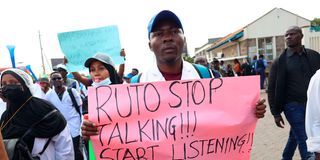
Kenya Medical Practitioners, Pharmacists and Dentists Union members participating in a demonstration in Nairobi.

What you need to know:
- The ordinary citizens who fought, sacrificed, and grieved within a system teetering on the brink provided the starkest indictment of the nation’s health failures.
- From a landmark court ruling in January to a constitutional crisis over a multibillion-shilling deal in December, the year delivered a relentless cascade of crises that exposed the fragility of a nation’s promise to care for its people.
The story of Kenya’s health sector in 2025 was not written by politicians or medical union officials. It was written in hospital corridors where mothers slept on benches, detained over unpaid bills.
In warehouses where billions of shillings worth of life-saving HIV drugs gathered dust. In the quiet despair of nurses who contemplated ending their lives after months without pay. And in the grief of parents who buried children the system failed to save.
The ordinary citizens who fought, sacrificed, and grieved within a system teetering on the brink provided the starkest indictment of the nation’s health failures.
From a landmark court ruling in January to a constitutional crisis over a multibillion-shilling deal in December, the year delivered a relentless cascade of crises that exposed the fragility of a nation’s promise to care for its people.
This is how it unfolded, month by month.
JANUARY: ATTEMPTED SUICIDE DECRIMINALISED
The year opened with a rare moment of progress.
On January 9, Justice Lawrence Mugambi delivered a historic ruling that declared Section 226 of the Penal Code unconstitutional. The provision, which had criminalised attempted suicide and subjected Kenyans to up to two years in prison, a fine, or both, was struck down in a decision that shifted the national approach from punishment to medical care.
“It is my finding that applying the purpose and effect principle of constitutional interpretation, Section 226 of the Penal Code offends Article 27 of the Constitution by criminalising a mental health issue, thereby endorsing discrimination based on health, which is unconstitutional,” Justice Mugambi ruled.
He further held that the law violated Article 28, which guarantees the right to human dignity, noting that criminalising actions “beyond their mental control” was degrading.
It also contravened Article 43, which enshrines the right to the highest attainable standard of health, including mental health services.
Mental health experts had long condemned the law, arguing that it stigmatised people living with mental health conditions and discouraged them from seeking help.
The petition was spearheaded by the Kenya National Commission on Human Rights and the Kenya Psychiatric Association, alongside mental health advocate Charity Muturi, who passed away before the ruling was delivered.
FEBRUARY: PRIVATE HOSPITALS SHUT THEIR DOORS
A slight reprieve had come in January with the distribution of 2.3 million doses of BCG vaccines. But by February, a new crisis erupted.
The Rural and Urban Private Hospitals Association of Kenya (Rupha) declared an indefinite suspension of services under the new Social Health Authority scheme, citing millions in unpaid claims and crippling financial distress.
“We cannot keep treating patients for free. SHA owes us millions, yet we have salaries to pay, drugs to buy, and bills to settle,” said Dr Brian Lishenga, Rupha chairperson.
A Rupha report painted a devastating picture. Seven out of 10 nurses in private and faith-based hospitals had been laid off due to delayed payments. The financial collapse led to the dismissal of 66 per cent of nurses and 56 per cent of clinical officers, forcing 82 per cent of hospitals to scale down operations or shut entire branches.
The chaos extended to patients. Those without national identification cards, like Kisumu resident John Ochieng, were turned away, unable to access care under SHA’s biometric verification rules.
Rupha further criticised the SHA’s proposed reimbursement model—less than Sh75 per outpatient per month—as unworkable. The breakdown of the new Universal Health Coverage scheme had begun.
MARCH: LIFE-SAVING DRUGS STRANDED IN A WAREHOUSE
In March, a shocking revelation emerged: an emergency consignment of life-saving HIV drugs valued at Sh4.4 billion had been sitting unused in a Nairobi warehouse since the previous year.
The drugs, procured under Pepfar, were desperately needed by patients already facing rationing of essential medication like dolutegravir. But distribution had stalled due to a foreign aid freeze—and critically, the Ministry of Health was awaiting a Sh1.2 billion allocation from the National Treasury simply to cover logistics costs for moving the commodities to the counties.
The delay put vulnerable lives at risk and exposed Kenya’s dangerous reliance on foreign donor funding. Pepfar funds 40 per cent of the country’s HIV drugs.
Life-saving medicine was available. A lack of political will and domestic funding kept it locked away.
APRIL: A DUAL EPIDEMIC STRIKES
The month brought a deadly convergence of two major disease outbreaks.
A Kala-azar (visceral leishmaniasis) outbreak, primarily affecting Wajir and Marsabit counties, claimed at least 33 lives nationally, with over 1,041 cases reported. Children under five were disproportionately affected, often arriving at overcrowded health facilities too late due to shortages of testing kits, drugs, and blood supplies.
Simultaneously, a cholera outbreak hit three counties. Mercy Akinyi, a resident of an informal settlement, detailed the appalling conditions—the lack of clean water and government neglect—that allowed the deadly but preventable disease to flourish in her community.
MAY: UHC FRONTLINE WORKERS IN CRISIS
The burden of a collapsing system fell heaviest on those running it.
Throughout May, Universal Health Coverage (UHC) workers, including nurses and Global Fund staff, staged protests outside Parliament demanding permanent employment, better conditions, and payment of outstanding arrears.
Mirriam Wachera, a UHC nurse who served on the Covid-19 frontline in 2020, shared a harrowing account of the toll. Employed on short-term contracts, she and her colleagues were overworked and looked down upon despite performing the same duties as permanent staff. “I fell into a deep depression and experienced severe anxiety,” Wachera recounted.
“I remember taking medication and thinking that if I overdosed, I would be free from pain. But I hesitated for my children’s sake.”
She confirmed that at least five UHC nurses from her cohort had died by suicide—a stark illustration of the mental health crisis gripping the nation’s medical workforce.
Their plea was simple: a pathway to permanent, pensionable employment. It went unheeded.
JUNE: CAMERAS FOR A CURE – A FATHER’S ULTIMATE SACRIFICE
By June, the promise of UHC had shattered against the reality that catastrophic spending remained the norm for Kenyan families facing severe illness.
Fredrick Ochieng’, a Nairobi-based filmmaker and photographer, embodied this devastating financial toll. His 13-year-old son, Bradley, was diagnosed with a brain tumour deemed inoperable in Kenya.
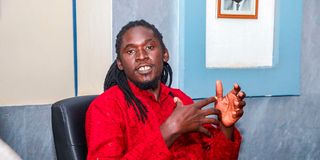
Fredrick Ochieng’, a filmmaker, during the interview at Nation Centre, Nairobi, on May 19.
Ochieng visited every major hospital, incurring out-of-pocket consultation fees of at least Sh8,000 at each—a total of Sh100,000 on consultations alone.
Faced with a system that had exported its best specialists and offered no access to complex care, he was forced to look abroad. His final act of sacrifice: selling his professional cameras to fund his son’s treatment in India.
Bradley, unfortunately, passed away in December.
JULY: THE ORGAN HARVESTING SCANDAL
The month brought a month of reckoning over a major organ trafficking scandal.
On July 22, Health Cabinet Secretary Aden Duale received a 313-page investigative report from a 13-member independent committee led by Prof Elizabeth Bukusi. The committee had been formed earlier in the year following allegations that Kenya had become a hub for transplant tourism.
The investigation, focused primarily on Mediheal Hospital in Eldoret, uncovered a coordinated scheme involving illegal organ donations, falsified identity documents, and inflated medical fees. Brokers had targeted impoverished young men, promising up to Sh1,000,000 for a kidney but often paying between Sh50,000 and Sh300,000 after surgery.
Many recipients were wealthy foreign nationals, notably from Israel and Somalia. Surgical teams often included foreign doctors, primarily Indian citizens, operating outside Kenyan labour and medical laws.
Kidney transplant services at the Mediheal Group of Hospitals remained suspended throughout July. The committee recommended immediate investigations and potential criminal charges against Dr Swarup Mishra, the founder of Mediheal.
Duale suspended Dr Maurice Wakwabubi, the then acting head of the Kenya Blood Transfusion and Transplant Services, and other technical leads suspected of oversight failures.
Victims who testified before the National Assembly Health Committee reported lifelong health complications, including chronic pain and inability to perform manual labour, leaving them in deeper poverty than before donating.
The government used the report to fast-track the Kenya Policy on Blood, Cells, Tissues, and Organs, establishing a centralised registry, enforcing the Relationship Rule requiring proof of family ties between donors and recipients, and stiffening penalties for transplant tourism under the Health Act.
AUGUST: STRANDED ABROAD
The Social Health Authority created a bureaucratic nightmare for critically ill Kenyans seeking treatment abroad—a service previously streamlined under the National Hospital Insurance Fund.
Investigations by Nation revealed that documentation requirements for overseas medical travel had skyrocketed from five to 26 documents.
Anne Nyambura, requiring a life-saving Sh4 million liver transplant in India, detailed her ordeal. Despite meticulously compiling the paperwork and travelling with the promise of a payment guarantee, she found herself abandoned by SHA, with no communication and the threat of surgery delays or discharge detention looming.
Even more tragic was the case of Baby Chloe Agnes Nyang’au, a 10-month-old requiring urgent congenital heart surgery unavailable in Kenya. Although treatment was approved, SHA issued a Beneficiary Commitment Form promising only Sh500,000 of the Sh1.625 million cost—then failed to honour the guarantee and went silent, leaving the family stranded abroad.
CS Duale admitted that the Benefits Package and Tariffs Advisory Panel had not yet gazetted a specific list of covered overseas services. Yet he suspended all overseas medical travel for 30 days, effectively trapping critically ill Kenyans in a system that offered no viable alternatives.
The list of services was gazetted in September.
SEPTEMBER: 15 MONTHS WITHOUT PAY
The plight of healthcare workers reached breaking point, highlighted by the story of Lucy Kigumo, a clinical officer employed under the Global Fund TB Programme.
The last time Lucy received a salary from the Ministry of Health was June 2024–15 months earlier. Lucy and 90 colleagues working in county facilities had been caught in a bureaucratic tug-of-war following the transition of their programme from the Global Fund to the Kenyan government. Despite an agreement to absorb them into permanent roles, National and County governments stalled, each citing the other’s lack of funding or payroll data.
Lucy, a frontline worker treating up to 50 contagious tuberculosis patients daily, recounted surviving on her partner’s income while the government owed her at least Sh1 million in unpaid salary.
Most devastatingly, she revealed the crisis had claimed a colleague’s life.
“Due to this mental and financial strain, one of my colleagues took her daughter’s life and then committed suicide.”
OCTOBER: INFANT DEATHS MOUNT AS DOCTORS STRIKE
The month became the deadliest for Kenya’s most vulnerable.
As the Kiambu County doctors’ strike stretched into its 127th day, Kiambu Level 5 Hospital confirmed that 118 babies had died between January and September 2025. Parents came forward to reveal the circumstances of the deaths, accusing the hospital of medical negligence.
Dr Davji Atellah, Secretary-General of the Kenya Medical Practitioners, Pharmacists and Dentists Union, directly linked the rising deaths to the absence of specialists, delays in treatment, and a lack of essential emergency drugs.
NOVEMBER: DETAINED OVER HOSPITAL BILLS
In November, the cruel reality of healthcare financing was exposed through the practice of patient detention.
Nancy Akoth, 35, arrived at Mama Lucy Kibaki Hospital bleeding and in pain, only to learn she was miscarrying. After treatment, she was discharged with a Sh15,030 bill.
Because she had not registered for SHA and could not pay, she was held captive.
Nancy was one of over 100 women detained at the facility, forced to share beds or sleep on benches. She was freed only after former Governor Mike Sonko cleared her debt alongside 29 other mothers in a Sh2.2 million gesture. Nairobi Governor Johnson Sakaja later cleared a further Sh7 million for 65 additional women.
Hospital CEO Frederick Obwanda denied detention, calling it an attempt to ensure financial viability and urging citizens to register for SHA. But the story of Tabitha Atieno underscored the devastating human cost. She lost her newborn daughter at the same hospital and was subsequently detained over a Sh39,000 bill—before her baby was buried by the hospital.
DECEMBER: A MULTIBILLION-SHILLING DEAL IN LIMBO
Kenya’s health sector closed the year at the centre of a high-stakes legal and diplomatic drama.
On December 4, in Washington DC, Prime CS Musalia Mudavadi and US Secretary of State Marco Rubio signed a $2.5 billion (Sh322 billion) Health Cooperation Framework alongside
President William Ruto. The deal promised a direct infusion of $1.6 billion from the United States over five years, bypassing traditional NGO intermediaries to fund state agencies directly. It aimed to move nearly 14,000 health workers onto the permanent public payroll and stabilise the fight against HIV/Aids, malaria, and tuberculosis while providing financial backbone for the Social Health Authority.
By mid-December, the deal hit a wall at the High Court in Milimani, Nairobi.
In petitions led by Senator Okiya Omtatah and the Consumers Federation of Kenya, critics argued that the executive had overreached, negotiating a secretive deal without the public participation required by Article 10 of the Constitution.
Justice Bahati Mwamuye and Justice Chacha Mwita issued conservatory orders that effectively froze the agreement.
Omtatah argued that by committing Kenya to match funding with $850 million of its own money, the government had created a massive extra-budgetary obligation without parliamentary approval.
The most explosive element involved what critics called a “Data for dollars” trade-off. The agreement requires Kenya to digitise health records and provide real-time access to epidemiological data and pathogen samples. Consumers Federation of Kenya warned that once sensitive medical data—including genomic information and HIV statuses—is shared with foreign entities, the harm to privacy is “permanent and irreversible.”
Government officials fought back. Principal Secretary for Medical Services Ouma Oluga argued that only de-identified, aggregated data would be shared and that the deal actually strengthens Kenya’s sovereignty by moving control of health commodities from foreign NGOs back to government.
As the year drew to a close, the standoff had created a deep rift. Medical unions, including KMPDU and Kuco, threatened legal action to lift the freeze, warning that the court’s intervention could collapse ARV supply chains and trigger mass layoffs of frontline workers.
Civil society maintained that no amount of funding justifies bypassing the law or risking the private data of millions.
The case is set for a major showdown in February 2026, leaving the Sh322 billion deal and the 13,800 jobs attached to it suspended in judicial uncertainty.