40 years of healing the sky: Kenya's next frontier in the ozone fight
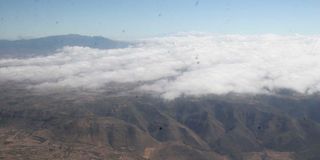
An aerial view of Eastern escarpments of Rift Valley in Kijabe area showing massive land degradation blamed on depletion of ozone layer causing extreme weather conditions.
What you need to know:
- Forty years ago, the world agreed to protect the ozone layer and created the International Day for its preservation, celebrated every year on 16 September.
Without the ozone layer, life on Earth would not be possible. This vital shield protects us from harmful ultraviolet radiation and keeps our planet habitable.
On 16 September, Kenya celebrated World Ozone Day at Michuki Memorial Park under the theme “40 Years of the Vienna Convention: From Science to Global Action”.
Forty years ago, the world agreed to protect the ozone layer and created the International Day for its preservation, celebrated every year on 16 September.
Also read: All you need to know about the ozone layer
This year also marks four decades of the Vienna Convention and the Montreal Protocol – a global success story that shows how science, technology and political will can solve even the biggest environmental challenges.
Germany and France are proud to support Kenya in protecting the ozone layer and tackling climate change through the PROKLIMA programme, implemented by GIZ in cooperation with the Kenyan Ministry of Environment, Climate Change and Forestry.
The cooling conundrum and the green solution
Cooling is essential to modern life. Fridges keep our food safe, supermarkets depend on cold storage, and air conditioners make homes, offices and hospitals comfortable. But traditional cooling systems release gases that damage the ozone layer and heat the planet. As demand for cooling rises, emissions rise too – creating a vicious circle of hotter weather and even greater demand.
Green Cooling offers a way out. It combines highly energy-efficient appliances with natural refrigerants that neither harm the ozone layer nor significantly contribute to climate change. Germany through GIZ supports Kenya with policy advice, technology transfer and practical training so that technicians, companies and consumers can adopt these sustainable solutions.
The results are already visible. Since 2010, more than 1,000 Kenyan refrigeration and air-conditioning technicians have been trained in the safe handling of natural refrigerants. Fifteen technical training institutions now educate their own trainers to spread this knowledge nationwide. Kenya has even become a regional hub: two “training of trainers” courses brought together refrigeration experts from 12 African countries to learn safe installation of modern air-conditioning and refrigeration systems using the natural R290 refrigerant.
To make these trainings practical, 16 partner institutions have been equipped with modern technology – including air conditioners, fridges, freezers and chillers that use natural gases, as well as refrigerant recovery units, recovery cylinders and vacuum and charge kits.
Also read: Global temperatures crossed critical 1.5°C milestone for the first time in 2024 – new report
Border controls are equally important. Over 200 customs officers from the Kenya Revenue Authority, the Customs Service Department and the National Environment Management Authority have been trained and provided with special analysers to identify refrigerants and stop illegal imports of ozone-depleting substances. Beyond technicians and customs, Germany through GIZ also supports the Energy and Petroleum Regulatory Authority in developing and updating Minimum Energy Performance Standards for household appliances. These standards help Kenyan households save energy, reduce costs and cut emissions.
This technical cooperation is part of a much broader climate and development partnership between Germany and Kenya, with current commitments of around 450 million euro. The partnership strengthens Kenya’s progress towards its Nationally Determined Contributions under the Paris Agreement. It supports mitigation measures—such as renewable energy, green hydrogen and e-mobility—and adaptation projects, including climate-resilient and environmentally friendly agriculture.
Together, we aim to accelerate Kenya’s path to net-zero emissions while increasing resilience to the impacts of climate change.
The Montreal Protocol proves that global challenges can be overcome when science, technology and political action come together. Germany looks forward to continuing its close cooperation with Kenya to promote Green Cooling technologies and protect the ozone layer. Everyone can contribute: choosing energy-efficient appliances, maintaining air conditioners responsibly, or supporting policies that protect our climate. Small actions in kitchens, supermarkets and offices add up to a big difference.
By working together—governments, businesses and citizens—we can ensure that the success of the Montreal Protocol is only the beginning. Let us safeguard the ozone layer, slow climate change and create a healthier planet for our families today and for future generations.
The author is the head of Development Cooperation of the German Mission to Kenya, Somalia and the Seychelles