Abandoned in hospital wards: The heavy toll on Kisumu’s forgotten babies
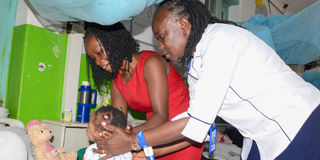
Mary Adongo, an occupational therapist, and Salome Situma (right), nurse and head of the paediatric department, tend to an abandoned baby at Kisumu County Referral Hospital.

What you need to know:
- Each year the hospital is forced to provide care for numerous newborns; some with disabilities or birth defects, and others who are healthy but have been abandoned at the facility.
- The longest time a child has remained abandoned in the facility, she says, was one year. That child, who was later reunited with her family after efforts to transition her to a children’s home failed, passed away two months later.
Dressed in white lab coats, a team of medics makes their rounds in the paediatric ward of Kisumu County Referral Hospital, moving from one bed to the next with practised routine.
Unlike a room typically filled with playful children, this ward is wearily silent; missing the usual laughter, jumps, and excitement of young ones.
Tucked in a corner, one-year-old Nancy* (not her real name) holds adorably onto her doll.
After completing their rounds, one of the medics picks up the baby, who smiles when called by name, for a routine session of occupational therapy. She is one of several infants for whom the hospital has become an unintended long-term home, their stays stretching from months to over a year due to abandonment.
According to the facility’s head of paediatric ward Salome Situma, baby Nancy, who was abandoned at the facility by her father, was born with cerebral palsy, a neurological disorder that appears in infancy or early childhood and permanently affects body movement and muscle coordination.
For the last four months, the hospital's paediatric ward has been home to the baby, with staff ensuring she receives the care necessary for her development.
Ms Situma notes that the baby was brought to the hospital by her father, who expressed frustration over raising his daughter alone.
During counselling, the child's father revealed that the baby's mother had left the family when Nancy was only six months old, citing an inability to care for the child.
The father, who lived in Mombasa and worked menial jobs for survival, moved to Kisumu after losing his job in search of better opportunities. While there, he visited the facility with a request for the child to be moved to a children's home until he could regain stability.
“During the consultation, the baby’s father excused himself as if to take a call; and that was the last time we ever saw him,” says Ms Situma.
Efforts to trace the father have failed to yield results in the four months since his disappearance, the nurse explains.
She further reveals that transitioning the baby to a children's home has been hindered by several challenges, including the lack of the father’s consent to proceed.
“We are hoping to do what is necessary to facilitate the baby’s swift transition,” says Ms Situma, adding that the baby’s continued stay in the facility also carries health risks and other challenges.
According to the health expert, the baby is constantly vulnerable to infections whenever new patients are admitted.
This, she says, has led to the baby contracting several airborne and bacterial illnesses, which have compromised her health.
Furthermore, the infant misses out on maternal bonding, while the constant care required from hospital staff also disrupts normal hospital operations.

Rebecca Okinda, a nutritionist, weighs one of the babies abandoned at Kisumu County Referral Hospital.
Nancy is not alone.
In the hospital's newborn and maternity wards are infants aged one and three months, born to mothers with mental health conditions.
Sophia Asha, a medical officer in the paediatric ward, says one of the newborn's mother was brought to the facility by a well-wisher during her eighth month of pregnancy.
After giving birth, the mother has been unable to breastfeed, forcing the hospital to seek supplementary milk supply.
Consistent nutrition
“We depend heavily on well-wishers to supply infant formula for the baby. Sometimes it also falls to us to go out of our way to provide for her,” says Ms Asha, explaining that this reliance also compromises the child's consistent nutrition.

Ms Sophia Asha, a medical officer in the paediatric ward, during the interview.
The health expert notes that on numerous occasions, staff are forced to carry the baby with them during medical rounds, a practice that also increases her risk of exposure to infections.
Ms Asha also reveals that toward the end of last year, a young mother abandoned her newborn in the hospital’s maternity ward and disappeared.
Fortunately, the young mother had used her own mother’s Social Health Authority registration card, which made tracing her whereabouts possible.
“It wasn’t until we called the number left in the registration book that we realised the name she had used was not her own, but her mother’s,” says Ms Asha.
Four days later, when the newborn’s mother finally returned to the facility, she revealed that she had felt unable to raise the child due to economic hardship and believed abandoning the baby was her only option.
She explains that she was already struggling to raise two other children, who were being cared for by their grandmother.
“After counselling, she agreed to take her child back home. We haven’t conducted a follow-up yet, but we hope the baby is now in good hands.”
According to Ms Situma, each year the hospital is forced to provide care for numerous newborns; some with disabilities or birth defects, and others who are healthy but have been abandoned at the facility.
The longest time a child has remained abandoned in the facility, she says, was one year. That child, who was later reunited with her family after efforts to transition her to a children’s home failed, passed away two months later.
“One of our biggest challenges is the process of transitioning these newborns to children's homes. There is often a lot of back-and-forth with the authorities, and sometimes it takes up to a year before a child is relocated to their new home,” she explains.
She adds that these children are also frequently left without adequate care during healthcare workers' strikes.
Ms Situma shares this while revealing that the department is now planning to launch a programme called “Don’t Dump a Baby,” aimed at raising awareness at the community level.
Dr Elizabeth Kuta, a paediatric expert at Aga Khan Hospital in Kisumu, says cases of child abandonment in health facilities remain common across the country, especially in public hospitals.
While some children end up staying longer in hospitals when born to mothers with mental health conditions, others are abandoned for reasons such as teenage pregnancy, incest, financial pressure from the high cost of living, or birth defects, among other factors.
When left in facilities at the neonatal stage, she explains, hospitals are often forced to shoulder the responsibility of caring for the newborn.
“In the absence of breast milk, facilities must switch to formula, and in some cases, babies may even be introduced to cow’s milk;compromising their health,” she says, adding that this added responsibility comes at an extra cost to the hospital.
The expert says staying at the hospital also exposes newborns to nosocomial infections, putting their health at risk.
This, she explains, may result from interacting with other hospitalised children in the wards or being handled by healthcare providers who are also attending to sick patients.
“The children are likely to be exposed to pneumonia, meningitis, candida, and other infections, which can turn fatal due to their low immunity,” says Dr Kuta.
She adds that these children are also at risk of losing emotional attachment due to separation from loved ones. While hospital staff may step in to help, they are not in a position to provide care in the same way a mother would.
“The children are likely to face challenges with attachment that may affect future relationships, and some may develop behavioural disorders,” says Dr Kuta.
She adds that the children’s growth monitoring may not be optimal, and instead, they may end up struggling with malnutrition if not properly nourished.
Other challenges include a lack of exposure to sunlight due to confinement in hospital wards, and the inability to play, which can contribute to delayed developmental milestones, including speech and motor skills like walking.
These children, she explains, also tend to mature prematurely as a coping mechanism in a stressful environment, which may lead to behavioural issues, including being violent.
The health expert emphasises that to address the growing number of cases, there is a need for awareness campaigns to reduce teenage pregnancies and for the economic empowerment of women.
She also states that hospital paediatric departments should be strengthened to improve the effectiveness of child placement, whether through children's homes or adoption, to prevent children from overstaying in hospitals.
“Our health facilities should also be supported in creating dedicated spaces for abandoned babies, separate from general wards, where they can receive proper nutrition, have access to a play area, and get medical support while awaiting transition.”


