Africa's agroecology push faces uphill battle as climate deadline passes

Dr Million Belay (centre), the general coordinator of the Alliance for Food Sovereignty in Africa, among other delegates following proceedings at the second Africa Climate Summit in Addis Ababa, Ethiopia on September 9, 2025.

What you need to know:
- Only five African countries, including Kenya, submitted their updated climate commitments by the early 2025 deadline; leaving 48 nations scrambling to include agroecology in their plans before November's crucial UN climate talks in Belem, Brazil.
As delegates gathered for the second Africa Climate Summit in Addis Ababa, Ethiopia, a sobering reality emerged: Africa may be losing its chance to reshape global climate negotiations around its own farming practices.
Only five African countries, including Kenya, submitted their updated climate commitments by the early 2025 deadline; leaving 48 nations scrambling to include agroecology in their plans before November's crucial UN climate talks in Belem, Brazil.
"We're running out of time," said Dr Antwi-Boasiako Amoah, the incoming chairperson of the Africa Group of Negotiators, speaking on the summit sidelines. "If we can't get agroecology into our national plans, we'll never get it onto the COP30 agenda."
The summit, which started on September 8, ends today.
The $50 billion challenge
At stake is Africa's ability to champion farming methods that don't rely on expensive imported fertilisers and pesticides; a shift that threatens lucrative business interests in developed countries.
Africa currently imports over $50 billion worth of synthetic farm inputs annually from developed nations, making any push toward locally-produced organic alternatives a potential threat to established trade relationships.
"I see very strong resistance from developed countries because conventional agriculture benefits them very much businesswise," Amoah explained. "These benefits are hardly talked about in the negotiation rooms, but they drive the politics behind closed doors."
The resistance isn't just economic - it's procedural. For agroecology to gain traction at international climate talks, it must first appear in countries' National Adaptation Plans (NAPs) and Nationally Determined Contributions (NDCs) - the formal climate commitments each nation submits to the UN.
Missing the moment
A comprehensive review by the Alliance for Food Sovereignty in Africa reveals the scale of the challenge: only 22 per cent of African NDCs and 19 per cent of NAPs currently mention agroecology explicitly.
"This study exposes a critical gap in policy integration," said Dr Million Belay, the Alliance for Food Sovereignty in Africa’s general coordinator. "We cannot talk about climate adaptation and mitigation in Africa without talking about agroecology."
The timing couldn't be more critical. With COP30 scheduled for Belem from November 10-21, the window for influencing global climate finance is narrowing. Once negotiations begin, it's too late to introduce new priorities.
"If we can get between 20 and 50 countries fronting agroecology in their NAPs and NDCs, then negotiators will have to report on the subject," Amoah said. "Once it finds itself in the synthesised report, it will automatically attract international attention."
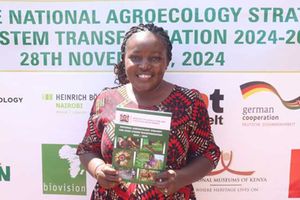
Kenya's National Agroecology Strategy for Food System Transformation, launched in 2024, acknowledges that current food systems "are not sustainable and are unable to sufficiently meet the needs of our growing population."
At the county level, Murang'a and Vihiga have already launched agroecology framework policies, creating legal mandates to incentivise locally-produced organic farm inputs.
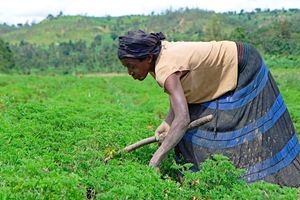
The approach promotes soil health through composting rather than synthetic fertilisers, encourages farmer-saved seeds instead of expensive hybrids, and supports crop diversification over monoculture - practices that research shows can improve biodiversity, water regulation, and soil carbon while buffering temperature extremes.
The business case
Success in getting agroecology recognised at COP30 would unlock access to major climate finance facilities like the Green Climate Fund, enabling governments to fund large- scale production of organic farm inputs and farmer training programmes.
But the path forward requires unprecedented continental coordination. With 43 African countries still working on their climate commitments, advocates are racing against time to build the critical mass needed to influence global negotiations.
"Most things we discuss in negotiation rooms have political inclinations, economic implications, and social connotations," Amoah noted, citing the US President Donald Trump administration's previous withdrawal from the Paris Agreement due to fossil fuel interests. "The same dynamics apply to agriculture."
As the November deadline approaches, Africa's climate negotiators face a choice: continue importing expensive farm inputs that degrade soil and increase dependency, or unite behind homegrown solutions that could reshape both agriculture and climate finance.