Another chance to fix the plastic crisis. Will Geneva talks deliver?
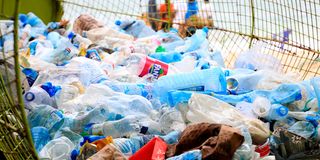
A plastic recycling point at the Nyali Public Beach in Mombasa.

What you need to know:
- The world leaders are attending the second part of the fifth session of the Intergovernmental Negotiating Committee (INC 5.2) that will run from Tuesday to August 14, 2025
In Geneva, Switzerland
At the heart of the ‘Peace Capital’, delegates from more than 170 countries are gearing up to hammer out a possible agreement that will potentially end plastic pollution globally.
They are attending the second part of the fifth session of the Intergovernmental Negotiating Committee (INC 5.2) that will run from Tuesday to August 14, 2025.
The United Nations Environment Program (UNEP) calls plastics pollution a global problem.
A 2024 update from the International Union for Conservation of Nature (IUCN)shows that every year, about 460 million metric tons of plastic are produced, and out of that number, an estimated 20 million end up polluting our environment.
This number will go up by 2040 if nothing is done by governments around the world.
On the eve of the start of the negotiations, there was a sense of calm at the Palais des Nations where negotiators trickled in to set the stage for the talks.
The talks happening in Geneva, Switzerland, are the second part of the fifth session in a two-year UN treaty-drafting process that will address plastic pollution across its full lifecycle.
It all started in Kenya’s capital, Nairobi, during the fifth session of the United Nations Environment Assembly (UNEA) when countries passed a historic resolution which was adopted to develop an international legally binding instrument on plastic pollution, including in the marine environment.
The whole process was to end by 2024.
Last year, however, while there was swelling hope that the government would finally ink a deal in Busan, South Korea, there was a disappointing end to the negotiations. It resulted in the postponement of the treaty to this year.
The world now waits, and a decision will be made over the next couple of days.
Kenya, together with 54 other countries, will be represented by the Africa Group of Negotiators (AGN), sharing a common voice that will speak on behalf of the people in Africa.
A report released last week on countries’ positions on the Global Plastics Treaty by the Centre for Science and Environment shows that Kenya proposes that a plastic product under consideration should meet 'all' criteria requirements rather than 'any'.
Kenya asks the reviewing committee to develop an initial list of plastic products along with its justification.
Kenya also wants a baseline study to be done on the levels of production within its national jurisdiction to inform a reduction schedule for the production of plastic.
Griffins Ochieng, Executive Director of the Centre for Environment Justice and Development (CEJAD), said in a press statement that the negotiations are an opportunity for Africa to assert its position, protect its people, and shape an ambitious, legally binding treaty that delivers real, systemic change.
“Let this treaty reflect the lived realities of our people, not the boardroom interests of petrochemical companies as witnessed over the past negotiations,” he said.
In 2017, Kenya banned the use of plastic bags and extended this to all single-use plastics in protected areas such as the National Parks, forests and beaches.
“Kenya’s single-use plastic ban showed that policy works, but real progress requires going beyond recycling to tackle the root cause: overproduction. A binding global treaty must shift us from managing plastic waste to ending plastic waste,” said Fredrick Njau, Programme Coordinator, Sustainable Development Programme, Heinrich-Böell Foundation.
Gerance Mutwol, a Plastics Campaign Manager, Greenpeace Africa, told the Nation yesterday that Africa has to seize this moment to lead because he believes that the stakes are higher this year.
“Now more than ever, countries must set aside national interests and come together to forge a treaty that is not only ambitious, but truly fit for purpose, one that can confront the unchecked plastics production and call for an urgent reduction in plastics production and tame the health risks from the toxic chemicals in plastics,” he said.
He added that African Negotiators should not lose sight of the real impacts their decisions will have globally.
“The continent is disproportionately affected by plastic pollution despite contributing the least to its production. As they sit in Geneva, they should remember that back home our communities and ecosystems are suffering the consequences of plastic pollution from health risks and degraded ecosystems,” Gerance said.
“With over 1.5 billion Africans set to be either positively or negatively impacted by the outcome of this treaty, their decisions carry immense weight. The time for ambition is now, the world is watching, and Africa must speak with one strong, unified voice,” he added.