Cash only: Private hospitals cut off civil servants over SHA debt crisis
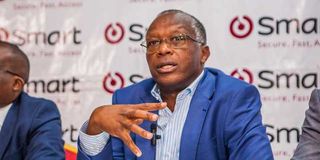
Kenya Healthcare Federation Chairperson Kanyenje Gakombe speaks during a past event in Nairobi. The federation says private hospitals will now ask civil servants to pay in cash.

Private hospitals across the country will no longer treat civil servants unless they pay in cash following the government’s failure to release payments over nine months.
All civil servants, except teachers and police officers, will be required to pay in cash to access services at all private health facilities if the Social Health Authority (SHA) and the Health ministry do not intervene.
In a letter dated August 7, the Kenya Healthcare Federation (KHF) informed SHA Chief Executive Officer Mercy Mwangangi that private healthcare providers can no longer sustain the financial burden of treating public servants without compensation from the government’s health insurance scheme.
“Unless the outstanding claims are settled per the contractual terms, providers will have no choice but to request that public servants pay for both past and future medical bills directly, and then seek reimbursement from their employers and/or the SHA,” wrote Dr Kanyenje Gakombe, the chairperson of the federation.
KHF said it’s unable “to sustain credit to public officers”, marking a potential turning point in the relationship between private healthcare providers and the government’s health insurance scheme.
Kenya Healthcare Federation Chairperson Kanyenje Gakombe speaks during a past event in Nairobi. The federation says private hospitals will now ask civil servants to pay in cash.
The federation, the health sector’s board of the Kenya Private Sector Alliance, works with commercial healthcare facilities, professional associations and non-State healthcare firms.
The letter was copied to the leaders of major healthcare associations, including the Christian Hospital Association of Kenya, Rural and Urban Private Hospital Association (Rupha) and Kenya Association of Private Hospitals, and the Kenya Conference of Catholic Bishops’ health services, dental associations and pharmaceutical societies.
“Provider records show that the above-mentioned scheme has not substantially, or at all, settled claims since its inception nine months ago,” wrote Dr Gakombe.
The federation explained that the prolonged non-payment has pushed private healthcare facilities to their financial limits.
Own resources
“Providers can no longer fund the scheme using their resources, including savings, bank facilities and supplier credit,” the letter states, highlighting how hospitals have been forced to use their own resources to continue serving public servants.
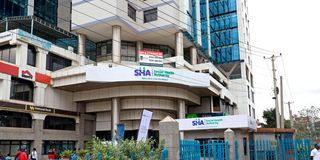
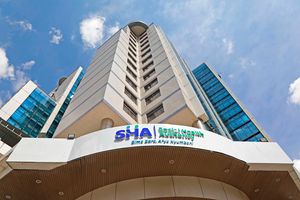
Under its newly established Social Health Authority (SHA), Kenya is rolling out social health insurance financed by both tax revenues and individual/household premium contributions.
The situation, the federation said, has created an unsustainable burden on private healthcare providers who initially agreed to participate in the scheme based on expectations of timely payments. They say continued participation threatens their operational viability.
Also Read: The good, the bad and SHA: Hits and misses of Kenya’s universal healthcare plan, one year on
Despite the harsh ultimatum, the federation emphasised that the decision was not taken lightly.
“While providers deeply regret having to take this course of action, it remains the only viable option to ensure they remain operational and accessible, not just to public officers, but to all patients,” the letter states.
In an email conversation seen by the Nation, Dr Mwangangi responded to the providers on Thursday, saying that the authority is working on the payments.
“Dear Providers, this communication is well noted. SHA is engaging to fast-track all payments for adjudicated and approved claims,” Dr Mwangangi wrote.

Former Health Chief Administrative Secretary (CAS) Dr Mercy Mwangangi.
Health Cabinet Secretary Aden Duale had earlier claimed the ministry did not have the correspondence, but promised to engage with the affected facilities.
During a press conference at Afya House yesterday morning, Mr Duale took issue with the federation’s letter being shared with the media.
“Let that person go to the CEO’s office and inform them of the problem. We don’t conduct our internal communication through press conferences. If the facility has not been paid, let them engage SHA directly.
Not appropriate
“It is not appropriate for them to address us through Nation Media. We have seen you bringing patients to your media house—turn the media house into a health centre, we will register you, give you a portal and deal with your claims,” Mr Duale said, while reprimanding the Nation reporter who had asked the question.

Health Cabinet Secretary Aden Duale.
Responding to Dr Mwangangi’s email, Dr Gakombe indicated that the government needs to fund its share of the universal health coverage (UHC) wallet.
“We are all committed to UHC. We take cognisance of the fact that UHC can only succeed if it’s properly funded through different participants. SHA requires funds. We as members and beneficiaries must fund it directly through contributions or indirectly through taxes,” he wrote.
He added: “Providers need funding, too, to deliver their mandate. We prefer to be paid from and by SHA or other pooling mechanisms such as private insurance or occupational schemes. We hope that the government and members will enable SHA to purchase services for its millions of members.”
Dr Brian Lishenga, the chairperson of Rupha, said that the government has not made any remittances to hospitals since SHA started.
“The government is one of the reasons why SHA is underfunded. They are not paying—this is the irony of life in this country. You just see these people full of lip service,” he said.
The Public Officers Medical Fund, managed by SHA, differs slightly from the Social Health Insurance Fund in terms of coverage limits. SHA continued with the limits previously under the National Health Insurance Fund (NHIF).
Own scheme
He explained that despite civil servants having their own negotiated scheme through their unions, the government does not remit their SHA contributions or their scheme payments.
“They are hit twice. The scheme has not paid SHA; therefore, hospitals have not been paid. Hospitals have been treating civil servants for free, and still, we are being called criminals,” Dr Lishenga said.
Under NHIF, the annual bill from hospitals used to be between Sh3.5 billion and Sh4 billion.
“The hospitals are owed that amount in under nine months,” Dr Lishenga said. “Healthcare has to be funded; if the system fails, then the provider has to revert to individual payments. This is the only way.”
Meanwhile, SHA has suspended 40 health facilities from the national health scheme over alleged fraud. The suspended facilities are in Nairobi, Homa Bay, Bungoma, Kakamega, Vihiga, Busia, Kajiado, Wajir, Kisumu, Kilifi, Mandera and Kirinyaga.
Dr Mercy Mwangangi said the facilities would not be entitled to any benefit from SHA during the period of their suspension.