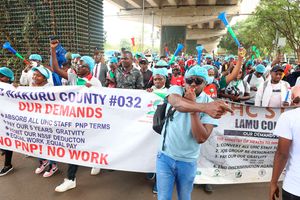
Caught in the middle: Governors finger Duale in fresh feud over 7,000 UHC workers
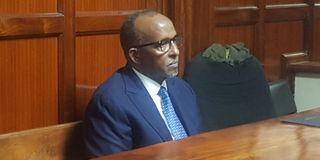
Health CS Aden Duale in the dock at Milimani High Court on June 23, 2026.

The fight over more than 7,000 Universal Health Coverage (UHC) workers has stopped being a labour dispute and turned into a straight-up turf war between counties and the national government, with the workers themselves stuck watching from the sidelines.
The Council of Governors and the Ministry of Health have spent the past week trading accusatory letters over who is responsible for absorbing the workers into permanent and pensionable employment, a promise that has now dragged on for six years. Governors accuse Ministry officials of overstepping their mandate; the Ministry accuses counties of sabotaging health services. In between, another round of correspondence has produced nothing but more waiting for the workers.
"If the national government respected all the agreements that we have heard in respect to UHC workers, there would be no health workers on the street but in hospitals attending to sick Kenyans," said Ahmed Abdullahi, Chair of the Council of Governors.
"The challenge we are having is that there is a mismatch between the mode of financing and the kind of contract they want us to give the UHC workers."
On July 21, 2026, a day before UHC workers were due to hold a fresh demonstration, Dr Jane Imbunya, Principal Secretary at the State Department for Public Service and Human Capital Development, wrote to PS Medical Services Dr Ouma Oluga confirming that more than 7,000 UHC staff had been transferred to their respective county governments and that payroll data was ready for integration.
"This State Department is committed to providing technical assistance to ensure a smooth transition of the UHC staff," Dr Imbunya wrote, adding that it was awaiting the respective county governments to verify and integrate the staff into their payrolls.
PS Oluga then wrote to the County Public Service Boards, asking them to integrate UHC workers on permanent and pensionable terms across the various counties.
Mombasa Governor AbdulSwamad Nassir, who chairs the Health Committee at the Council of Governors, fired back with a rebuttal letter that left no room for ambiguity on the counties' position.
"We wish to state that the proposed central transfer of payroll is not practical until outstanding matters relating to availability of resources for payment of salaries by county governments are addressed conclusively. Until that is done, migration of payroll data by the Ministry of Health to respective county governments will not be tenable," Nassir wrote.
He went further, questioning whether a Principal Secretary even has the constitutional authority to instruct county governments on employment matters.

Council of Governors vice chairman Ahmed Abdullahi (left) with Homa Bay Governor Gladys Wanga (centre) and Kakamega's Fernandes Barasa.
"Translating the UHC staff's terms of service to permanent and pensionable terms remains the mandate of county governments through their respective County Public Service Boards. This mandate cannot be unilaterally exercised by the Principal Secretary through a letter."
Abdullahi put it more bluntly: "A PS has no powers to instruct governors. How can a PS instruct county public service boards to put people on the payroll yet there is no allocation? He has no such powers. They do not seem to understand their roles."
The Council has since instructed County Public Service Boards to disregard the Ministry's letters altogether, a direct institutional standoff that leaves UHC workers with nowhere to turn.
At the heart of the dispute is a financing problem both sides acknowledge but neither has resolved. Health Cabinet Secretary Aden Duale announced in April 2026 that all UHC workers would be converted to permanent and pensionable employment starting July 2026, funded through the Division of Revenue Bill. He said Cabinet had approved the terms and the Salaries and Remuneration Commission had signed off on the pay structure.
Governors say the funding architecture does not match that employment promise. "They want us to absorb UHC workers as permanent and pensionable in counties, but they have only provided the money for one year under the County Government Additional Allocation Act, which is yet to be assented to," Abdullahi said.
The distinction matters: a conditional grant, which is what counties currently receive, can be withdrawn, but a permanent employment contract cannot. Governors say they are effectively being asked to make an open-ended commitment on the back of a one-year, non-guaranteed funding line.
"The money is there; they sent Sh9 billion. All we are saying is that instead of giving it to us for one year as a conditional grant, give it through the Division of Revenue Act, which can be amended so that this money is available in coming years. We will then have no issue giving UHC workers permanent contracts," Abdullahi said, calling instead for the conditional grant to be converted into equitable share, money that is constitutionally guaranteed to counties and cannot be unilaterally withdrawn by the national government.
Until that happens, he said, no letter from a PS will move the Council. "We will not allow the PS to intimidate counties by writing letters to us. We are not answerable to them."
The UHC workers were hired during the Covid-19 pandemic on short-term contracts and promised permanent absorption as the country transitioned from NHIF to SHA and built out its Universal Health Coverage infrastructure. That promise has been renewed, renegotiated and deferred so many times that the workers have developed a precise scepticism about every new announcement.
They have been on strike since June 30, 2026, demanding what was promised back in 2020: gratuity payments set at 30 per cent of their basic salary, and a permanent employment contract that does not expire.
UHC workers are not the only health workforce issue counties are managing. Abdullahi also addressed the Kenya Medical Practitioners and Dentists Union's threat of a doctors' strike, saying the Council had obtained the necessary codes from the Ministry of Public Service to pay doctors above what HR systems previously allowed.
"Beginning August, we will start paying doctors the CBA rates as agreed. We know there is an element of arrears. We were waiting for a special code from the Ministry of Public Service because it was taking those doctors above what was in the HR system. We have waited one year to allow us to pay the agreed rates. We have obtained it. We will pay it."
He closed with a warning to those advocating for the return of health services to national government control, a proposal that has gained traction as county health systems face sustained criticism
"The solution is not to return the health docket to the national government. In any case, national government hospitals are not run any better than county government hospitals. To take health back to the national government requires a referendum, and it is Kenyans who can do that, not us. Let every person keep their part of the bargain, put the money where we have agreed it should be paid, and we will pay the UHC workers."
Follow ourWhatsApp channel for breaking news updates and more stories like this.