CEPI unveils Sh322bn plan to protect the world against future pandemics
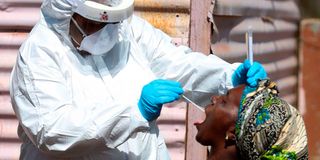
A doctor administers a Covid-19 test. During the pandemic, the world paid the price of not being prepared.

What you need to know:
- During Covid-19, the world paid the price of not being prepared.
An ambitious five-year strategy aimed at transforming how the world prepares for and responds to epidemic and pandemic threats has been unveiled.
Announced by the Coalition for Epidemic Preparedness Innovations (CEPI) in Oslo, Norway, the plan, dubbed CEPI 3.0, calls on governments, philanthropies, and global partners to invest Sh322.5 billion ($2.5 billion) to strengthen the planet’s disease defences ahead of the strategy’s 2027 launch.
This development comes as health experts warn that the threat of large-scale disease outbreaks is growing.
Research suggests the likelihood of another pandemic comparable to Covid-19 within our lifetimes is significant, with global economic losses from future pandemics estimated to average more than $700 billion annually.
Recent outbreaks of Nipah, Ebola, Chikungunya, and Marburg have served as stark reminders that the world remains vulnerable.
“During Covid-19, the world paid the price of not being prepared,” said Dr Richard Hatchett, CEO of CEPI. “Science offers us a solution: by taking decisive action now, we can secure a safer future for all.”
At the heart of CEPI 3.0 is the organisation’s flagship 100 Days Mission—an ambitious goal to develop safe, effective, and accessible vaccines against a novel virus with pandemic potential within just 100 days of it being identified.
Modelling suggests that had this been achievable at the outset of Covid-19, more than eight million lives could have been saved and trillions of dollars of economic damage avoided.
To achieve this, CEPI 3.0 is built around three interconnected priorities. First, the plan aims to develop vaccines targeting both known and emerging threats, advancing work on dangerous pathogens like Lassa, Nipah, and Rift Valley fever while building scientific knowledge across the viral families identified by the World Health Organization as having pandemic potential.
This foundational research is designed to give scientists and health authorities a critical head start when a new pathogen emerges.
Second, CEPI will accelerate the development of rapid-response vaccine platform technologies and embed them with regional manufacturers worldwide.
By working closely with regulators in advance, the goal is to ensure that when a new threat appears, vaccine development, manufacturing scale-up, and regulatory review can all happen far more quickly and equitably than they did during Covid-19.
Third, the strategy will invest in strengthening and stress-testing global scientific networks so they can be rapidly activated in an emergency.
As part of this, CEPI aims to secure access to one to two billion doses of regional manufacturing capacity to enable a fast and geographically fair outbreak response.
“CEPI is a global R&D champion and, for Africa, its 100 Days Mission is transformative. Our partnership with CEPI helps Africa to strengthen our surveillance capacity so we can detect outbreaks early and put in place the infrastructure to develop and manufacture safe and effective vaccines that make Africa and the world safer,” said Dr Jean
Kaseya, director-ceneral of the Africa Centers for Disease Control and Prevention.
Since its founding less than a decade ago, CEPI has supported more than 50 vaccine candidates, co-led the COVAX initiative that delivered nearly two billion Covid-19 vaccine doses, and contributed to scientific breakthroughs across a range of dangerous pathogens.