Clinical officers: This is why we are on strike
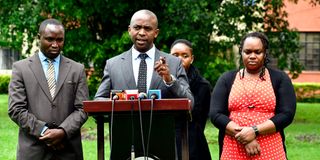
Kenya Union of Clinical Officers national chairman Peterson Wachira (centre) and other officials address journalists outside the union’s offices yesterday. They called on the government to offer the staff contracted under the Universal Health Care programme permanent jobs and to immediately post all interns.

What you need to know:
- Speaking on Fixing the Nation on NTV, Kenya Union of Clinical Officers (KUCO) Chairman Peterson Wachira criticized the government for locking clinical officers out of the Social Health Authority (SHA) claims approval system, despite their crucial role in dispensaries, health centres, and outpatient services.
- He explained that this exclusion prevents them from accessing the SHA platform to offer care under Universal Health Coverage (UHC), forcing patients to pay out-of-pocket for services that should be covered.
Clinical officers across the country have downed their tools, demanding immediate inclusion in the Social Health Authority (SHA) system and the implementation of their Collective Bargaining Agreement (CBA), citing systemic exclusion that has left many Kenyans unable to access affordable healthcare services.
Speaking on Fixing the Nation on NTV, Kenya Union of Clinical Officers (KUCO) Chairman Peterson Wachira criticized the government for locking clinical officers out of the Social Health Authority (SHA) claims approval system, despite their crucial role in dispensaries, health centres, and outpatient services.
He explained that this exclusion prevents them from accessing the SHA platform to offer care under Universal Health Coverage (UHC), forcing patients to pay out-of-pocket for services that should be covered.
Mr Wachira further noted that the government’s decision to use the Kenya Medical Practitioners and Dentists Council (KMPDC) as the sole accreditor under SHA has sidelined thousands of clinical officers, nurses, and other health professionals.
As a result, clinical officers cannot process claims, meaning patients seeking treatment in dispensaries and health centres are left with no choice but to pay cash or endure long delays in accessing care.
“A patient needing urgent care at a dispensary is now forced to pay or travel miles to a bigger hospital, yet we are qualified and available, take, for instance, a woman suffering complications after a miscarriage. A clinical officer at a nearby dispensary can provide immediate post-miscarriage care (MVA), but because we are locked out of SHA, she is either forced to pay or referred to a distant hospital—risking her life in the process. This is happening every day, and it's unacceptable, “he said.
He notes that despite handling over 90 percent of patients in public health facilities, clinical officers say they have been deliberately locked out of SHA, preventing them from offering essential healthcare services under Universal Health Coverage (UHC).
“Many Kenyans seeking treatment in dispensaries and health centres are being forced to pay cash for services meant to be covered. We are the backbone of primary healthcare, yet we are blocked from the SHA system. This is a deliberate move to frustrate us and deny Kenyans affordable care,” said Mr Wachira.
He further emphasised the impact of this exclusion on patients, many of whom rely on clinical officers as their first and often only healthcare providers.
“Imagine a mother walking into a dispensary with her sick child, expecting to be treated under UHC, only to be told she must pay because the clinical officer available cannot access SHA. This is unacceptable. Kenyans are being denied essential healthcare, not because we lack capacity, but because of deliberate policies meant to frustrate us,” he added.
He further highlighted how the exclusion is crippling critical procedures such as cataract surgeries, which are primarily performed by clinical officers.
“We have trained professionals ready to restore vision for thousands of Kenyans suffering from cataracts, yet they are being denied access to the SHA system. What this means is that people who could be treated today are left to suffer in darkness simply because of bureaucratic bottlenecks and vested interests,” he said.
KUCO alleges that powerful figures within the Ministry of Health and SHA are deliberately excluding clinical officers to monopolize healthcare services and divert patients to private hospitals.
“The cartels that looted NHIF are now running SHA. They are manipulating the system to ensure only their facilities and professionals receive funds,” Mr Wachira claimed.
The union has also accused the Ministry of Health (MoH) and county governments of breaching the return-to-work agreement that ended their 99-day strike last year.
The deal included key commitments such as a Collective Bargaining Agreement (CBA), promotions for clinical officers, comprehensive medical cover, and the confirmation of UHC clinical officers and those on short-term contracts into permanent and pensionable positions.
However, Mr Wachira says that despite signing the agreement, the government has failed to implement these provisions, leaving clinical officers with no choice but to resume their strike.
“We are done with negotiations. The law is clear—implement it. We want to see our names in the SHA system and our CBA signed, or the strike continues. This discrimination and exclusion has been occasioned by the blatant, illegal, and unreasoned refusal by SHA to recognize the facilities and practitioners registered and licensed by the Clinical Officers Council, “he said.


