Day 48 of public health officers' strike leaves Kenya exposed to El Nino epidemics

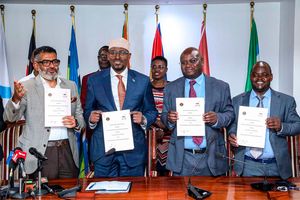
Brown Ashira, national secretary- general and CEO of the Kenya Environmental Health and Public Health Practitioners Union. He has criticised the government's heavy focus on hospital-based, curative healthcare at the expense of community prevention, noting that public health officers are treated as "a poor cousin of the health sector."

What you need to know:
- The professionals tasked with preventing waterborne epidemics, inspecting food, and containing outbreaks before hospitals are overwhelmed.
As the Ministry of Health assures the nation that Kenya is fully prepared for the impending El Niño rains, the country's primary defence line against mass disease outbreaks is virtually unmanned.
Public health officers and community health officers, the frontline professionals tasked with preventing waterborne epidemics, inspecting food, and containing outbreaks before hospitals are overwhelmed, are now 48 days into a nationwide strike. As heavy rains threaten low-lying areas and informal settlements, union leaders warn that the ongoing standoff leaves the country dangerously vulnerable to preventable outbreaks of cholera, dysentery, malaria, and severe diarrhoeal diseases.
Also read: Revealed: Where El Niño will hit hardest
"They must stop lying to themselves that public health officers are working. We are not working. We are on strike. God forbid if anything happens... but we are still there waiting," said Brown Ashira, national secretary- general and CEO of the Kenya Environmental Health and Public Health Practitioners Union (KEHPHPU).
While doctors and nurses treat patients inside hospital walls, public health officers operate outside them, acting as a preventive shield to keep communities from falling ill in the first place. During major climate events like El Niño, their role shifts from routine regulation to active emergency outbreak response.
The essential mandate of Kenya's public health officers spans a wide spectrum of preventive care and emergency mitigation. They lead rapid response efforts, execute contact tracing, and handle risk communication during disease outbreaks. In the face of flooding, these officers map high-risk zones, investigate disease vectors, and manage community sanitation to stop waterborne pathogens and malaria from spreading.
Their daily duties also encompass critical food and environmental safety checks, such as sampling maize for aflatoxins, testing vegetables for pesticide residues, and enforcing water safety standards across municipal supplies. Inside healthcare facilities, they maintain biosecurity by enforcing infection control, managing toxic medical waste disposal, inspecting occupational safety, and authorising the legal disposal of unclaimed bodies under the Public Health Act.
These officers now find themselves forgotten at the precise moment they are needed most. The dispute underscores a deep systemic bias within Kenya's healthcare model, which heavily prioritises curative care over preventive infrastructure.
"We are the neglected cadre. Actually, the word 'neglected' is a bit soft. We are the forgotten cadre. We are the underestimated cadre," Ashira emphasised, pointing to a critical staffing shortage. Kenya currently relies on just 4,200 public health officers for a population approaching 50 million, with only 110 stationed at the national level, a team facing an imminent staffing cliff as many near retirement by 2028.
"By 2028, we are going to have a crisis at the national level because the majority of those 110 officers will retire," Ashira warned. "Unless we act now, the CBA negotiations must address employment directly to fix these acute shortages at both county and national levels."
Ashira criticised the government's heavy focus on hospital-based, curative healthcare at the expense of community prevention, noting that public health officers are treated as "a poor cousin of the health sector."
"It is a very unfortunate scenario," Ashira said. "When the President established two separate state departments, one for Medical Services and another for Public Health, it seemed like an opportunity, yet the priority imbalance remains. We have been on strike for over 46 days, counting down, and the government
still hasn't seen the need to engage us."
At the centre of the deadlock are long-standing grievances over pay, job security, and professional recognition. Public health officers receive a monthly risk allowance of just Sh2,000 to Sh3,000, compared to up to Sh15,000 for nurses and Sh50,000 for doctors.
"The risk doesn't choose a cadre. The risk is spread across, and all of us are exposed. It should be harmonised across the board," Ashira argued, adding that because preventive work stops illness before it reaches the clinic, its impact is far too easily overlooked.
"Health doesn't just begin at the hospital gate. It begins before the gate, in the food we eat, the environment we live in, and the air we breathe," said Ashira.
Ashira also issued a 14-day ultimatum regarding proposed regulations that would require the Director General of the Kenya National Public Health Institute (NPHI) to hold a clinical medical degree.
"They are clinicalising public health mandates. Proposing that the head of NPHI must be a medical doctor is a fallacy. What surgery is taking place at the National Public Health Institute? There is no clinical work there. If they do not revise that report, we will withdraw all our colleagues from the institute and leave it entirely to the doctors," Ashira noted.
He added that many officers hired on temporary Universal Health Coverage contracts during the height of the Covid-19 pandemic in 2020 have still not been confirmed as permanent and pensionable staff.
Mohamed Ali, KEHPHPU national treasurer and a practising public health officer, dismantled arguments that preventive work carries lower biological risks than bedside clinical care, sharing personal experiences of on-the-job exposure:
"The exposure is not theoretical. During Covid-19, I contracted the virus while conducting contact tracing in the field and was isolated for weeks. Even outside hospitals, we are publicly exposed," said Ali.
Ali also highlighted the constant threat of bloodborne pathogens during hospital waste oversight.
"When you suffer a needlestick injury during waste management, you can't wait for test results; you must start post-exposure prophylaxis (PEP) immediately for four weeks. This alone justifies our demand for fair risk allowances," said Ali.
Pushing back against ministry assertions that Kenya's health system is prepared for El Niño without frontline officers active in the field, Ali emphasised that outbreak control cannot happen from an office.
"When floods hit, cholera, dysentery, diarrhoeal diseases, and malaria surge. Mitigating these threats requires field-based epidemiology, outbreak investigations, and immediate containment," said Ali.
Vincent Sunda, organising secretary of the National Association of Community Health Officers, shed light on grassroots challenges, explaining how donor dependency and flawed funding structures cripple preventive efforts. Though recognised as the foundational tier of care under the Primary Health Care Act of 2023, community health functions remain starved of direct state investment.
"For a very long time, community health has depended on donor funding, making the programme unsustainable," Sunda said, pointing out that officers routinely monitor households with Multidrug-Resistant Tuberculosis without uniform risk compensation.
"County support is completely fragmented. Some counties don't offer any risk allowance to officers handling infectious cases in the field," said Sunda.
Sunda criticised health financing frameworks like the Facility Improvement Fund Act, which allocate funds based on hospital admissions rather than community wellness.
"By channelling money to facilities based on patient numbers, we implicitly reward hospitals for having sick patients rather than keeping communities healthy. Everyone agrees prevention is better than cure, yet we refuse to resource prevention," said Sunda.
Sunda also warned of regulatory gaps in training and persistent logistical shortfalls on the ground.
"Private colleges are offering unaccredited six-month courses marketed as pathways to health jobs, leaving graduates stranded because the recognised minimum training period is two years. Meanwhile, field supervisors are expected to oversee vast regions without basic transport or equipment," he explained.
To break the 46-day deadlock and deploy frontline defences before El Niño rains peak, union leaders have laid out a clear set of demands. They are calling for the immediate issuance of permanent and pensionable employment letters for all public and community health staff on temporary Universal Health Coverage contracts. Furthermore, they demand a harmonised risk allowance that standardises monthly risk pay across all health cadres to accurately reflect shared workplace hazards.
The unions are also pressing for the urgent negotiation and execution of pending Collective Bargaining Agreements to address cost of living allowances and improve overall working conditions. On a systemic level, the leadership is demanding a reallocation of national health budgets to ensure preventive public health is given equal priority and funding alongside curative hospital care. Finally, they insist on amending the qualification criteria for the NPHI Director General post so that it remains open to public health, laboratory, and environmental health specialists.
Directly addressing official claims of emergency readiness, Ashira urged government leaders to meet them at the negotiating table without delay.
"Health Cabinet Secretary Aden Duale must step out of his comfort zone and engage public health union leadership. The government must stop telling itself that public health officers are working. We are not working; we are on strike," Ashira stated.