Deadly price of sand: How mining boom is claiming lives and land
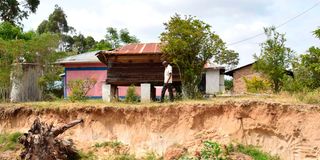
Phillip Bussani at the edge of his homestead in Manza Village, Machakos, where the land has been carved away by adjacent sand mining.

What you need to know:
- In Manza Village on the outskirts of Machakos Town, youthful miners now descend on farmlands in their pursuit of sand, having depleted the local riverbeds amid a booming trade.
- Environmentalists have put authorities on the spot as uncontrolled sand harvesting degrades farmland and triggers bloody conflicts between miners and farming communities.
A fresh grave stands at the homestead of Virginia Kanini in the sleepy Ivumbuni Village, Machakos County; a poignant reminder of her second-born son, Stephen Kioko, who died six months ago while mining sand nearby. The family remains devastated.
“Kioko was supposed to be working in Qatar by this time. We had made all the arrangements,” Kanini tells Healthy Nation. “He loved his dogs.”
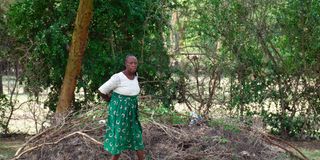
Virginia Kanini stands near the fresh grave of her son, Stephen Kioko, in Ivumbuni Village. He died when a sand pit collapsed on him.
Kioko, 34, had been expected to pick up his son from a local nursery school that fateful afternoon. Instead, he joined sand miners in River Miw’ongoni, which snakes through the village. When the preschooler arrived home, he threw a tantrum. “He loudly wondered why his father had not come to pick him up from school as he always did,” Kanini recalled.
The growing appetite for sand nationwide has fuelled reckless mining in Machakos County, claiming another victim and leaving Kanini’s family in anguish. The peasant farmer now believes the team of miners working with Kioko denied him a fighting chance by fleeing when the sand pit collapsed on him. He was pulled out lifeless.
Kioko’s death is a recurring tragedy in a county where the sand trade has become a major revenue source. According to residents, at least three other miners have died in similar collapses near the same spot in the last two years. Kioko’s death, however, prompted a significant reduction in mining locally after village elders firmly opposed the activity. Yet, across the wider county, unchecked sand harvesting continues to intensify.
In Manza Village on the outskirts of Machakos Town, youthful miners now descend on farmlands in their pursuit of sand, having depleted the local riverbeds amid a booming trade. Environmentalists have put authorities on the spot as uncontrolled sand harvesting degrades farmland and triggers bloody conflicts between miners and farming communities.
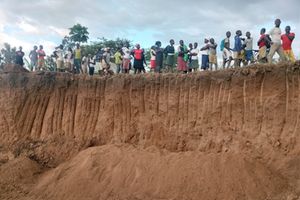
The practice has prompted intense outcry over ruined roads, damaged water systems, exposed graves, and gaping gullies that leave houses dangling precariously.
“When it rains, we are marooned for days and sometimes weeks as the pits left behind by sand miners fill with water,” said Phillip Bussani, whose homestead in Manza is among those on the verge of collapse. “We are appealing to anyone with soil and debris from construction sites to dump it here to make our neighborhood livable again.”
Machakos leaders are well aware of what is required to address the sand mining crisis. Take Kalama MCA Maeke Musyimi, an agriculture and biosystems engineer, who links the rampant harvesting to increased water scarcity from drying rivers.
Also read: Illegal sand harvesting ravages Kitui rivers
“Machakos enacted a sand Act in 2014 to regulate mining and trade, but the law is ineffective without supporting regulations,” he told Healthy Nation. “In truth, we don’t necessarily need new laws to fix this environmental mess; we need political will, starting with the governor.”
He pointed to Mwala Constituency as a success story, where MP Vincent Musyoka has led the fight against uncontrolled sand harvesting. At the peak of the crisis in 2016, Musyoka even threatened to arm residents with bows and arrows to deter miners. The bold strategy proved effective, making reckless sand mining in Mwala a thing of the past.
Kathiani Deputy County Commissioner Mary Kamau has added her voice to those pressuring Machakos Governor Wavinya Ndeti to rein in unregulated sand harvesting. “Wanton sand mining undermines ongoing environmental restoration efforts,” she stated recently.
Meanwhile, a team of researchers from Maseno University, the United States International University (USIU) in Nairobi, and the University of Gothenburg in Sweden has linked the rampant sand harvesting in Machakos and across the country to a booming sand trade. This surge is driven by President William Ruto’s affordable housing programme, other major infrastructure projects, and the poor regulation of the lucrative industry. Their three-year study on the challenges facing Kenya’s sand sector was inspired by a 2019
United Nations Environment Programme report that raised global alarm over diminishing sand resources.
“Any promise of maendeleo (development) rests upon the availability of vast quantities of sand. As the essential ingredient in concrete, sand is the unacknowledged foundation of modernity. Yet it is routinely overlooked, its status as a strategic resource unrecognised. Until recently, sand occupied only a marginal place in discussions about natural resources, mineral extraction, and their links to conflict or climate change. It falls outside the usual categories that gauge a resource’s potential for conflict: it is neither precious nor rare. Morever, sand lacks the allure of diamonds or gold and is not viewed as a critical mineral for the green transition, like cobalt, lithium, or manganese.”
“On the contrary, most regard sand as a mundane material—seemingly ubiquitous and extracted merely for domestic used as a ‘construction mineral,” states a section of the sand study report seen by Healthy Nation.
The study on the sand industry, led by Prof Kennedy Mkutu of USIU, Dr Michael Owiso of Maseno University, Dr Jan Bachmann of the University of Gothenburg, and Dr Bernard Musembi Kilaka of both Gothenburg and Maseno University, underscores the urgent need for proper regulation in managing sand resources.
“In the counties, with the exception of Makueni, legislation on sand harvesting is either absent, unimplemented, or unenforced,” notes a section of the research report.
“Environmental regulatory mechanisms are overwhelmingly ineffective, and the licensing of sand mining sites is erratic and incomplete. Consequently, much of Kenya’s sand harvesting operates outside existing regulations.”
The researchers further point to the National Environment Management Authority , which they found has limited capacity to regulate sand harvesting and trade. They also identified a fundamental conflict of interest between national and county governments as a major barrier to enforcing existing laws.
“While the national government is concerned with environmental protection and security, county governments oversee natural resources but depend on cess revenue from sand transport,” the researchers note.
To address these systemic failures, the study calls for harmonising the various laws governing riparian zones, including those related to wildlife, land, forests, and agriculture, to enable coordinated and effective management of sand resources.