Employed Kenyans bear crushing SHA burden as millions dodge levy
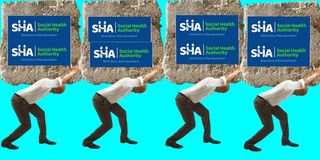
Kenyan workers in the formal sector have found themselves shouldering the Social Health Authority's financial burden.

Burdened salaried workers are financing Kenya's Social Health Authority (SHA) almost single-handedly whilst the vast majority of the workforce dodges contributions, latest data reveals.
This month alone, just 70,793 formal sector workers contributed Sh5.9 billion of the Sh6.7 billion collected by the authority. Meanwhile, 187,727 informal sector members—from a pool of 16.7 million eligible workers—managed only Sh780 million in contributions.
The stark disparity exposes a fundamental flaw in the system designed to achieve universal health coverage. According to Kenya National Bureau of Statistics data, the informal sector represents 83 per cent of the country's workforce, totalling 19.9 million workers compared to just 3.1 million salaried employees.
Sh150 billion gap
Dr Ouma Oluga, a health financing expert, explains that Kenya's total health expenditure of approximately Sh500 billion annually leaves a persistent funding gap even after government budget allocations.
"Even after accounting for all government budgets, medical insurance payments, and social insurance contributions, we still face a deficit of Sh150 billion," Dr Oluga said. "This shortfall traditionally becomes out-of-pocket expenditure, with salaried employees bearing the burden through harambees and direct payments."
Under the SHA system, formal workers contribute 2.75 per cent of their salary through automatic payroll deductions—a non-negotiable arrangement that provides no room for monthly decision-making or cash flow considerations.
However, the informal sector faces an entirely different reality. For someone earning Sh10,000 monthly, the SHA contribution of at least Sh6,000 annually represents a significant financial decision, equivalent to three months' rent, meals, school transport, or business stock.
"It was easier when we were paying Sh500 per month, but with the annual payment, it is difficult to pay that amount when there are other competing interests," says Ms Millicent Akinyi, a fish trader who was forced to drop her membership after the payment structure changed.
'Lipa Pole Pole' fails
Recognising these challenges, the government introduced "Lipa Pole Pole SHA", a flexible payment system allowing daily, weekly, and monthly schedules. However, Ministry of Health data reveals the programme's limited impact—only 1,207 Kenyans have enrolled, contributing a mere Sh2.9 million.
Remarkably, the Hustler Fund loan repayments have attracted 3,184 customers contributing Sh3.5 million—more participants and higher amounts than the flexible SHA system.
The mathematics of the current model appears unsustainable. With only 3.1 million formal workers supporting a system designed for 55 million Kenyans, universal health coverage cannot realistically be achieved by taxing the minority whilst the majority remains outside the system.
NHIF Déjà Vu
The challenge mirrors problems experienced with the National Health Insurance Fund, where only the sick consistently paid premiums, with many dropping off once they received full benefits, rendering the scheme unsustainable.
Under NHIF, only 22 per cent of registered informal sector members were active compared to the targeted 74 per cent. The retention rate for formal sector workers was 77 per cent against a targeted minimum of 88 per cent, placing the insurance at risk of settling claims and meeting administrative costs.
Despite more than 24 million Kenyans registering with the Social Health Authority, only a fraction remit money to the system.
Sh60 billion target
The government projects collecting over Sh60 billion in the 2025/2026 financial year from salaried Kenyans alone—significantly higher than expected collections from the informal sector.
Health policy expert Dr Brian Lishenga warns that the current approach is fundamentally flawed. "The solution requires either making contributions truly affordable and accessible, or finding alternative funding mechanisms that don't rely solely on individual contributions," he said.
"Until then, salaried workers will continue carrying the load whilst the majority of Kenyans remain outside Kenya's healthcare financing revolution, accessing care through traditional out-of-pocket payments or simply going without."
Dr Lishenga cautioned against the system's long-term viability: "We cannot continue to overtax one segment of the population whilst allowing another to bypass contributions. If the government does not develop a solid mechanism to collect from informal workers, the system will collapse under financial strain."
Calls for review
The government acknowledges that voluntary registration will never achieve universal coverage in an economy where 83 per cent of workers are informal, but has yet to develop a clear strategy ensuring compliance from informal workers.
In January, Members of Parliament called for a review of the 2.75 per cent deduction, citing poor services and system unreliability.
"It's time to review it—it is not worth the 2.75 per cent being deducted. Why should the government overtax its people just because they are employed?" asked Kitui Rural MP David Mwalika.
As the authority develops comprehensive mechanisms for self-paying Kenyans through a special unit tasked with creating implementation plans, the question remains whether universal coverage can be achieved without a more equitable distribution of financial responsibility.
The SHA system has reduced harambee contributions by 80 per cent for formal workers, limiting them to non-essential expenses that won't drive families into poverty. However, this benefit comes at the cost of an increasingly unsustainable funding model that threatens the very universal coverage it was designed to achieve.


