Families struggling to meet the needs of autistic children
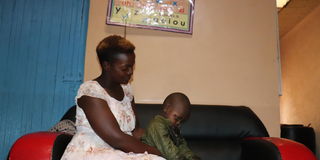
Keziah Wanjiru and her child Daniel Gathii, who is autistic, at their home in Njoro sub-county, Nakuru County.

What you need to know:
- The World Health Organization estimates that one child out of every 100 in the world is autistic.
“I am afraid of getting another child because of what I am going through with my first born. It is every mother’s dream to have a ‘normal’ child, but mine was fine until he was six months old,” says Jane Njeri, mother of a nine-year old child who is abled differently.
In 2014, Jane was elated to have her first child, Charles Kennedy, who later suffered bouts of fever that spanned two years. At the time, he was misdiagnosed with rickets and later Cerebral Palsy. Charles was given the wrong medication, which worsened his condition.
His mother says that he could sleep too much, was inactive, and his hair was not growing. When Jane sought further medication, her son finally got the right diagnosis of Autism Spectrum
Disorder (ASD).
This condition made Charles get a heightened sense of smell, which makes him sensitive to the food he wants to eat. Charles is also non-verbal and doctors have recommended that he takes a speech therapy test, whose cost ranges from Sh3,000 to 6,000 per session. Jane says the family cannot afford that because the boy also has another condition; scoliosis - a sideways curve of the spine- which he developed in 2023, forcing him to wear a corset that costs them about Sh15,000.
Jane says she had to adjust from a life of working to becoming a full-time caregiver. Things are not different for Keziah Wanjiru, who hails from Jewatho, Njoro sub-county in
Nakuru.
“I was always afraid of leaving the house with my child, and even when I did, I used to cover him so he could not be seen because I felt ashamed and was afraid of stigma,” she says.
It took joining support groups for her to accept that she was not alone and that there were other children like hers.
Keziah’s child also had a misdiagnosis at first. Daniel Gathii was diagnosed with Cerebral Palsy.
Keziah accepted the diagnosis, unaware of the symptoms, and joined a group of mothers of children with Cerebral Palsy, but she noticed her child was exhibiting different symptoms.
When she sought a second diagnosis, she got a convulsion disorder.
A Magnetic Resonance Imaging (MRI)- a noninvasive medical imaging test that produces detailed images of almost every internal structure in the human body- showed his brain was
damaged.
When Daniel was two and a half years old, he was diagnosed with ASD and ADHD (Attention-Deficit/Hyperactivity Disorder) and has been on medication.
“My child has been on anticonvulsants since birth. In 2021, a 300-milliliter bottle of Epilim went for Sh1,700, but now it goes for Sh2,300. This takes him about 20 days as his dosage is six milliliter - day and night.
He takes another drug called Phenobarbital, which in 2021cost Sh10, but it’s now triple the price.
“I had a job, but I stopped working because my child is dependent on me. When I want to go anywhere, I must go with him. But he is becoming heavier as he grows and a time will come when I will be unable to do this,” she says.
Keziah believes her child’s condition is a result of the medication she took during the first three months of her pregnancy.
Although she is a bit reluctant to take Daniel to school, she asks the government to come in and help in other ways by capping the cost of medication and diapers as they are becoming too expensive.
She also calls on parents who are in denial to accept their childrens’ diagnosis, and join other supportive groups to easen the burden.
The World Health Organization (WHO) estimates that one child out of every 100 in the world is autistic.
While it can be challenging to diagnose autism before the age of 12 months, it is usually detectable by the time a child is two years old.
In Kenya, the disorder affects approximately four per cent of the population according to a 2007 Autism Society of Kenya estimation - that is one autistic child for every 25 children, which is higher than the global level.
These populations, both children and adults, face multiple challenges since a majority of them have minimal speech, or are non-verbal, or do not identify social cues as easily as their neurotypical peers.
James Mwaniki, an occupational therapist at Nakuru County Referral and Teaching Hospital, tells Healthy Nation that autism is a brain disorder that affects social interaction and communication.
He says it is difficult to engage a child with autism in a play activity, which ends up limiting their performance.
ASD is accompanied by routine stereotyped body movements (uncoordinated body activity) like continuous knocking of the head, uncoordinated jumping, and finger flapping among others.
They may exhibit temper tantrums and extreme anger, whereby a child can engage in self-injurious behavior like biting their lips or fingers or banging their head because their pain
threshold is very high.
The main management of ASD for occupational therapists is sensory integration. This is because people living with autism vary and react to external stimulation differently. They are hypersensitive to sound, touch, smell and hearing.
According to Mr Mwaniki, ASD has no major known cause, although there are existing theories that infections from the mother who is expectant or abuse of some drugs can cause the condition.
Additionally, brain infections or traumatic brain injuries during developmental stages can affect the part of the brain that coordinates communication and social interaction.
ASD ranges from mild to moderate to severe. In mild cases, one can live a life that is near normal as it usually is unnoticeable unless the person shares the information voluntarily. In moderate to severe cases, they display prominent symptoms at a close glance such as
stereotyped body movements, sleep disorder patterns, lack of speech, and social withdrawal symptoms that limit their performance, especially academically.
Mr Mwaniki explains that if ASD is not well managed and taken care of in early or late adulthood, a child can develop a full-blown mental disorder.
“In adulthood, ASD may turn out to be a severe mental disorder called schizophrenia. This is especially true with the severe type of ASD acquired during early childhood and not well
managed. While the main therapeutic intervention is sensory integration, our key focus in the management of ASD is symptomatic. We first do a comprehensive analysis and
assessment of the child because each child is unique. We identify the problems and then manage them through sensory integration. Others benefit from psychiatric management, especially the severe cases- some may be given drugs to control their behaviour, especially extreme hyperactivity where the concentration span is very low.”
Peris Wangari, director of Arthur for Others Foundation, started creating awareness of neurological conditions and fighting for the rights of mothers of children who have
developmental disorders after her child was diagnosed with Celebral Palsy.
She says that society and even parents are unaware of these conditions and generalise them as disabilities.
She says the government is slackening in creating awareness of neurological and developmental disorders despite the rising cases.
She notes that regrettably, people with autism typically fall behind in terms of schooling, employment, and eventually socioeconomic status as adults because there are insufficient policies, training programmes, and infrastructure to integrate them into society from a young age and calls on Parliament to be inclusive in law-making.