Farewell to ‘Papa’: The medic who built Kisumu’s healthcare stranded in death
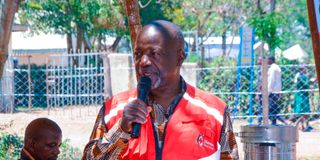
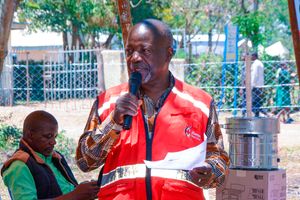
A picture of Dr George Rae at a past event.

What you need to know:
- His family now faces a stark dilemma: his body cannot be repatriated until a hospital bill exceeding Sh20 million is settled.
They affectionately referred to him as ‘Papa'. Dr George Rae was celebrated for his light-hearted spirit, often diffusing high-pressure situations with laughter and reminding his colleagues: “It doesn’t have to be this serious.”
And when Dr Joshua Okise, acting Chief Executive Officer of Jaramogi Oginga Odinga Teaching and Referral Hospital (JOOTRH), shared the news of his death with staff a few days ago, it triggered a wave of tributes, many not missing the nickname ‘Papa’, which defined the kind of man he was.
His former secretary, Moraa, remembered him as an icon of respect: "Papa had a lot of respect for both seniors and juniors in the line of duty."
Having served as the CEO of JOOTRH from 2020 to 2024, Dr Rae’s impact on the institution was profound. His colleagues attribute transformative infrastructure like a vital oxygen plant built during the Covid-19 pandemic and an ultra-modern kitchen to partnerships he fostered.
Also read: George Rae, the doctor failed by everyone
On December 11, 2025, JOOTRH held a ceremony to honour its former CEOs. Though Dr Rae was invited, he was unable to attend as he was undergoing treatment in South Korea. He had travelled as part of a delegation from Kisumu County government to attend the Smart Cities conference. His interest centred on how Artificial Intelligence and digitisation could be integrated into Kisumu’s urban services.
“On December 4, while touring South Korea's National Assembly, Dr Rae collapsed. He was rushed to a hospital and died several days later," says Prof Rogo.
Oxygen plant
During the height of the Covid-19 pandemic, Dr Rae was instrumental in securing a reliable oxygen supply for patients when cylinders were critically scarce.
Dr Okise notes his specific contributions: “He established an oxygen plant that provided life-saving piped oxygen directly to the wards, and an ultra-modern kitchen to replace the hospital’s aging facilities.”
Dr Okise adds that his loss is felt far beyond the hospital walls; “it is a loss for the entire Kisumu County and, most poignantly, for the sickle cell community”.
Dr Rae had pioneered the ‘Sickle Cell ZERO’ movement, issuing a simple yet powerful directive to his communications team: "Something has to be done."
“This initiative bore significant fruit, leading to Kisumu County’s first-ever sickle cell conference, the establishment of warrior support groups, and the employment of trained ‘warriors, within the medical field at JOOTRH,” says Dr Okise.
Through his instrumental partnerships, he brought bone marrow transplant services closer to home, making the facility a sanctuary for those living with the disease.
According to Kisumu Governor Anyang Nyong'o, Dr Rae was an accomplished clinician, a visionary administrator and a gentle, yet firm leader whose commitment to public health care transformed institutions and touched countless lives.
He adds that Dr Rae will be remembered as a humane leader who believed in teamwork.
“Even after handing over in 2024, his devotion to service did not wane. As a health advisor within the Kisumu County department of medical services, he continued to give generously of his intellect and experience; strengthening partnerships and mobilising resources,” says Governor Nyong’o.
His profound care extended beyond the living to the deceased; he was instrumental in establishing the Kwee Funeral Parlor, which provided executive morgue services to the region. Beyond his work in Kisumu, Dr Rae achieved numerous milestones in the wider medical sector.
For Dr Lorraine Anyango, head of Corporate Communications, Dr Rae fuelled her passion for health communications.
Their paths first crossed during the third Universal Health Coverage (UHC) conference when she was serving as a rapporteur and digital storyteller.
Later, while serving as the advisor to the governor on UHC, Dr Rae called her to join the team delivering health insurance to Kisumu’s most vulnerable residents. Together, they developed the communication strategy for ‘MARWA’, a health insurance program for Kisumu’s most vulnerable. “Despite being the eldest among us, Dr Rae refused to rest,” she says.
“From unveiling the name at JOOTRH to recording the jingles that echoed across the county, Dr. Rae trusted my capability every step of the way,” says Dr Anyango. “Despite being the eldest among us, he refused to rest. Using the ‘needle and spokes’ model, we visited nearly every primary school in the sub-county to ensure pupils understood MARWA, so they could carry that message home to their parents.”
When Dr Rae transitioned to become CEO of Kisumu's main Referral Hospital, Dr Anyango saw his greatest passion come to the fore. Together, they built a powerful synergy that transformed regional care, launching support groups and successfully advocating for ‘warriors’ to be covered under the MARWA programme.
Perhaps most touchingly, he opened employment doors for medics living with the sickle cell disease, including the late Dr Hellen Ooro. To many, Dr Rae was more than a colleague or boss; he was the channel through which life-changing opportunities flowed.
Guided by an innate humanity, he placed patients and community at the heart of every initiative—from Kisumu's MARWA medical cover and the direct piping of oxygen to hospital wards, to programmes for managing sickle cell. To those he leaves behind, this medic, who passed away far from home, was the architect of countless life-changing programmes and a rich, enduring legacy in medicine.
Until his demise, Dr Rae served as the head of Partnerships and Resource Mobilisation for the Kisumu County Department of Medical Services, Public Health, and Sanitation.
Dr Simon Kigondu, president of the Kenya Medical Association (KMA), lauds Dr Rae’s contributions as a member of the body, where he helped steer key healthcare reforms.
“Notably, the November 2017 consultative meetings convened by KMA through the Managed Healthcare Committee resulted in a landmark document that directly informed improvements in NHIF service provision—now under the Social Health Authority (SHA),” says Dr Kigondu.
Yet, the system Dr Rae dedicated his life to improving appears to have failed him in the end.
He passed away while undergoing treatment in South Korea, where he had fallen ill during an official work-related. His family now faces a stark dilemma: his body cannot be repatriated until a hospital bill exceeding Sh20 million is settled.
“The health system and the government has let our colleague down,” says Dr Khama Rogo, the family spokesperson. “That this happened to a high-level professional is an even bigger indictment. It shows the system doesn’t work. We went to SHA, and they told us their policy does not cover an individual who falls sick outside the country.”
Dr Rogo adds that since Dr Rae died while on official duty for both county and national governments, they should take responsibility for his repatriation.
“Is this sum too large for the Kenyan and county governments to cover?” He asks. “I don’t understand how someone can work so hard only to be failed so profoundly. It is bad.”
His body remains abroad, awaiting the settlement of a bill exceeding Sh20 million.
Kisumu County government has committed to facilitating the body’s transportation, but this hinges on settling the outstanding bill of approximately Sh17 million; a sum that remains a nightmare for the grieving family.
[email protected]
Additional reporting by Angeline Ochieng