Food, income and security: The triple win of Nyeri's integrated farms
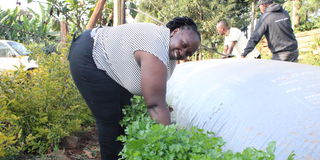
Ms Consolata Wambui harvesting coriander at her permaculture farm next to a biogas plant in Nyeri on September 8, 2025.

What you need to know:
- Farmers combine horticulture, cash crops, and multiple types of livestock into a single, symbiotic operation.
Farmers in Nyeri County are turning to an integrated, climate-smart farming model that is slashing production costs, guaranteeing sustainable incomes, and providing nutritious diets for their families.
At the heart of this transformation is permaculture, a method of intercropping diverse crops on a single piece of land, practised as part of a broader integrated farming system. This approach sees farmers combining horticulture, cash crops, and multiple types of livestock into a single, symbiotic operation.
Homes are equipped with biogas plants, whose nutrient-rich slurry is channeled to crops, forage grasses, and fish ponds. This creates a closed-loop system where every output becomes an input for another activity, drastically reducing external costs.
“What we are doing involves water harvesting and prudently utilising that water for multipurpose agricultural activities. But the most important thing with this type of farming is that each agricultural activity complements the other, reducing the cost of production,” Wambui Muthungu from Kihuyo Village, Tetu Constituency, says.
She adds that this type of farming also guarantees the use of climate-smart and organic farming practices.
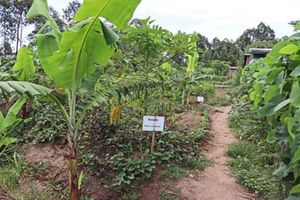
On her farm, deep trenches double as water-harvesting systems and growing beds for yams and bananas. Raised seedbeds behind the house host vegetables such as kales, amaranth, spinach, coriander, African nightshade and onions.
Flourishing coffee bushes, which dominate a section of the farm, were unaffected by the drought that often causes massive berry abortion between late August and October. A water pan with fish is installed within the coffee farm itself.
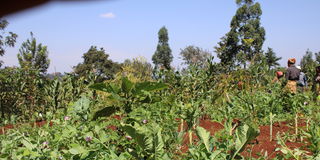
A florishing permaculture garden in Nyeri County.
“Drought cannot affect the coffee because of the slurry from the biogas plant. We also apply enough mulching. With these technologies, we don’t use fertiliser or any chemicals; we practise pure organic farming. For example, we replaced the fertiliser with bokashi manure, which we formulate using locally available raw materials, including leaves from different vegetation and dung. It takes about a month for bokashi to be ready for use. We use the same raw materials to formulate pesticides and other inputs,” says Muthungu.
The results are tangible. Previously, she spent Sh500 per coffee bush to yield 3-5 kilos of cherries. This year, she expects 15 kilos per bush. “We’ve eliminated the monthly Sh1,000 firewood cost by using biogas from our dairy cows,” she adds. “It’s a circular type of farming.”
“I use the slurry to grow Napier grass and other animal feeds. I feed the Napier grass to the dairy cows, which give me milk and the biogas.”
The model was introduced by RODI Kenya, a local organisation. Bernard Wambugu, a retired accountant, notes that the shift has brought significant household savings. “Between 60 and 70 per cent of household expenditure is on food. I can eliminate that and be sure I am eating healthy.”
“They trained us in permaculture with an emphasis on organic farming. Now we can interplant vegetables with tubers, herbs, and any edible plant without using chemicals. It’s a good concept because instead of going to the market, you grow and eat your own, and you are sure of your health.”
His farm features a diverse, integrated system including a fishpond, poultry, dairy cows, and an apiary. He combines these with crops such as vegetables, dairy goats, coffee, and herbs, many of which are planted in raised beds.
For Julia Wanjiku from Mukurweini, the integrated system provides daily income and food security. “We eat animal protein every day—from milk, fish, meat, or eggs. We also mix various vegetables for nutritious meals,” she says. The water from her fishpond irrigates a kitchen garden that earns her Sh500 to Sh1,000 daily.
According to Ann Mathenge, a Nyandarua nutritionist, this approach is transformative. “With a variety of livestock, a family can alternate protein sources and still have a nutritious diet every day.”
“Animal proteins remain a challenge in many homesteads. We no longer talk of a balanced diet; the focus is on proper feeding. With a variety of livestock like the dairy cows, goats, fish, and poultry, a family can alternate the animal sources of proteins and still have a nutritious diet every day.”
Store floodwater
Agronomist Peter Chege of RODI-Kenya emphasises the critical role of water harvesting. Trenches store floodwater, slowly releasing it to crops, while affordable, locally-built water tanks ensure supply for domestic use and irrigation.
“It’s a way of farm utility and resilience,” says Chege. “And it ensures farmers have enough water to make permaculture and integrated farming successful.”
He adds: “We are spending about Sh80,000 to construct a water storage tank that would have cost Sh350,000. It means that farmers have enough water for domestic use and irrigation. Water harvesting is a critical component for permaculture and integrated farming,” says the agronomist.