Forgotten heroes: The untold mental health struggles of caregivers
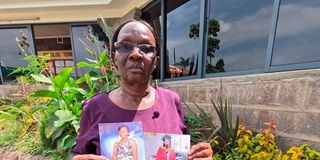
Linet Jumba holds pictures of her daughter Sonia, who has bipolar, in Nakuru on April 30, 2025.

What you need to know:
- Caregivers suffer burnout or fatigue and while they are pivotal in the welfare of patients with mental illness or chronic ailments, there are no existing caregiver-specific laws, leaving families to crumble under financial and emotional stress.
At 72, Linet Jumba’s hands tremble slightly as she cradles a faded photograph—a fragile portal to another time. The image captures her daughter Sonia in infancy, swaddled in a soft green shawl. Sonia’s skin glows under the photographer’s flash, her almond-shaped eyes wide with the quiet wonder of a newborn discovering light, shadow, and the blurred edges of existence.
The photo was taken 38 years ago when Sonia was one month old.
“"She was and still is my beautiful child," Linet murmurs.
Sonia grew up like any other child, hitting all milestones while progressing with her education.
“She was not a troublesome child. In fact, she was very bright, getting recognition for her public speaking skills and even leadership all through to university,” Linet recalls.
In 2009, Sonia graduated with a degree in Political Science from Catholic University of Eastern Africa. She was immediately employed as a children’s officer in the State Department for Social Protection after an impressive internship period.
“Sonia did not tarmac like most graduates do. She was immediately posted to Nyamira County to work in the Children’s Department. She was later transferred to Nakuru,” narrates Linet.
In 2012, Sonia got engaged and was preparing for marriage—a milestone that should have been a celebration. But days before the wedding, the groom’s family abruptly called it off.
Linet says this might have triggered Sonia’s downward spiral. “She was never the same after that.”
Linet says her daughter sank into depression and for four years, they tried to get her the medical assistance she needed.
In 2016, Sonia reconciled with her ex-fiancé and had a civil wedding. “She came home with pictures of the civil wedding telling me they had formalised the relationship. I was surprised but I wished them both well,” recounts Linet.
But Sonia’s relief was short-lived. Two weeks after giving birth, her husband left her and filed for divorce, deepening her trauma. “Sonia sank into postpartum depression. The divorce hit her hard and I had to come in to help her.”
This would mark the start of constant hospital visits and erratic behaviour on Sonia’s part that would eventually lead to a bipolar (I) diagnosis, a condition she has lived with for nine years now. Bipolar is marked by extreme mania and depression.
“Taking care of Sonia has not been easy. She has accumulated a lot of debt. I even had to sell my retirement land to offset the debts,” says Linet.
When the Healthy Nation team met Linet, she explained that her daughter had accumulated debt valued at Sh5 million across banks, saccos and even online money lending applications, but there’s no development to show for the money.
“Sometimes she buys household items and then sells them all or even gives out for free. I have had to use police to bring back her furniture whenever she has the manic episodes.”
Sometimes Sonia gets violent.
Linet breaks down when asked how taking care of her mentally ill daughter has affected her own mental health. “I am all alone,” she sobs. “There’s only so much help you can get at the beginning, but taking care of Sonia and her child is expensive and people eventually get tired of helping.”
Linet says she had envisioned her retirement as a time of peace, where she could focus on farming and look forward to the occasional visits from her children and grandchildren, but she has instead been thrust into being the sole caregiver and provider to her daughter. It’s been a lonesome journey, but recently she found a community of caregivers like her in Nairobi, where she lives.
“There’s a support group of caregivers that meets at Citam Buruburu. I have met other caregivers of children with special needs as well as of loved ones living with mental illness. It’s comforting to know I am not alone.”
For 30-year-old Peris Wangare, welcoming her son Arthur into the world in 2021 was not as smooth as she had envisioned. Immediately after delivery, the baby got admitted at the Neonatal Intensive Care Unit as he had developed severe birth asphyxia due to prolonged labour.
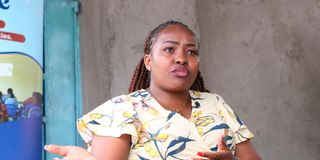
Peris Wangare, the founder of ‘Arthur For Others' during the interview on May 7, 2025. Her son had cerebral palsy and died at the age of two.
After two weeks in hospital, Peris and her son were discharged, and this would mark the start of a physically strenuous and mentally exhausting two-year journey of taking care of her child; whose condition meant that he would be admitted to hospital frequently.
“It took three different doctors diagnosing Arthur with cerebral palsy for it to sink in and even then, I was in denial because I thought when we left the hospital after he was born, he would hit milestones just like other children do, but he didn’t,” says Peris.
As a first-time mother with a child living with disability, Peris was susceptible to stigma and discrimination associated with such births. She isolated herself and her child and unknowingly sank into depression.
“I feared taking Arthur out to bask in the sun because of what people would say about him. I wouldn’t shower for days. I would make sure the child was fed and clean, but I neglected myself. Through all this, I did not get someone to hold my hand.”
She adds that there is also the financial constrain that comes with taking care of a child with special needs. Peris could not secure a job because she was her son’s full-time caregiver. Her family would help pay bills.
“There are drugs that Arthur was supposed to take daily, and we would spend Sh5,000 on a monthly basis. He was also on a special diet. Physiotherapy is expensive in private facilities. In government hospitals, the rates are subsidised but there’s congestion and you won’t get quality services.”
It’s while taking Arthur for the physiotherapy sessions at Nakuru County Teaching and Referral hospital that Peris was able to build a community of caregivers who encouraged her to start speaking about her experience as young mother with a special needs child.
“I gathered a few parents on WhatsApp and we started sharing our experiences. I encountered parents who had older children, and it humbled me since I was starting out and I had a lot to learn. That peer support group gave us a shoulder to lean on.”
Share on Facebook
Peris began sharing her son’s experience on Facebook. Through this, she was able to mobilise for items like diapers and wipes, which she distributed among fellow caregivers. This was the beginning of ‘Arthur for Others’, a community-based organisation she founded in the process of trying to cater to the needs of the caregivers.
This initiative would come full circle when Arthur celebrated his second birthday on March 18, 2023. Unknown to Peris, this would be his last birthday.
“I wanted this milestone to be celebrated by everyone in our community of caregivers, and so I brought together 15 caregivers with their children. We had a successful event at AIC Bondeni. But a month later on April 27, 2023, Arthur passed on.”
By this time, Peris had undergone a training on mental health awareness and she had a support system to help her navigate the loss of her child. Still, she felt something needed to be done to address the mental wellbeing of caregivers.
“Most of the caregivers experience burnout and chronic stress. They do not work, so finances are constant problem and with the high cost of living they are a stressed lot. Most of them are single mothers because the husbands left them due to the toll of taking care of a special needs child.”
Having lived through the experience of taking care of a child with special need, Peris says the society still views disability as a manifestation of cultural taboos.
“Disability is perceived as a curse in the traditional context, but these are conditions that are proven medically, and even if you are well today, you don’t know about tomorrow - there are things that can leave you with a disability.”
In 2024, Peris founded Shamiri Initiative, where she trains caregivers on mental health and wellness. This, she says, has been a welcome reprieve for the burdened caregivers who are often ignored in the conventional healthcare system that is predominantly patient-centred.
“We tend to forget there is someone behind the child or patient, what are we doing for the caregiver? Nothing. At Shamiri Initiative, we encourage the caregivers to prioritise their self-care. When a child sleeps, a caregiver can, for instance, have a dance therapy to loosen up. They can also meet in a support group and do something fun.”
In May, Peris conducted a workshop for 25 caregivers to children with special needs in Bahati Sub-county, through the Shamiri Initiative.
Peris notes: “Caregivers are the foundation of healthcare, and neglecting their well-being has negative consequences for patients and the healthcare system overall.”
According to Dr Erica Adagala, a consultant psychiatrist based in Nakuru, caregivers suffer burnout or fatigue and while they are pivotal in the welfare of patients with mental illness or chronic ailments, there are no existing caregiver-specific laws, leaving families to crumble under financial and emotional stress.
Dr Adagala says the current County Mental Health Action plans prescribed by the Mental Health Act of 2022 should address the needs of caregivers.
“In the county mental health action plans, we are discussing the promotion of local research on mental illness, school programmes for prevention and early intervention of mental illness, as well as caregiver packages,” she adds
During a recent Nation Media X (Twitter) Space, caregivers across Kenya shared raw, unfiltered stories of their struggles—exposing a national crisis that has long been ignored: