From 500kg to 1,442kg: How two women tripled their harvests using 'controversial' seeds
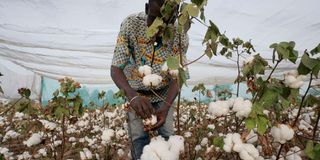
Genetically modified cotton.

What you need to know:
- Two farmers tripled their cotton harvests by switching to genetically modified Bt cotton.
- Despite this success across 23 counties, Kenya's adoption of similar Bt maize technology has been delayed for five years, costing the country an estimated Sh8.7 billion.
- Experts argue that embracing proven climate-resilient crops is essential as extreme weather increasingly threatens traditional farming.
In the arid landscapes of Kitui County, where drought has become an unwelcome annual visitor, Winny Mubea watched her maize crops wither year after year. The rains, when they came, were erratic and unpredictable. Her three-acre farm was barely breaking even, yielding a meagre 500kg of cotton that left her struggling to cover costs.
But in 2020, faced with yet another season of climate uncertainty, Winny made a decision that would transform her livelihood. She switched to Bt cotton—a genetically modified variety engineered to resist the destructive pests that had been ravaging her crops alongside the harsh weather.
The results were remarkable. Her first harvest yielded 1,442kg—nearly triple her previous output. Since then, her yields have continued to improve, and she now travels across the region training other farmers in climate-resilient agriculture.
"The difference was incredible," Winny reflected, speaking at a recent agricultural conference. "For years, I watched my crops fail while the weather became more unpredictable. This technology gave me hope again."

Winny Mubea, a Bt cotton farmer from Kitui, during the national dialogue on genetically modified food on June 3, 2025.
Hundreds of kilometres away in Busia County, where rainfall is abundant but cotton yields had mysteriously stagnated, Nancy Odemba was fighting her own battle against agricultural disappointment.
In 2019, her one-acre farm produced just 196kg of cotton—a return that barely justified the labour invested. Frustrated but determined, she attended a Bt cotton demonstration in 2020. What she witnessed convinced her to take the plunge. Her yields soared to 596kg that year, then to 967kg in 2021.
The transformation extended beyond individual farms. The Nambale Farmers’ Cooperative, which Nancy chairs, recently reported harvesting 96,000kg of high-quality cotton—all from the improved variety that's proving its worth across Kenya's diverse climate zones.
The science behind the success
Both farmers shared their experiences during the National Science Dialogue held on May 3, at Kenyatta International Convention Centre. The event, themed "Growing Food and Protecting the Planet," brought together scientists, policymakers, farmers, media, and the public to explore how biotechnology can enhance resilience to climate shocks.
Organised by the ISAAA AfriCentre, the Kenya National Academy of Sciences, the Kenya Agricultural and Livestock Research Organisation, the National Biosafety Authority, and the Africa Science Dialogue, the conference highlighted the urgent need for climate-smart agricultural solutions.
Bt cotton—a pest-resistant variety genetically modified to produce insecticidal proteins from the Bacillus thuringiensis bacterium—has now been commercialised in over 23 counties across Kenya. The technology offers farmers higher yields, better weather tolerance, and significantly reduced pesticide costs.
Science, Research and Innovation Principal Secretary Shaukat Abdulrazak underscored the urgency of leveraging scientific solutions amid worsening food insecurity.
"Approximately 1.8 million people in these regions are food-insecure," he stated. "To effectively confront these pressing challenges, we must harness the full potential of science, technology, and innovation."
He identified climate-resilient crops, smart water management, and bio-fortified foods as essential tools in the fight against hunger and malnutrition—challenges that are intensifying as climate change disrupts traditional farming patterns across East Africa.
A costly delay
Whilst cotton farmers celebrate their success, a more politically sensitive crop remains caught in regulatory limbo. Bt maize—engineered to resist stem borers and fall armyworms—has been ready for commercial use since 2019, having passed comprehensive safety and field trials. However, legal and societal hurdles have blocked its rollout.
The delay has come at a significant cost. A recent study by the Breakthrough Institute, Alliance for Science, AATF, ISAAA AfriCentre and CIP revealed that the five-year delay in Bt maize adoption has cost Kenya an estimated $67 million (approximately Sh8.7 billion).
The report, titled Genetically Modified Crops in Kenya: The Cost of Delay, forecasts that if Kenya had adopted Bt maize in 2019, the country would have realised Sh28.2 billion in benefits by 2029. It also projected that an additional 194,000 tonnes of maize could have been produced by 2024 alone.
The numbers paint a stark picture of Kenya's food security challenge. The country currently produces around 45 million 90kg bags of maize annually against a national demand of 62 million bags. The deficit is plugged through costly imports from neighbouring countries like Uganda.
Experts argue that Bt maize, which is tolerant to stem borer and fall armyworm pests, could bridge this gap, particularly in mid-altitude and transitional zones where climate variability poses the greatest threat to traditional farming.
Environmental, health benefits
Beyond yield gains, Bt maize presents significant environmental and health advantages. Its built-in pest resistance reduces the need for chemical pesticides, lowering production emissions and improving food safety by reducing fungal infections that lead to dangerous aflatoxins.
The maize is engineered with precision—much like how modern medicine targets specific diseases—ensuring that non-target insects and surrounding ecosystems remain unharmed.
Genetically modified crops like Bt maize undergo rigorous safety assessments and public participation processes before approval. Two varieties have been developed specifically for Kenya: one that resists stem borers and another that fights fall armyworms. Both are derived from a soil-based bacterium with a long history of safe use.
Overcoming political, social barriers
The technology may be scientifically sound, but public resistance remains strong, rooted in past political decisions. A ban imposed in 2012 by former President Mwai Kibaki remained in place throughout the Uhuru Kenyatta administration. It was finally lifted by the Kenya Kwanza government in October 2022, citing the urgent need to reduce food costs.
Justice Oscar Angote, in a 2023 judgment, noted that Kenya has established a robust biosafety framework ensuring public health and environmental protection.
However, concerns persist. Some civil society organisations continue to advocate for agro-ecological alternatives, citing food sovereignty and ethical concerns. In a recent joint briefing in Nairobi, Greenpeace Africa and local advocacy groups argued that agroecology better supports biodiversity, climate resilience, and farmer autonomy. They called for more public education and data transparency before adopting GM foods.
Efforts to bridge the divide are ongoing. Religious leaders, once sceptical of GMOs, are now partnering with scientists to promote awareness and understanding.
Dr George Michuki, founder and CEO of the Africa Genomics Centre and Consultancy Company, draws parallels between modern genetic modification and traditional breeding methods.
"Just as we once bred stronger bulls, we now engineer better crops," he explained. "The tools simply make the process faster and more precise."
He points out that even medical insulin, formerly derived from cow and pig liver, is now produced through genetic engineering—illustrating the widespread safety and acceptance of the science in healthcare.
Expert consensus on safety
Independent food safety expert Allan Liavoga, echoed this view, citing long-standing protocols from the World Health Organization and World Food Organization that affirm the safety of GMOs.
"These organisations have developed protocols over the past 30 years, adopted by nations worldwide," he said. "They ensure that the scientific processes which GMOs and other organisms undergo are thoroughly safe."
Dr Liavoga urged farmers to understand that GMOs can coexist with other farming practices rather than replace them entirely.
"There's a misconception that GMOs must replace all other methods," he clarified. "But genome editing is just one of many tools we can integrate, guided by science."