From menace to market: Scholar turns deadly dodder weed into natural dye

Prof Richard Mibey, of the University of Nairobi, displays a shirt and a hat dyed using a Japanese dodder extract during the National Research Festival at Egerton University in Nakuru County on August 18, 2025.

What you need to know:
- Once a deadly farm parasite, Japanese dodder is now a surprising source of eco-friendly natural dyes.
- Kenyan scientist Prof Mibey is turning the destructive weed into high-value dyes and shoe polish innovations.
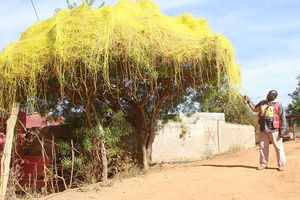
Japanese dodder, a parasitic plant with distinctive green tendrils, is arguably the greatest threat to farmlands and forests. It suffocates a wide variety of trees, destroys hedges and fruit orchards, and poses a serious risk to food security, livelihoods and ecosystem’s health.
While scientists work tirelessly to find a lasting solution to the dodder menace, one scholar at the University of Nairobi has taken a different path. Professor Richard Mibey, former Vice-Chancellor of Moi University, has been promoting the plant after discovering it to be a valuable source of natural dye for clothes, leather and other materials.
“We have used a dye made from tea leaves and dodder extracts on this shirt. It is 50 per cent tea and 50 per cent dodder extract,” Prof Mibey told Healthy Nation as he showcased an African print shirt during the National Research Festival at Egerton University on Monday.
His innovation drew wide attention at the “Sustainable Agriculture and Food Security” forum, which was graced by Prof Shaukat Abdurazak, Principal Secretary for Science, Research and Innovation. Prof Abdurazak urged scholars to emulate Prof Mibey by developing practical, marketable innovations that address everyday problems.
“We must turn excellent science into everyday solutions on farms, in markets and in households so that food is affordable, farming is profitable, and our economy remains globally competitive,” Prof Abdurazak said.
He further challenged innovators to prioritise solutions to challenges in arid and semi-arid areas—the country’s untapped food basket.

Prof Richard Mibey, of the University of Nairobi, displays a bucket of Japanese dodder and a bag during the National Research Festival at Egerton University in Nakuru County on August 18, 2025.
Prof Mibey’s breakthrough comes at a time when Kenya is struggling with Japanese dodder, also known as strangle weed or witches’ shoelaces. The invasive plant forms a dense canopy on its host, casting thousands of tendrils before eventually strangling the host to death. The Kenya Plant Health Inspectorate Service has described it as the most destructive weed in the country, with researchers warning of growing fears among farmers.
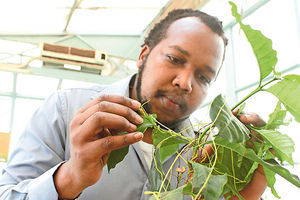
Dr Steven Runo, a scientist who has long studied Japanese dodder, explained that it penetrates host plants by puncturing their vascular tissue at multiple points. “Once dodder attacks a plant, it quickly spreads while embedding itself through specialised nodes that suck water and nutrients. This weakens the plant and eventually kills it,” he said.
The molecular biologist, a specialist in parasitic plants, believes Japanese dodder also kills its hosts by injecting a toxic substance.
In parts of western Kenya, where dodder is rampant, farmers have nicknamed it “the HIV of plants” because it causes withering before killing trees. In Makueni, where it has invaded mango and citrus orchards, authorities link its spread to rising human–wildlife conflict due to the destruction of forests.
Celebrated scientist
Against this backdrop of devastation, Prof Mibey has focused on the plant’s potential uses. With a strong background in natural dyes—he was celebrated for his role in reviving the Rivatex textile factory at Moi University—the mycologist views dodder as a potential source of sustainable dye.
“When I boiled dodder tendrils in a controlled environment, they produced a yellow dye on fabric and a black dye on leather. It was a eureka moment. The longer you boil the tendrils, the more permanent the dye becomes,” Prof Mibey said.
“I am exploring ways of extracting dyes for use on cars and houses. At the same time, I am finalising a dodder-based shoe polish, which should reach the market by November.”
His work also aligns with global efforts to promote environmentally friendly practices. “Natural dyes do not irritate the skin, making them safe for children and people with sensitive skin. Using natural dyes for clothes and shoes reduces reliance on chemical dyes, which often pollute rivers and soils,” he explained.
Prof Mibey has also previously discovered eco-friendly fungi to control water hyacinth in Lake Victoria.
The extraction of natural dyes from Japanese dodder could be transformative for farmers struggling with the weed. Beyond tackling the invasive plant, his innovation offers new income opportunities.
“We have already exhausted the dodder that had grown on trees around the University of Nairobi, so we now buy it from farmers. A kilo sells for Sh100,” Prof Mibey said.
The success of the dodder dye has spurred him to search for more nature-based solutions. “The next time we face an environmental catastrophe, such as the fall armyworm, I will be quick to find its silver lining. There is always a positive side to every problem,” he said.