From skin rash to liver transplant: How Anne Loko’s routine check-up turned life-threatening

What you need to know:
- What began as a minor skin issue spiralled into a life-threatening condition requiring urgent transplant.
- A near-fatal diagnosis reveals systemic failures in transplant access, funding, and long-term patient support.
Anne Loko walked into a dermatologist's office in 2021 looking for answers to what seemed like a routine skin problem. She had no idea that the visit would unravel a life-threatening illness, push her to the brink of death and end in a liver transplant thousands of kilometres from home.
“At first, the symptoms seemed cosmetic, almost trivial. I had flare-ups, dark patches and pigmentation,” she recalls. “A punch biopsy revealed inflammation, and I was asked to do more blood work.”
The results were alarming. Her platelets were low, her white blood cells were down, and she was anaemic. From dermatology, she was referred to a haematologist, where she underwent extensive screening for hepatitis, autoimmune conditions and blood disorders. An autoimmune test came back positive, and a rheumatologist diagnosed her with lupus.
But even that diagnosis did not explain how quickly her health was deteriorating. Within days, her platelet levels dropped from 66 to 28, a fall drastic enough to require hospitalisation and further tests. Doctors started her on steroids, but she did not improve. Scans instead showed that her liver was small and her spleen was enlarged.
Complications came quickly after that. She developed ascites, a condition where fluid accumulates in the abdomen. She was also diagnosed with Grade 3 oesophageal varices, a dangerous swelling of the veins in the oesophagus that could rupture at any moment. “I was at risk of bleeding out. I also developed portal hypertension, caused by increased pressure in the liver's blood vessels,” she says.
By March 2021, barely weeks after her symptoms had intensified, Anne had spent three weeks in hospital in Nairobi undergoing bone marrow biopsies, imaging scans and repeated blood work. The verdict from a gastroenterologist was devastating: end-stage liver disease. “The cause remained a mystery. They called it idiopathic; there was no known cause. But I had all the signs of liver cirrhosis, and it was irreversible,” she says.
In hindsight, her body had been sending signals for much longer. For nearly two years before the diagnosis, she had been struggling with extreme fatigue, sleeping full nights and still waking up tired, with an ordinary eight-hour workday leaving her completely drained. “I thought I was just tired like everyone else,” she says.
After the formal diagnosis, the symptoms grew harder to ignore. She developed intense itching, especially at night, then came confusion and disorientation. She had, without knowing it, been experiencing hepatic encephalopathy, a dangerous build-up of toxins, particularly ammonia, in the bloodstream caused by liver failure.
“I was hallucinating, and as it progressed, there was a risk of going into a coma,” she says. “I was given medication to flush the ammonia out of the body, but doctors were unequivocal: I needed a liver transplant. I was in denial. I kept asking, ‘What do you mean I need a transplant?’ I could not believe that within a month, I had gone from a skin issue to being told I needed life-saving surgery. When the liver is decompensated and no treatment works, a transplant is the only option.”
The next challenge was finding a donor. Her sister, who lives in Australia, offered to donate, and tests confirmed they were a perfect match. But the financial burden was enormous. The transplant alone would cost about Sh4 million, before accounting for tests, travel, accommodation and other expenses.
She organised a fundraiser. Her insurance covered part of the cost, and the now-defunct National Hospital Insurance Fund contributed Sh500,000, though not without complications. Her policy offered cover of Sh8 million, but because liver disease was classified as a chronic illness, the benefit was capped at Sh1 million.
In January 2022, at the height of the Covid-19 pandemic, Anne, her sister and their caregiver travelled to India. They were quarantined for a week on arrival, followed by about five weeks of rigorous testing. “They check everything: lungs, heart, kidneys, even your teeth. You must have zero infection,” she says.
The process was both physically and emotionally exhausting. On February 22, 2022, she went into surgery. The procedure lasted 14 hours, but she was in theatre for 17. “In addition to the liver transplant, I underwent a partial splenectomy, repair of damaged blood vessels in the kidneys and a check on a suspected hiatal hernia. I woke up in the intensive care unit (ICU), where I spent nine days, before moving to the general ward for another eight,” she says.
The recovery was gruelling. She forgot how to walk and had to relearn, managing her first steps only the day before she was discharged from the ICU. The first year after surgery was the hardest. She was taking about 50 tablets a day, some before food, some after, and the heavy medication brought its own complications, including steroid-induced diabetes that had to be managed for a period.
Today, Anne lives with what she calls a “new normal”.
“A transplant is not a cure, it's a treatment. You take immunosuppressants for life so your body doesn't reject the organ. My routine now includes regular lab tests, initially every few days, now every three months, and strict medication adherence,” she explains.
Costly medication
The costs remain significant. She spends about Sh45,000 a month on medication alone, with one box costing nearly Sh40,000 and lasting about three weeks. She is no longer eligible for private insurance and relies on a corporate cover limited to inpatient care, meaning outpatient costs, including medication, come entirely from her own pocket. “For most people, that is not sustainable,” she says.
Her experience has made her an advocate. She is now treasurer of the Liver Diseases and Transplants Association of Kenya (Lidtak), a patient-led organisation focused on awareness, policy reform and support for transplant patients. Many of its members are children with rare conditions such as biliary atresia, alongside liver cancer patients.
Through the association, Anne has seen just how common liver disease is, and how little attention it receives. The Ministry of Health does not even observe the day marked internationally as World Liver Day. The absence of data makes things worse. Kenya has no national registry, meaning no reliable count of how many people have liver disease or how many are waiting for transplants. “Without data, it's difficult to engage the government or push for policy change,” she says.
Lidtak is calling for expanded insurance coverage for transplant patients. Currently, public support is largely focused on kidney disease, with a renal package covering pre- and post-transplant care for kidney patients, but no equivalent for liver transplants. “Healthcare should not prioritise one organ over another. We are saying: cover all transplants under the Social Health Authority,” she says.
The association is also pushing for reforms to expand the donor pool, since currently only family members are permitted to donate. “That limits access. We need to include deceased donor transplants and allow non-related donors under proper regulation,” she says.
She is equally critical of existing government support for overseas treatment, noting that the hospitals approved for treatment abroad are not always the most specialised or cost-effective for transplant patients, and that the Sh500,000 government contribution is far short of what a procedure costing between Sh4 million and Sh5 million demands.
One of the most painful realities, she says, is that patients cannot proceed to a transplant if they cannot afford post-transplant care, and many never even make it to surgery. “There is a lot of mortality at the fundraising stage. People simply cannot raise the money in time,” she says. “And if you don't take your medication after surgery, your body rejects the organ. The cost doesn't end at surgery; it follows you for life.”
To ease the burden on members, Lidtak has begun negotiating subsidised services with labs and hospitals and is exploring partnerships to reduce the cost of immunosuppressants, but Anne is clear that lasting change must come from policy. “We need government support, structured funding, access to medication and better systems,” she says.
A silent killer that outpaces malaria
Dr Christopher Opio, a gastroenterologist and hepatologist at Aga Khan Hospital, says liver disease is a public health emergency that Kenya has yet to fully reckon with. “Liver disease has become a serious and growing public health emergency in Kenya. When the liver stops working, essential functions such as blood detoxification, digestion and energy storage break down, putting people at serious risk,” he says.
According to 2021 World Health Organization (WHO) data, liver disease is the eighth leading cause of death in Kenya, and the seventh when Covid-19 is excluded, with a death rate of 23.01 per 100,000 people. That is higher than malaria, which kills 22.05 per 100,000, and heart disease at 18.65 per 100,000. “This is a silent crisis,” says the medic.
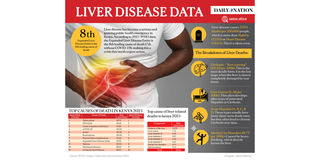
Liver cirrhosis is the most lethal form, accounting for 19 deaths per 100,000. Liver cancer follows, killing about two per 100,000, and often develops after years of untreated hepatitis or cirrhosis. Alcohol-related liver damage accounts for 0.72 deaths per 100,000.
High-risk groups in Kenya, he notes, include adults with chronic hepatitis B and C infections, which carry the highest risk of cirrhosis. Men are more likely than women to die from alcohol-related liver problems and from cirrhosis. People with obesity, high blood pressure or diabetes are also significantly at risk from Metabolically Associated Fatty Liver Disease. “Most never know they have it until the damage is irreversible,” he warns.
Because the liver is resilient, symptoms typically only appear when up to 75 per cent of it is already damaged. But early warning signs do exist: a dull ache or feeling of fullness in the upper right abdomen, itchy skin caused by bile salts building up because the liver can no longer process them, dark urine, pale or clay-coloured stools, and a slight yellowing of the eyes, which is often the first visible sign.
When the liver fails, consequences extend well beyond the organ itself. Toxins build up and reach the brain, causing confusion or mood swings. Fluid collects in the abdomen, causing painful swelling. Pressure in the hepatic veins can lead to internal bleeding in the oesophagus, and the body becomes significantly more vulnerable to infections.
Dr Opio attributes the neglect in part to how Kenya's health system is funded and prioritised. HIV/Aids and TB dominate attention, while cirrhosis develops quietly from other conditions and typically goes unnoticed until it is too late. Routine screening is not in place, and without affordable tests outside cities, silent liver damage continues to spread.
He acknowledges that Kenya's hepatitis B vaccination programme for infants is a reason for hope, but warns that the current adult population faces an immediate and enduring risk. He recommends yearly liver function tests to allow for early diagnosis and timely intervention.
A transplant at home, at last
In April, Kenyatta National Hospital (KNH) opened a new chapter in Kenyan medicine by partnering with West China Hospital of Sichuan University to launch the country's first living donor liver transplant programme. The collaboration is designed to build a permanent local facility for complex surgeries, bringing in specialised equipment, technical expertise and the training needed to sustain the programme independently over time.
As part of the plan, experts will first assess KNH's facilities to identify what infrastructure upgrades are required. The partnership also covers long-term research and the training of Kenyan medical staff. One of its central aims is financial relief for Kenyan families.
Currently, a liver transplant requires travel abroad, with costs reaching Sh18 million in Italy, Sh15 million in South Africa and around Sh10 million in India. By establishing this capacity locally, the cost is expected to drop to around Sh5 million, a move that could begin to make life-saving care accessible to the common Kenyan, while also strengthening the healthcare system as a whole.