From tears to testimony: Rural mothers find hope in Kajiado’s maternal health revolution
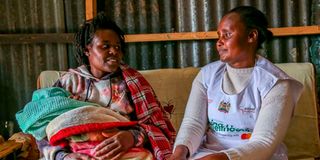
Veronica Lankoi (right), Esookota community health promoter, visits Lilian Ntengese at her house to check on her health and that of the baby in Kajiado County on July 14, 2025.

What you need to know:
- Health workers and volunteers transform maternal care, saving lives of vulnerable women like Simaloi and Lilian through early diagnosis and treatment.
- Maternal health interventions powered by collaboration bring change: iron therapy, risk monitoring and education help mothers overcome cultural barriers, anaemia, and preeclampsia, ensuring healthy babies and thriving families.
The chirping of birds at dawn has become the soundtrack to hope for mothers across rural Kenya. In villages where the nearest hospital requires a day's journey and cultural beliefs can prove deadlier than disease, a quiet revolution is unfolding—one motorcycle ride, one knock on the door, one saved life at a time.
For women like Simaloi Ateli*, these early morning routines have transformed from rituals of desperation into pathways of possibility. Five months pregnant and living in Oloosuyian, Kajiado, she rises each Tuesday for what has become her lifeline: routine antenatal visits that represent far more than medical check-ups.
“I am praying and seeking medical help so that this baby can be born healthy and live like other babies so that my story changes from tears to testimony,” Simaloi explains as she arrives at Kajiado County Referral Hospital.
Her journey to this moment of cautious optimism has been marked by heartbreak. Having been forced to drop out of school in lower primary and married young, she now faces the challenge of a difficult motherhood. The stakes couldn't be higher—she has already lost two pregnancies, both in the early trimesters.
What makes Simaloi's story particularly compelling is how it illuminates a broader crisis affecting maternal health across rural Kenya. Like many of her peers, she knows little about reproductive health, a knowledge gap shaped by low education levels and reinforced by deeply entrenched cultural beliefs and practices.
When Daniel Sankaire, a clinical officer specialising in reproductive health at the county referral hospital, first encountered Simaloi during a community outreach in her village, she was battling with severe anaemia—a condition that threatened both her life and that of her unborn child.
Two pregnancies lost
“Her case is special because every child lost is a generation lost,” Daniel explains. “She has lost two pregnancies, and now she is a priority for me. I want her to carry this pregnancy to term and finally go home with a baby.”
The numbers told a stark story. In pregnancy, normal blood levels should be above 10 grammes per decilitre. For Simaloi, it was seven, a level that left her weak, dizzy, and vulnerable to complications while putting her unborn child at higher risk of miscarriage, stillbirth, or being born underweight. “We put her on treatment, and now she is doing well—her levels are up to about 11 grammes per decilitre,” Daniel notes.
But Simaloi's anaemia wasn't an isolated case. In 2023, Daniel conducted a study that revealed connections between culture and nutrition in Kajiado. His findings showed how communities where female genital mutilation (FGM) has been practised often discourage women from eating well during pregnancy, believing that if they eat too much, their babies would grow bigger, making childbirth more difficult.
“Because they have undergone FGM, they prefer small babies, thinking delivery will be easier,” he explains. “But that comes with two serious problems: babies born underweight, and mothers suffering anaemia from poor diet and nutrition.”
The challenge extends beyond cultural restrictions to the foundation of the pastoral lifestyle. In rural Kajiado, milk serves as the staple food, consumed by women at nearly every meal. While nutritious, this narrow diet creates a medical complication.
“During antenatal clinics, we give women iron supplements,” Daniel explains. “But if you take iron with milk, the calcium binds with the iron, and your body can't absorb it properly.”
Iron is crucial during pregnancy because it helps form haemoglobin, the protein in red blood cells that carries oxygen to both mother and baby. Without adequate iron absorption, women risk anaemia, which can cause fatigue, dizziness, and complications during childbirth. For babies, iron deficiency can lead to low birth weight, preterm birth, or developmental delays.
Medical challenges
The geographical isolation compounds these medical challenges. From Simaloi's home, the journey to the county referral hospital is long and expensive. When she and her mother cannot raise fare for a motorbike ride, they trek—an option that makes such visits difficult and limits contact with health professionals.
Recognising the high-risk nature of her case, the medic now monitors her closely at the hospital rather than in the community, scheduling visits twice a week.
“Every woman who plans pregnancy hopes for a bundle of joy,” he reflects.
“This time, we are seeing her twice a week to give the pregnancy the best chance to reach full term. It is never easy to watch a woman lose a pregnancy, and we want to ensure that this time her experience ends with a healthy baby, not another heartbreak.”
Thirty-three-year-old Lilian Ntengese from Intinyika village in Kajiado Central represents another facet of this maternal health crisis. Today, she cradles her newborn, her joy unmistakable after a pregnancy journey that saw her in and out of hospitals and ultimately led to a preterm delivery. “I call him Japheth, because I saw that even in the Bible, Japheth went through hardship,” she explains.
Lilian's ordeal began when she was diagnosed with preeclampsia, a pregnancy complication characterised by high blood pressure and swelling in parts of the body, such as the legs and face. When she arrived at the hospital for routine clinics at almost 26 weeks pregnant, her blood pressure was dangerously elevated.
“With preeclampsia affecting multiple organs, her system and body were at risk, and allowing her to carry the baby to full-term posed danger to her kidney, liver, and blood,” Daniel explains. “The primary treatment for severe preeclampsia is delivery. The underlying problem lies with the placenta. Removing it helps protect the mother's health. In some cases, if the pregnancy is high-risk, we may terminate it even before the foetus reaches viability.”
After weeks of careful monitoring at Kajiado County Referral Hospital, Lilian was referred to Kenyatta National Hospital, where she delivered Japheth at 33 weeks. The baby was immediately placed in the nursery, and Lilian remained in the hospital to stay close to her son until he gained enough weight to go home safely.
Daniel reveals that Lilian's platelet levels were extremely low. “At that level, if she started bleeding, it would have been almost impossible to stop. By the fact that somebody was in the outreach, we were able to counsel her and let her go to the hospital, gradually managing the high blood pressure. We also prevented convulsions.”
Patients with severe preeclampsia can experience convulsions, with high blood pressure affecting both mother and baby.
“Sometimes, patients with severe preeclampsia can have convulsions,” Daniel notes. “The biggest danger is that high blood pressure affects both the mother and the baby. Our primary goal is to control blood pressure and ensure the mother safely delivers.”
Baby Japheth has now completed his 10-week clinic visit, and Lilian reports that he is healthy and thriving.
Both Simaloi's ongoing journey and Lilian's successful outcome share a crucial common thread: community health outreach. Lilian’s case was identified thanks to Veronica Lankoi, a community health promoter conducting door-to-door mobilisation in her village. “What community health outreach is doing is an upper hand,” Veronica explains.
“We are now saying every woman and every child, everywhere. It doesn't mean that we wait for the women to go to hospital, but we go to them where they are, then the experts attend to them with the purpose of making sure there is no maternal and neonatal mortality at all.”
Daniel confirms the programme's importance in Lilian's case: “If she was not presented to the hospital, she would have either lost her life, that of her baby, or both, not only due to preeclampsia but also because her platelets level was extremely low.”
Through the Saving Lives and Livelihoods programme funded by the Mastercard Foundation and supported by Africa Centres for Disease Control and Prevention (Africa CDC) and implemented by partners Amref Health Africa, Red Cross, and Unicef, mothers like Simaloi and Lilian who previously couldn't be reached by health officials now have access to routine clinic visits in Kajiado County. The programme addresses multiple facets of maternal health: screening for diseases, providing treatments and timely follow-ups, and ensuring immunisation of children like Japheth after delivery.
Rahab from Africa CDC describes the programme's collaborative approach: “With this collaboration, a lot has been achieved. Each partner complements the other. For instance, if there are issues of low health-seeking behaviours experienced maybe during outreaches, the information is relayed to another partner who maybe is in charge of risk communication and community engagement, and that has helped with people turning out to seek health in facilities. Once there is health, we know that the economy grows.”
Beyond immediate medical intervention, healthcare workers like Daniel use these opportunities to educate communities about nutrition and maternal health. By monitoring pregnancies and involving family members like Simaloi's mother, they're teaching women about essential foods and healthy practices. “The lessons are not easy to follow, especially during the drought season, but I believe that even small daily improvements can reduce the risk of anaemia,” Daniel explains.
For Simaloi, who still dreams of working in a health facility despite her interrupted education, each hospital visit represents more than medical care. As she continues her twice-weekly visits, monitored closely by Daniel’s team, her story remains unfinished, but no longer without support.
Meanwhile, Lilian reflects on her experience with evident relief. She remained in the hospital after delivery to stay close to her son until he gained enough weight to go home safely.
Through the convergence of traditional community structures and modern medical intervention, women who once faced pregnancy in isolation now have advocates, educators, and healthcare providers walking alongside them. The programme continues to reach remote parts of the country, screening for diseases, offering treatments and timely follow-ups, and providing immunisation for children after delivery.
The journey from tears to testimony continues, documented in the stories of women like Simaloi, still hoping, and Lilian, now celebrating her healthy son—one village visit, one saved life, and one healthy baby at a time.
*Name changed to protect the privacy of the woman.