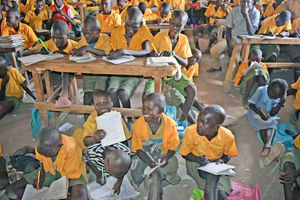
High heat, slower learning: Study links rising temperatures to delayed child development
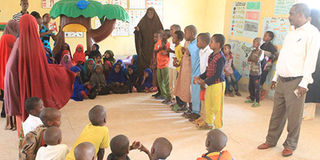
ECDE learners and their teachers in Mandera.

What you need to know:
- A new study published in the Journal of Child Psychology and Psychiatry finds that children growing up in hotter environments are significantly less likely to meet early literacy and numeracy milestones, even before formal schooling begins.
- Analysing data from nearly 20,000 children across six countries, researchers found that exposure to average maximum temperatures above 30°C reduced the likelihood of achieving basic learning benchmarks, with the strongest effects seen among children living in poverty and resource-poor settings.
Researchers have found that unusually high temperatures can impede early childhood development.
The study published in the Journal of Child Psychology and Psychiatry reports that children growing up in hotter environments are less likely to achieve key early learning milestones, particularly in reading and basic maths. The negative effects are most pronounced among children facing poverty or limited access to resources, highlighting how climate change can influence learning well before formal schooling begins.
The study shows that children exposed to average maximum temperatures above 30°C were significantly less likely to meet expected literacy and numeracy benchmarks than peers living in cooler conditions. The researchers analysed data from 19,607 children aged three to four in Gambia, Georgia, Madagascar, Malawi, Palestine, and Sierra Leone. These countries were selected because they provided detailed information on child development, household conditions, and climate, allowing researchers to estimate individual heat exposure.
Children’s development was assessed using the Early Childhood Development Index (ECDI), which measures progress in four domains: literacy and numeracy, social-emotional development, approaches to learning, and physical development.
The researchers combined ECDI data with 2017–20 Multiple Indicator Cluster Surveys, which include indicators such as education, health, nutrition, and sanitation. The data were then linked to climate records on average monthly temperatures.
The results revealed that children exposed to temperatures above 30°C were 5.0 to 6.7 per cent less likely to meet basic literacy and numeracy milestones than those exposed to temperatures below 26°C during the same season and in the same region.
The strongest effects were observed among children from economically disadvantaged households, those with limited access to clean water, and those living in densely populated urban areas.
“We urgently need further research to understand the mechanisms behind these effects and to identify factors that protect children or increase their vulnerability. This knowledge is essential for developing policies and interventions that enhance preparedness, adaptation, and resilience as climate change accelerates,” said lead author Jorge Cuartas, assistant professor of applied psychology at NYU Steinhardt.