No theatre, no ambulance: Homa Bay’s Magunga Hospital’s struggle to deliver care
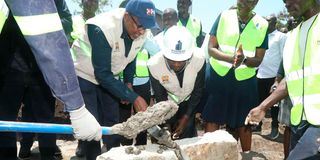
Health Cabinet Secretary Aden Duale lays the foundation stone for the construction of a new building at Magunga Level Four Hospital in Suba South, Homa Bay County, on October 23, 2026.

What you need to know:
- The hospital serves at least 15,000 people in Suba South.
- Overcrowding has resulted in cross-infections among patients.
- The facility lacks an operating theatre and ambulance, while its maternity wing has only five beds.
Parents who take their sick children to Magunga Level Four Hospital in Suba South, Homa Bay County, risk walking out with new infections.
Magunga is the main health facility in the region, serving at least 15,000 people. However, it faces serious infrastructure challenges that put its most vulnerable patients at risk.
While health workers can manage common illnesses like malaria and typhoid, patients who need specialised care or surgery must go elsewhere. The hospital lacks an operating theatre, forcing residents to travel long distances for even basic surgical procedures.
Children suffer the most. In standard facilities, patients are separated into male, female, and paediatric wards. At Magunga, there is no such division. Adults and children share a single ward regardless of age, gender, or diagnosis.
Hospital Superintendent Dr Richard Ojuok acknowledged that this setup has caused cross-infections among patients.
"Our ward is small. Keeping patients of different ages in the same room has in the past led to the re-infection or transmission of illnesses to children who sought services for completely different infections," he said.
He explained that the problem is structural rather than clinical. An ideal setup would separate adults from children and further divide adult wards into medical and surgical units. Currently, the hospital cannot isolate contagious or airborne illnesses among adults from children, whose immune systems are still developing.
"Exposing children to infections that are common among adults is a major threat that some of our patients face," Dr Ojuok warned.
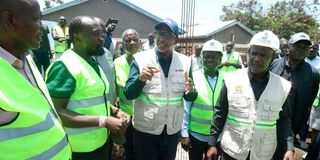
Health Cabinet Secretary Aden Duale (centre) and his Treasury counterpart John Mbadi (right) during an inspection of the construction of a new building at Magunga Level Four Hospital in Suba South, Homa Bay County, on October 23, 2026.
The maternity wing is equally stretched, with only five beds available.
"We struggle to find space when more than five women deliver at the same time," Dr Ojuok added.
As a referral facility, Magunga is expected to receive patients from smaller dispensaries and clinics across Suba. However, space constraints at the top level create a risky environment for mothers and newborns.
Getting to the hospital presents another hurdle. Dr Ojuok noted that vehicles frequently break down due to poor roads.
"The situation becomes worse when it rains. Patients take hours before they get help at the hospital," he said.
The hospital also lacks an ambulance, leaving patients to rely on private vehicles during referrals.
Community Health Promoters (CHPs) face similar obstacles when referring patients to Magunga. Tobias Odera and Richard Lango, CHPs from Magunga B village, reported that some residents avoid the facility due to a history of delayed care.
"Some blood tests are taken at Homa Bay or Kisumu. It takes a long time before a patient knows what ails him or her," Odera said.
Lango said that patients also struggle to access medication.
"We come from a region where poverty is high. Many people prefer seeking services where it is cheaper. Unfortunately, they sometimes fail to get drugs at the hospital, forcing them to spend more in private pharmacies," he explained.
To address these challenges, the government is investing Sh100 million to construct a new block that will house additional wards and accommodate modern medical equipment.
Health Cabinet Secretary Aden Duale commissioned the project on October 23, accompanied by Health Principal Secretary Ouma Oluga and Treasury Cabinet Secretary John Mbadi.
Dr Ojuok said the new building will feature up to 30 beds, with expectant mothers as the primary beneficiaries.
"We will be able to admit more patients and serve a larger population," he noted.
The project will also establish the region's first mortuary. Currently, residents transport deceased family members to a private facility near Sori Town in neighbouring Migori County.
Defending the project, Mbadi said the mortuary will ease the financial burden of body preservation for grieving families.
"Let us not make funerals a burden to families. That is why we want to have a mortuary in Magunga so that transport costs during funerals are reduced," Mbadi said.
Duale directed the contractor to complete the project by May next year, adding that President William Ruto would officially open it.
Homa Bay County Health Executive Grace Osewe said the upgraded facility will offer patient care, maternal and newborn health services, emergency care, and diagnostic services. It will also strengthen referral links between primary healthcare facilities and higher-level hospitals.
"The construction of the hospital is only the first step towards transforming health care in the region. Its success will depend on adequate medical equipment, qualified healthcare personnel, essential medicines and supplies, effective management and sustainable operational financing," Ms Osewe said.
She added that the investment complements broader health sector reforms in Homa Bay, including the planned elevation of Homa Bay County Teaching and Referral Hospital to a Level Five facility. Osewe also requested a power backup generator to resolve frequent electricity outages.
Dr Oluga noted that health indicators in Homa Bay remain below the national average, attributing the gap to inadequate hospital infrastructure.
"We are implementing projects that are changing the people’s lives. We will continue implementing them efficiently, on time and to the required standards to improve the performance of the healthcare system," he said.
Other local developments include a planned upgrade for Sindo Sub-County Hospital and a Sh500 million project undertaken by the Kenya Defence Forces to upgrade the county referral hospital under President Ruto's directive.
For Suba South residents, ongoing construction of the Sori-Magunga road passing near the hospital gates has begun easing transport, with further improvements in healthcare access expected once the new ward block opens.
Magunga's struggles reflect a broader issue across Homa Bay, where facilities designated as Level Four hospitals fail to deliver matching services. The county has 23 Level Four facilities and 220 Level Two and Level Three primary healthcare centres, most of which fall short of required standards.
County Deputy Director for Medical Services Dr Amos Dulo clarified that the challenge extends beyond Homa Bay to other counties and national government facilities.
"Even Kenyatta National Hospital in Nairobi does not fully meet the requirements of a Level 6 hospital. The same applies to Jaramogi Oginga Odinga Teaching and Referral Hospital in Kisumu," Dr Dulo said, adding that classifications remain largely aspirational as guiding policies evolve.
Hospitals in Kenya are licensed by the Kenya Medical Practitioners and Dentists Council (KMPDC) under the Medical Practitioners and Dentists (Medical Institutions) rules. Licenses are granted only when the board approves the premises, facilities, and equipment, and is satisfied with the applicant's capability to run the institution.
Other regulatory requirements include:
- A satisfactory inspection report submitted to the Board by the relevant County Medical Officer of Health.
- Valid private practice licenses for all serving medical practitioners and dentists.
- Proper qualification and registration of all professional staff with relevant regulatory bodies.
- Adherence to minimum health care quality standards acceptable to the Board.
Dr Steve Ndonga, Nyanza branch chairperson and National Executive Council member of the Kenya Medical Practitioners, Pharmacists and Dentists Union (KMPDU), noted that most public facilities fail to meet statutory government standards.
"The Act stipulates what must be present in every facility for it to be classified at a certain level," Dr Ndonga said.
He explained that a functional Level Four hospital should feature an operating theatre and departmental heads who are specialists, including a gynaecologist, paediatrician, physician, and surgeon. It should also house a Newborn Unit (NBU), a nursery, a Newborn Intensive Care Unit (NICU), a medical ward with a High Dependency Unit (HDU) or Intensive Care Unit (ICU), a maternity unit with a theatre, and a surgical ward with its own theatre.
"It would be even sadder if we say a Level 4 hospital does not have a theatre, because in essence we would just be elevating hospitals by name," Dr Ndonga observed, citing Jaramogi Oginga Odinga Teaching and Referral Hospital, which has only about 30 consultants instead of the required 150 for a Level Six facility.
By contrast, Level Three facilities are primarily staffed by medical officers, assistant medical officers, and clinical officers. While they may lack specialists in every department, they require at least one family physician to manage cross-departmental cases and handle referrals.
"Technically, a Level Three facility should also have a theatre," Dr Ndonga explained, noting that while Level Three sites may lack an ICU, renal unit, or NBU, they must maintain a functional maternity unit with an operating theatre for medical officers.
Dr Ndonga emphasised that statutory provisions, including nurse-to-patient staffing ratios, are often ignored across public health centres.
"For small hospitals, like that one in Homa Bay, elevation should not just be by name. It should also meet staffing and infrastructure standards," he said.
Follow ourWhatsApp channel for breaking news updates and more stories like this.