Hospitals overwhelmed as nurses' strike disrupts maternal care
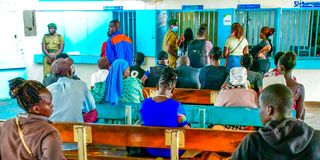
Patients wait to receive medical services at the Outpatient Department of Jaramogi Oginga Odinga Teaching and Referral Hospital in Kisumu on August 5, 2026. The hospital is experiencing a surge in patient numbers, with the maternity and newborn unit among the most affected, forcing some mothers to share beds temporarily before additional space becomes available.

What you need to know:
The Kenya Obstetrical and Gynaecological Society (Kogs) has urged the government to urgently resolve the nationwide nurses’ strike, now in its sixth day, as patients across counties continue to bear the brunt of disrupted healthcare services.
In a letter to newsrooms, the society’s president, Dr Kireki Omanwa, warned that the standard of care for pregnant mothers and women seeking critical reproductive health services is fast deteriorating when the nurses’ issues are put under the rug.
Kogs, in their letter, warned that the Kenyatta National Hospital (KNH) joining the nurses’ strike on Monday worsened the situation. This, however, changed after KNH nurses’ issues were eventually fixed a day after their strike began.
In a boardroom meeting between KNH leadership and the Salaries and Remuneration Commission (SRC), the two parties agreed to address all issues that had led KNH nurses to down their tools.
Effective Tuesday, the SRC reviewed allowances requested by KNH nurses, raising the uniform allowance from Sh15,000 to Sh25,000 per year, the Nursing Service Allowance from Sh20,000 to Sh30,000, and adjusting leave allowance according to job groups.
While KNH nurses have since resumed duty, their counterparts in most county hospitals remain off work.
“We are not doing well at all; even though KNH is now working, the number of patients coming in is huge, and patients are being turned away,” Dr Kireki told Nation.
“The problem is that the labour ward and the post-natal ward are completely overwhelmed. There are no beds. We have received patients from other hospitals,” he added.
The Kogs president fears this could increase maternal and child deaths at a critical time when the government is striving to end preventable fatalities.
“Every day that this strike continues, pregnant mothers, women with obstetric and gynaecological emergencies, and new-born babies face an increased risk of preventable illness, disability and death,” he said in the letter.
“Childbirth does not wait. Obstetric emergencies such as postpartum haemorrhage, eclampsia, obstructed labour, ruptured ectopic pregnancy, severe pre-eclampsia and foetal distress require immediate intervention. Equally, new-born babies often require prompt skilled resuscitation and specialised nursing care within the first minutes of life. These are services in which nurses and midwives play an indispensable role,” he added.
In May this year, President William Ruto launched the "Every Woman, Every New-born, Everywhere (Ewene)"initiative, which is part of a global push to end maternal deaths caused by preventable causes.
Dr Kireki warned that the ongoing strike will cripple efforts to ensure Kenya meets its target by 2028. He stressed that for the initiative to succeed, Kenya must have a functional maternal and new-born healthcare workforce that is adequately staffed and motivated.
“The objectives of reducing maternal and neonatal mortality cannot be realised while critical frontline services remain disrupted,” he said.
“Nurses and midwives are the backbone of Kenya’s healthcare system. They provide continuous bedside care, monitor labour, identify complications early, administer lifesaving interventions, care for critically ill mothers and new-borns, and ensure continuity of care. Their contribution to reducing maternal and neonatal mortality cannot be overstated,” he added.
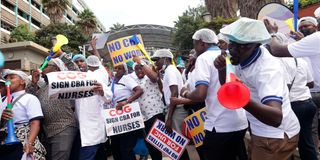
Nurses dancing outside Afya House in Nairobi on July 30, 2026 during the Kenya National Union of Nurses workers protests demanding the implementation of their Collective Bargaining Agreement (CBA) and calling on the Council of Governors (CoG) to sign and honor the negotiated deal.
At KNH, priority is given to women with the most critical conditions, including those with high blood pressure and those about to deliver.
Lucy Mburu, the Assistant Secretary‑General of the Kenya National Union of Nurses (Knun), yesterday told Nation that the SRC convened a meeting with nurses’ union leaders, the Council of Governors, and officials from the Health and Labour ministries.
By the time this article went to press, no resolution had been reached.
“We had planned to camp outside the governors' meeting that was planned for Thursday. We hope they will listen to us,” she said.
The Knun official told Nation it is regrettable that mothers are missing out on care, with most facilities now closed.
“A few counties have taken up nurses on locum,” he said.
In Isiolo, the situation is dire as all cadres of healthcare workers are now on strike. Dr Dennis Miskellah, deputy secretary‑general of the Kenya Medical Practitioners, Pharmacists and Dentists Union, told Nation that doctors in the county have been on strike for 66 days.
“Before the strike started, Isiolo doctors had not been paid for about three months. The county was deducting taxes but they were not remitting including loans, Social Health Authority (SHA) and PAYE. They also did not have a medical cover and some members have not been promoted for over a decade,” he said.
He noted that although the court directed Isiolo County and its doctors to pursue mediation, the employer has yet to show goodwill.
Doctors in Homa Bay and Siaya counties have also announced an impending strike. In Siaya, they say they will reject a new insurer contracted by the county government, while in Homa Bay, doctors accuse their employer of breaching the return‑to‑work formula agreement.
Nurses in Homa Bay have urged Governor Gladys Wanga to step down as Chairperson of the Human Resource, Labour and Social Welfare Committee at the Council of Governors (CoG) to help break the deadlock in the public health sector caused by the ongoing nationwide strike.
Lasting solution
Kenya National Union of Nurses and Midwives (KNUNM) Homa Bay Executive Secretary Emmadic Okeyo said the governor should rally her colleagues to find a lasting solution to the impasse.
“If she truly wanted to help us, she ought to have engaged her colleagues to spare Kenyans unnecessary suffering,” he said.
According to the union official, the county government had pledged to address the grievances but has failed to honour its word, despite signing an agreement committing to implement the nurses’ concerns.
Patients at Kisii Teaching and Referral Hospital (KTRH) are bearing the brunt of the nurses’ strike, with many forced to seek care in private facilities.
On Wednesday, wards at KTRH, which serves Kisii, Nyamira and Migori counties, lay largely deserted, their usual bustle replaced by silence. Only emergency cases were handled by a skeleton staff.
“I came with my diabetic mother. There are no nurses to administer her medication. We have already paid Sh4,500 at a private clinic,” said Moraa Nyanchama.
Kisii Governor Simba Arati had on Sunday pledged to reach an agreement with the striking nurses this week. However, by Wednesday evening, no deal had been struck.
In Kisumu, Jaramogi Oginga Odinga Teaching and Referral Hospital (JOOTRH) has been forced to reorganise operations and deploy extra nurses after the nationwide strike triggered a surge in patient referrals from Kisumu and neighbouring counties.
The hospital said its maternity, new-born, surgical, paediatric, internal medicine and emergency units are now overstretched. Nursing Director Teresa Okiri noted the hospital had anticipated this impact.
“On the first day of the strike, particularly in the reproductive health department, we recorded 44 admissions within 24 hours, which was unlike the previous days,” Okiri said.
The sudden influx of patients has placed immense pressure on healthcare workers, especially in maternity services, where nurses and doctors are working extended shifts to meet rising demand.
The new-born unit has been among the hardest hit, prompting the hospital to open an additional ward for critically ill infants. To reinforce key departments, 30 nurses have been deployed temporarily as admissions continue to rise.
Okiri said JOOTRH is now receiving an average of 50 critically ill emergency patients daily, cases that would ordinarily be handled at lower‑level public hospitals.
“What we are seeing is that patients who should ideally be transported by ambulance are now arriving on foot, by motorcycle or by public transport because the hospitals they first visited are not operating,” she said.
Despite the mounting workload, multidisciplinary emergency teams of nurses, doctors, emergency medical technicians and specialists have continued to deliver timely care to patients in need.
The relentless pressure has forced some staff, particularly in maternity and emergency departments, to remain on duty for up to 24 hours straight. To ease the burden and reduce fatigue, hospital management has adjusted duty rosters and is providing meals to frontline staff unable to leave their stations during the prolonged shifts.
“Our greatest concern is that if the strike continues and the wards become full, we may reach a point where patients have to share beds,” she said.
She warned that the situation risks undermining infection‑control measures, stressing that every patient deserves the dignity and safety of an individual bed.
“We want one patient to use one bed at a time. If patients begin sharing beds, infection prevention will be compromised,” she said.
On a normal day, Kitui County Referral Hospital would serve hundreds of patients, but when Nation visited yesterday, people were camped outside with no one attending to them. Others spent hours in the corridors hoping for care, while Kenya Medical Training College students attached to the facility were seen idling on social media instead of doing clinical work.
Mary Mutua, unaware of the strike, was among dozens of patients caught up yesterday.
“The government should come to our rescue and address the grievances raised by medics so that services can resume,” she said.
In neighbouring Makueni County, Deputy Governor Lucy Mulili urged union leaders behind the strike to give dialogue a chance.
Meanwhile, a Mombasa court ordered nurses to halt the nationwide strike until their grievances are resolved, but the directive has been ignored as most counties remain on strike.
Reporting by Hellen Shikanda, George Odiwuor, Wycliffe Nyaberi, Alex Odhiambo and Pius Maundu.